





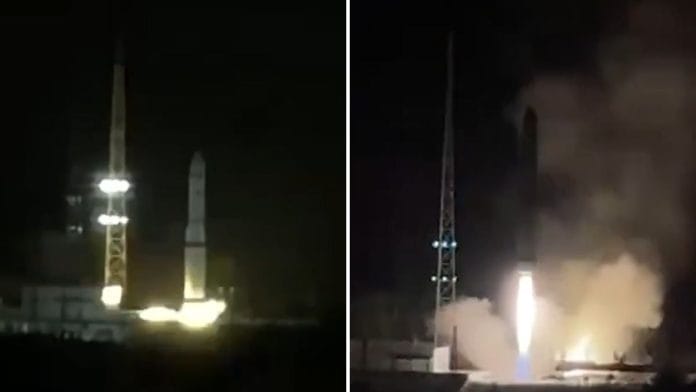


New Delhi: The Pakistan-China space collaboration seems to be on a steady track. A week after Beijing selected two Pakistanis for its space station missions, Islamabad announced Saturday that it launched its indigenous remote-sensing satellite into orbit. It’s the latest step in a deepening space partnership between the two countries. The satellite rode into orbit aboard a Chinese Long March-6 rocket, part of a launch infrastructure Pakistan does not yet possess.
The satellite, called PRSC-EO3, lifted off from the Taiyuan Satellite Launch Centre in northern China aboard a Long March-6 rocket, according to China’s state news agency Xinhua. Officials said the satellite successfully entered its planned orbit, in what was the 640th mission of China’s Long March rocket series.
“The Pakistan Space and Upper Atmosphere Research Commission (Suparco) has successfully launched its indigenous electro-optical satellite (EO-3) from the Taiyuan Satellite Launch Centre, marking another significant milestone in the nation’s space capabilities,” the Pakistan Foreign Office said in a statement posted on X.
This marks the third electro-optical satellite launched by Pakistan. SUPARCO comes under the Ministry of Defence.
EO-2 was deployed in February 2026, following the launch of EO-1 in January 2025. The agency had earlier expanded its capabilities with the launch of its first hyperspectral satellite, HS-1, in October 2025.
Pakistan described the launch as a milestone in its efforts to build indigenous capacity in space technology. In a statement, SUPARCO said the electro-optical satellite would strengthen the country’s ability to monitor natural resources, respond to disasters, and track environmental changes, Dawn reported.
An electro-optical (EO) satellite is a type of Earth observation system that captures high-resolution images using sensors that can detect visible, near-infrared, and ultraviolet light. Like a camera in space, it records reflected sunlight to generate detailed imagery that can differentiate between materials, vegetation, and built infrastructure. These satellites are widely used for applications such as reconnaissance, disaster response, and urban planning.
Pakistan President Asif Ali Zardari called the launch a “historic milestone,” describing it as evidence of the country’s growing technical expertise and self-reliance. Prime Minister Shehbaz Sharif praised the scientists and engineers involved and reiterated the government’s commitment to expanding the national space program, while also acknowledging China’s continued support.
Also read: Pakistani governor’s ajrak cap gets stolen in Sindh—right off his head
Chinese support for Pakistan’s space ambition
The launch highlights Beijing’s role in Islamabad’s space ambitions. Pakistan does not yet have its own launch facilities and has relied on Chinese rockets and infrastructure to deploy its satellites, even as it seeks to develop domestic technological capabilities.
The launch comes as Pakistan moves to broaden its space capabilities, combining homegrown development with close cooperation with China, including recent steps toward eventual human spaceflight.
A major sign of Pakistan’s renewed push in space came on 19 April, when two candidates were shortlisted for advanced training at China’s Astronaut Center under a bilateral agreement signed a year earlier.
Beyond human spaceflight, SUPARCO has accelerated its technical progress. In 2025, it launched three remote sensing satellites, including HS-1, the country’s first hyperspectral imaging satellite. It can analyse hundreds of light bands, enabling detailed detection of crop health, mineral resources, and environmental changes.
For much of its history, SUPARCO, formed by Pakistani physicist and Nobel laureate Abdus Salam eight years before ISRO, faced prolonged stagnation due to limited funding and shifting national priorities. That trajectory now appears to be changing.
Pakistan was an early entrant into Asia’s space race, becoming the region’s third country to launch rockets in 1962, when SUPARCO sent its first rocket, Rehbar-I, into space with assistance from NASA.
Space cooperation with China began in the early 1990s but remained limited for years, focusing mainly on training and infrastructure. Pakistan launched its first satellite, Badr-I, only in 1990, with Chinese support. The partnership gained momentum in the 2000s through initiatives such as the Asia-Pacific Space Cooperation Organization and major projects such as the launch of PAKSAT-1R in 2011.
Since then, bilateral agreements and long-term plans have deepened collaboration.
Mohammad Yousuf Khan, chairman of the Pakistan Space and Upper Atmosphere Research Commission, said on 28 February that the country expects to launch four more earth observation satellites by the end of the year.
He also noted that since 2011, Pakistan has placed two communication satellites in geostationary orbit. Among them, the PAKSAT-MM1 satellite, launched in May 2024, represents a significant step toward advancing the country’s “Digital Pakistan” initiative.
(Edited by Prasanna Bachchhav)