





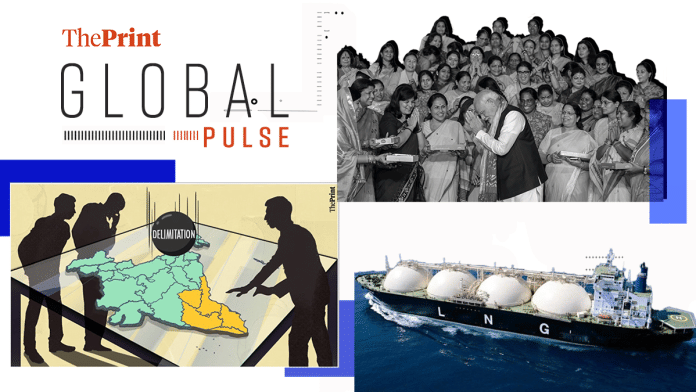


New Delhi: The Indian Parliament is debating three key bills, with the potential to redraw the country’s electoral landscape if brought into law—a 33 percent reservation for women in Lok Sabha and state assemblies, and an increase in Lower House sanctioned strength from 543 to 815 seats.
Along with the Constitution (One Hundred and Thirty-first Amendment) Bill, 2026, the Modi government has argued that the Delimitation Bill and Union Territories Laws (Amendment) Bill would also need to be passed to effectively implement women’s reservation.
In a Financial Times report, Andres Schipani and Michael Stott ask if the quota push is a boost for women, or the prime minister.
“Indian prime minister Narendra Modi has fired the starting gun on the country’s largest democratic overhaul in more than five decades that would increase the number of female legislators while creating one of the world’s biggest parliaments,” the report reads.
For those in favour, the quota, if implemented, would be a move long “overdue”. But the critics of the bills say that the proposed delimitation favours the ruling BJP. “They argue Modi’s proposal tips the balance towards the northern, poorer and more populous states where his party enjoys electoral dominance, while giving less representation to opposition-controlled southern states where the BJP has historically performed poorly,” the report says.
Journalist and author Neerja Chowdhury tells FT that the issue of women’s representation has become a north-south issue.
The Constitution allows for readjustment of constituencies in the Lower House after every census, but it last reapportioned seats in 1973. The population was about 548 million at the time, and is about 1.4 billion now, the report adds.
Bengaluru-based political analyst and author Sugata Srinivasaraju is quoted as saying, “Delimitation was always on the cards, and it has happened a few times since Independence, it is not a new idea, and it was necessary because the population size has grown.”
However, the report notes that Parliamentary Affairs Minister Kiren Rijiju said Wednesday that there had been no attempt to “mislead” the southern states. “No state is losing,” he said.
BBC’s Soutik Biswas also reports on how India is bracing for a “once-in-a-generation redraw of its political map”.
“Women make up only about 14% of India’s 543 lower house MPs. The reform would raise that to roughly a third, closer to global norms,” he writes.
The bills are the subject of much controversy and opposition, the report further notes.
John Brittas, MP of the opposition Communist Party of India (Marxist), tells BBC, “We support reserving 33 percent seats for women based on the current strength of parliament. We also want a further freeze on expanding overall seats in the parliament until population trends stabilise. We object to the haste in convening this session in the middle of an election season.”
The Constitution mandates that seats in Lok Sabha and state assemblies be allocated to each state based on its population, with constituencies of roughly equal size.
Prime Minister Narendra Modi has already called the Nari Shakti Vandan Adhiniyam a “historic leap”.
Meanwhile, Bloomberg’s Stephen Stapczynski reports that Indian LNG importers are turning to spot shipments after the recent drop in prices to tackle the supply crunch originating from the West Asia conflict.
Bharat Petroleum Corporation Limited, GAIL (India) Limited and Gujarat State Petroleum Corporation secured LNG shipments for April-June delivery at prices below $16 per million British thermal units, the report adds.
“The latest move comes after spot LNG prices fell to the lowest level in over a month,” it reads.
(Edited by Mannat Chugh)
Also Read: ‘Battle for women voters’ is changing the way elections are fought in India, writes global media