





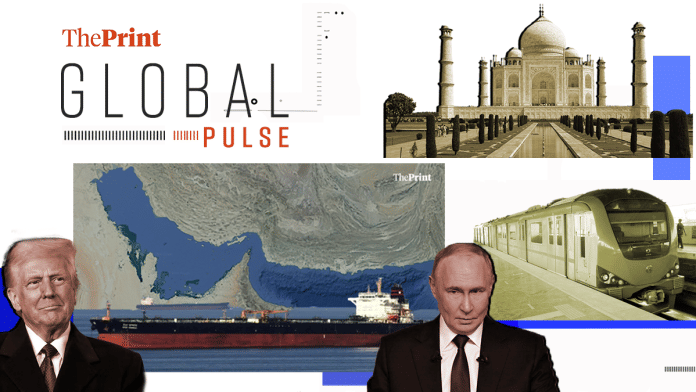


New Delhi: The Iran war has forced the US’ Asian allies to court its rivals for oil as supplies remain precarious and dependent on the Strait of Hormuz.
“America’s allies and strategic partners in Asia steered clear of buying Russian oil in order to comply with Western sanctions. And many had limited interactions with Iran, another major producer. The US and Israeli war on Iran has upended those dynamics,” The New York Times reports.
Securing a meeting or phone call with officials in Russia or Iran is “now top of the agenda”. South Korea, Japan, the Philippines, India, and Indonesia are all vying for crude from Russia and other nations.
For India, coming close to signing a trade deal with the US has meant distancing itself from Russia, especially amid US President Donald Trump’s imposition of punitive tariffs on New Delhi for buying Russian oil. “India had stopped buying Iranian oil in 2019, to comply with American sanctions on Tehran,” notes the report.
In the past few weeks, India was on the verge of replacing Russian oil with West Asia energy supplies to “placate” the US. “But the US-Israeli attacks on Iran and the ensuing blockade of the Strait of Hormuz made mincemeat of that plan. Instead, India had to resume buying Russian seaborne oil, now at a premium,” says NYT.
Meanwhile, an article in The Economist wonders: “What have the Mughals ever done for us?”
“In speeches to supporters, to parliament and to the nation, (Prime Minister) Narendra Modi has repeatedly invoked India’s centuries of slavery. Soon after taking power in 2014, he lamented that ‘the mentality of 1,200 years of slavery continues to haunt us’,” it notes, underlining that the target of the speeches was the series of Muslim empires that preceded British colonialism. And the Mughal empire was the longest-lasting of them all.
“The Mughals, Mr Modi’s Bharatiya Janata Party (BJP) insists, destroyed temples (which is true) and humiliated Hindus (which is contested). They took everything India had. And what, the ideology asks, did they ever give us in return?” the article reads.
While giving India language, cuisine, architecture and culture, it adds that the Mughals gave one more thing: “They brought the BJP to power.”
Referring to the demolition of the Babri Masjid in 1992, the report highlights that from 16 percent of seats in Parliament prior to the demolition, the BJP’s seat share rose to 56 percent by the time a Ram temple was consecrated on the site of the demolished mosque.
BJP has spent the better part of the last decade renaming Mughal cities, rejecting Mughal cuisine, and writing Mughals out of history books, the report notes.
“It is one thing to raze an edifice of brick and mortar. It is harder to eradicate a culture that has over five centuries permeated India’s blood and soil. That, then, is the best answer to their question of what the Mughals have ever done for them. They gave political Hinduism its eternal, indispensable villain,” says The Economist.
In the BBC, Nikhil Inamdar reports on the problem of ridership amid India’s metro expansion.
There is a broader trend of low ridership “confronting the breakneck expansion of India’s metro network”, says the report.
“Since 2014, the Narendra Modi government has splashed out over $26 bn on building metro connectivity across nearly two dozen Indian cities. The network has grown fourfold from under 300km to more than 1,000 km by 2025. Average daily ridership has also almost quadrupled from three million to over 11 million people in the last decade.”
However, the expanding network has “failed to achieve even a sliver of the ridership” projected during the planning stages.
“According to the Observer Research Foundation (ORF) think tank, ridership in some tier-3 cities such as Kanpur in the north was as low as 2 percent of the projected estimate, while in the southern city of Chennai it was 37 percent for the first phase,” says the report.
“Capital Delhi, which has India’s widest metro network, is perhaps the only exception where usage has slightly surpassed projections.”
But transport experts told the BBC that Delhi metro authorities have started counting each interchange as a separate ride, leading to inflation in ridership numbers.
The report asks: “So why has metro travel struggled in a country where car ownership is still low and other public transport systems are overcrowded and overstretched?”
There are multiple factors.
One transport expert told the BBC that projected ridership is difficult to calculate, and numbers are sometimes exaggerated to show that the project is “economically viable”.
Second, the affordability issue. “In Indian metro systems, the integrated journey cost can consume 20 percent of income for lower-income workers, above the global benchmark of 10-15 percent,” another transport expert is quoted as saying.
Other issues that keep demand suppressed are poor network planning and last-mile connectivity, says the report, adding that feeder buses to aid door-to-door connectivity remain scarce.
“Another issue in India is poor walkways and concerns about women’s safety,” it adds.
(Edited by Nida Fatima Siddiqui)