





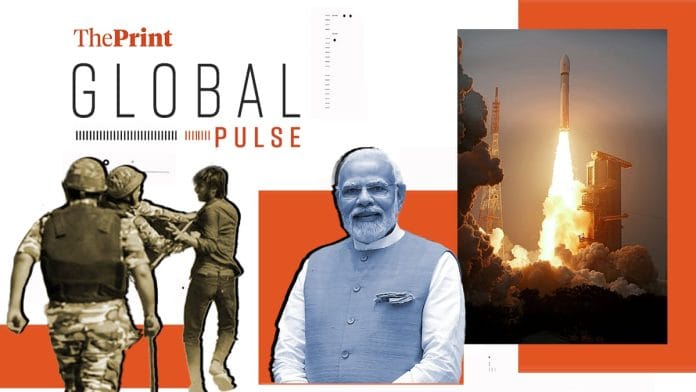


New Delhi: “India’s space industry is blasting off, thanks to Nehru, Modi, and Musk,” writes The Economist. With Artemis II returning after a successful lunar mission, the column puts the spotlight on India’s space programme and its upcoming first spaceflight mission—’Gaganyaan’.
“Its Gaganyaan mission will seek to add India to the small group of countries—comprising America, Russia and China—that have achieved crewed space flight.”
The column credits Jawaharlal Nehru, Narendra Modi, and Elon Musk for this rare feat. “Jawaharlal Nehru, India’s first prime minister. Nehru had a passion for science—big cities are littered with planetariums bearing his name—and established the precursor to ISRO in 1962, at the urging of Vikram Sarabhai, a leading physicist.”
However, until 2020, India’s space industry was “small and mostly government-controlled”. This changed when “the second pivotal figure” Narendra Modi opened up the sector to the private market in 2020. “His government opened up space to the wider private sector in 2020, creating IN-SPACe, a ‘single window’ where companies could obtain licences for space activity of all sorts as well as access to ISRO’s launch capacity.”
SpaceX founder and owner Elon Musk developed the Falcon 9 reusable rockets, which can drastically reduce the cost of launching satellites, “making more space-based businesses viable”.
Indian space tycoons hope this will prove lucrative for investments.
“If Gaganyaan succeeds next year, it should help draw greater attention to the businesses that supported it. India’s goals in space may have shifted since Nehru’s day, but development remains an important part of the plan. The government hopes that the sector will contribute to India’s rise as a powerhouse of advanced manufacturing. It is shooting for the Moon—but may just succeed,” the column says.
Abhishek Dey and Nikita Yadav of the BBC report on the Noida workers’ protest for higher salaries that turned violent Monday. “Earlier this week, rare scenes unfolded in Noida, a satellite city of India’s capital Delhi, as thousands of factory workers blocked roads, demanding higher wages and better working conditions.”
Most of them were non-unionised workers, employed in small factories across industrial clusters, producing auto parts, electronics, and garments, earning between 10,000 and 15,000 rupees a month, the report says.
“What began about a week ago as small, mostly peaceful protests across northern India has since escalated, turning violent in some areas. In Noida, police used tear gas to disperse crowds at several locations and arrested more than 300 people.”
Rakhi Sehgal, an independent labour researcher, told the BBC that “cost of living crisis” was a common thread across recent protests. “In Noida, domestic workers have also staged protests in recent days, demanding higher wages and better access to housing, healthcare and education for their children.”
As Dey and Yadav note, the war in West Asia has aggravated the current situation by creating gas shortages and raising the prices of LPG cylinders.
On the other hand, Veena Venugopal discusses the important Constitution amendment bill, which the Parliament was debating till Saturday this week, in the Financial Times India newsletter.
While the law ministry notified it into law last night, the law is pending discussion. “Two major developments are at play. The first is the delimitation exercise, which proposes linking the number of representatives each state sends to parliament with the latest population data—a move that will significantly increase the number of MPs. The second is the implementation of the women’s reservation bill.”
Venugopal notes that while the bill has been framed as an effort to represent women, the Opposition is calling it a “decoy” for carrying out delimitation.
The bill would increase the Lok Sabha seats from 543 to 815. “But does a larger House necessarily lead to better democratic functioning?”
“Parliament is meant to be a forum for debate and discussion, a space where representatives can voice the concerns and demands of their constituents. Even at its current strength, many parliamentarians struggle to find time to speak during sessions. An increase of more than 50 per cent in membership would further reduce individual speaking time.”
(Edited by Madhurita Goswami)
Also Read: Crucial test for ISRO’s Gaganyaan tomorrow — how crew will escape if mission is aborted