





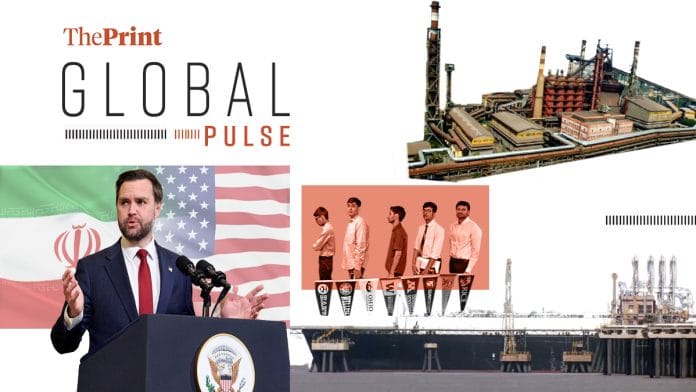


New Delhi: After enduring months of oil and gas supply disruptions spurred by the West Asia war-driven closure of the Strait of Hormuz, India may soon be presented with an opportunity to resurrect a critical energy relationship—with Iran.
In a piece for The New York Times, Alex Travelli writes that the US-Iran peace talks come at a critical time for India, one of the world’s largest importers of oil and gas.
“A report released on Wednesday by the Council on Energy, Environment and Water, a New Delhi-based think tank, found that India had just nine to 10 days’ worth of oil reserves remaining. Japan and South Korea, which are similarly dependent on imports from the Persian Gulf, each held roughly 200 days’ worth,” he reports.
Travelli also explains how India’s energy supply crisis began long before active fighting started this February. “Iran was once among India’s most important energy suppliers, before American sanctions pushed New Delhi to sever ties.” India met 14 percent of its crude oil demand through imports from Iran as recently as 2009. However, in 2019, the US forced India’s hand, compelling the country to stop buying Iranian oil altogether.
“Given the supply crunch, India has little choice but to buy oil wherever it can,” Travelli writes about India’s current situation.
Travelli also points out how India is sitting on a gold mine of refineries with some unique capabilities. “India’s location and the flexibility of its refiners allow it to pivot quickly toward new supplies, including heavier grades of crude that require more intensive processing,” he writes.
“The world’s largest refinery belongs to India’s Reliance Industries and sits directly across the Arabian Sea from the Strait of Hormuz. Oil tankers from the Gulf take two to three times longer to reach China’s giant refineries. They can complete a round trip to India in less time than it takes to make a one-way voyage to ports on China’s Pacific coast,” Travelli adds.
The NYT report also highlights how India has had to change suppliers multiple times, with America constantly changing the rules.
US sanctions slowly pushed India away from Iranian crude, while China doubled down to become Tehran’s largest buyer by far. For India, discounted Russian oil filled the gap after the Ukraine war, before Washington started cracking down on those purchases as well. Venezuelan crude too followed a similar cycle. Since 2025, the rules governing Russian oil have also shifted repeatedly, the report says.
“Having been burned by the current crisis, India is taking future disruptions more seriously. It is expanding its strategic petroleum reserve, blending more ethanol into its gasoline and accelerating investment in solar power and other renewable energy sources, even at the cost of deepening its reliance on imports from China, its great geopolitical rival.”
Meanwhile, Daniel Bush of the BBC reports on what impact being the face of the US-Iran deal will have on the fate of US Vice-President J.D. Vance.
This can be read in the backdrop of the frosty opening scenes that played out during the first round of talks in Switzerland. Though Vance and Iranian Foreign Minister Abbas Araghchi were in the same room, Araghchi simply greeted Pakistani Prime Minister Shehbaz Sharif and walked back to his delegation, while Vance watched from a distance. No handshakes, no photo-op. And then, a social media post from US President Donald Trump further inflamed tensions.
For Vance, the challenge, BBC’s Bush writes, is how he will sell the interim deal to the Republicans, “divided between anti-interventionist Maga supporters who opposed the war from the start, and conservative Iran hawks who believe the White House has ultimately capitulated to Tehran”.
Add to that the fact that he has to constantly operate under Trump’s shadow, with the US President’s tirades often contradicting his V-P.
“As he defended the US-Iran deal at the White House press briefing on Thursday, Vice-President JD Vance brushed aside a question about whether President Donald Trump had positioned him as the fall guy for an agreement that is broadly unpopular with Republicans in Washington,” writes Bush.
While Vance said that he thinks the President was joking, political commentators say this classic Trump, throwing Vance under the bus for deals of his own making.
“Vance has spent the week defending the memorandum of understanding with Iran. Yet he was often contradicted or overshadowed by Trump – and his uncertainty about the logistics of a signing ceremony he was planning to attend in Switzerland with Iranian leaders only further underscored his challenges in handling a defining issue of his vice-presidency,” Bush notes.
Some Republicans also argued that Vance had been handed a thankless Iran brief by a president with a long history of making his aides take the fall for unpopular decisions, the report notes
“The timing is awkward for Vance, who just days ago published a memoir that intensified speculation about a possible presidential run in 2028,” Bush writes.
Rupee depreciation bites students
Nikhil Inamdar of the BBC reports how a weakening rupee and visa crackdowns are forcing Indian students to rethink studying abroad.
“A weakening currency, bleak job prospects in the US and Europe, stricter visa requirements and immigration crackdowns have forced many to reconsider whether it is worth taking on hefty debts to move abroad,” Inamder writes.
Sushil Sukhwani, founder of Edwise International, told the BBC, “The market is clearly showing signs of slowing down. We’ve already seen enrolments to the UK and US fall by 20% over the last two years, and I expect another 10-15% decline from those levels going forward.”
Stricter visa rules are already showing their impact. In the UK, 76 percent of universities reported a drop in Indian student enrolments for the January intake, while in the US, enrolments declined by nearly 7 percent between February 2025 and February 2026.
Inamdar writes, “Many students who are already abroad have paid part of their tuition fees, but are now having to refinance loans and arrange additional funding to cover future installments, with the rupee down more than 10% against the US dollar in the last year,” Sukhwani told the BBC.
India’s influencer industry has grown steadily, with creators emerging across a wide range of interests and areas of expertise. One such category is “finfluencers”, influencers who focus on financial literacy and all things money.
The State, however, has not been particularly kind to this group and has repeatedly sought to impose restrictions on it. Krishn Kaushik, Chris Kay and Andres Schipani report for the Financial Times how “India plays ‘whack-a-mole’ with online financial influencers”.
“As the number of individual Indian investors grows—more than trebling since 2019 to 146mn, alongside a 50 per cent rise in the Nifty 50 index —regulators are cracking down on fraudsters who give stock tips under the guise of general financial knowledge. India’s capital markets watchdog has said in written orders that some content creators indulged in fraudulent activity,” the report notes.
Between April 2024 and May 2026, the SEBI said it had removed or blocked 162,000 posts and accounts linked to numerous ‘finfluencers’ across platforms such as Instagram, Telegram and YouTube.
The report makes a distinction between ‘finfluencers’ and influencers who provide general finance advice. People who are not registered with the SEBI are prohibited from providing direct or indirect advice related to securities or “making claims of returns”.
“One finfluencer banned in January this year, Avadhut Sathe, had more than 900,000 subscribers on YouTube. Sebi said he and his associates had collected Rs 6bn from clients for courses and access to a WhatsApp group where Sathe provided stock tips since October 2015,” the report notes.
The SEBI hasdeployed an AI tool, called Sudarshan, to scan posts and accounts in India’s more than 20 constitutionally recognised languages, FT says.
“While governments around the world are grappling with finfluencers who blur the line between investment education and advice, India’s problem is particularly challenging because of the rapid increase in novice retail investors and the multilingual landscape of the world’s most populous country.”