





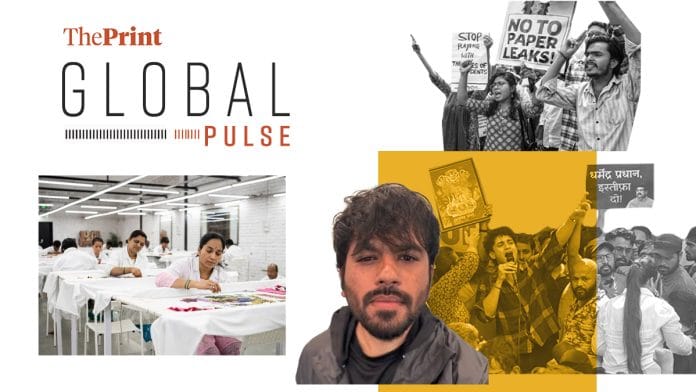


New Delhi: The Cockroach Janta Party (CJP) and its protest in New Delhi Saturday dominated global headlines. International media discussed, at length, the crises that fuelled the “Gen-Z movement” and what the party’s popularity could mean against the backdrop of youth revolutions that dethroned sitting governments in the neighbouring countries of Nepal and Bangladesh.
In Financial Times, Andres Schipani, Jyotsna Singh and Michael Stott reported on the exam “fiasco” in India and how it sparked widespread outrage.
“Manish Kumar was ecstatic when he aced India’s national exam for medical university applicants last month. But less than two weeks later, the government of Narendra Modi cancelled the tests after revelations that answers had been leaked before the test,” the report notes.
India’s youth echo Kumar’s sentiment. The NEET paper leak scandal directly affected 2.2 million applicants who gave the exam to bag one of the 1,30,000 seats in medical colleges across India. “Why is this happening with such a high-level exam taken by millions of students?” he asked while talking to FT.
The paper leak, which has happened earlier too, has “fuelled growing frustration among young Indians already grappling with high unemployment and economic uncertainty”.
This, the report argues, has “helped spark a rare challenge to Modi in the form of the Cockroach Janta Party, a viral new satirical online campaign whose creator has called for a mass demonstration to demand the education minister’s resignation”.
In The Wall Street Journal, Shan Li and Krishna Pokharel wrote about how “cockroaches” unleashed a political movement in India.
“The movement sprang from an online joke that went viral. The inspiration came from remarks by the Chief Justice of India’s Supreme Court, who during a hearing in May referred to many young people as parasites and cockroaches who don’t work and instead criticize institutions on social media. In a statement, Surya Kant said his comments referred to people who use fake degrees to enter professions like law and media, not young people overall,” the report says.
The comments provoked stark reactions among many, including Abhijeet Dipke, a 30-year-old recent graduate of Boston University in the US. Last month, he posted a question on X: “What if all cockroaches came together?”
“Thousands embraced the label,” the report notes.
The WSJ report points to the Indian economy as the main culprit. “India’s economy is one of the fastest-growing in the world, but many young people say the benefits haven’t reached them. Youth unemployment remains high, college graduates often struggle to find well-paid work and competition for stable government jobs is increasingly fierce. The unemployment rate for people aged 15 to 29 is about 15%, triple the rate for the population as a whole.”
All of this led to a massive protest organised by Dipke and the CJP at New Delhi’s Jantar Mantar.
Anupreeta Das and Suhasini Raj reported in The New York Times: “Thousands of protesters gathered in New Delhi on Saturday to support a nascent Gen Z movement demanding more accountability in government, and specifically the resignation of India’s education minister, under whose watch there have been several scandals involving student exams.”
Dipke asked the crowd gathered at Jantar Mantar: “How long will we live in fear of this government?”
According to NYT, Dipke has become a sort of “accidental hero” to millions of Indian youth who are frustrated with high unemployment and mismanaged national-level exams.
“The streets around the protest site were lined with police officers and paramilitary forces. But the event, which lasted about six hours, went off peacefully. Sonam Wangchuk, a well-known education and environmental activist who has long used civil disobedience, including fasting, as a means of protest, also spoke.”
One demand stood out: resignation of Union Education Minister Dharmendra Pradhan.
NYT also reported on Delhi’s harsh heat that has become a cause of concern. It’s affecting the working class disproportionately.
The correspondents spoke to Sunil Rastogi, an auto-rickshaw driver in New Delhi, who labours for 12 hours daily in the sweltering heat to make ends meet and save for the heart surgery he needs.
As temperatures soar past 40 degrees Celsius, Rastogi faces a dilemma that is not uncommon. “Should he work fewer hours, bringing home less for his family and delaying his surgery, or press ahead and risk worsening his fragile health?” the report says.
“For millions of workers like Mr Rastogi—wage laborers, construction workers, street vendors, delivery drivers—the scorching summer in New Delhi often forces them into a bitter trade-off between health and income. They keep the machinery of this city running, and they are among the most susceptible to its harshest conditions,” it adds.
The report also highlights the unevenness of Delhi’s heat. “Certain pockets, often those where the most vulnerable communities live, are more exposed to heat because of shrinking forest cover, heavy traffic and haphazard construction, according to a recent report by the Center for Science and Environment. With nighttime temperatures also rising, the window during which the human body can cool down enough for relief is narrowing.”
In WSJ, Mumbai made news, for one family’s embroidery works that have been successful in courting the world’s top luxury labels.
The embroiderers at this Mumbai atelier are keeping over 5,000 years of cultural heritage alive, notes the report.
Chanakya International textile house, founded in 1984 by Vinod Shah, has worked with over 30 of the top luxury houses, including Christian Dior, Prada, Gucci and Schiaparelli, it adds.
Today, Karishma Swali, his daughter, runs the house. “Swali has worked at Chanakya for more than 30 years and has been the managing and creative director for over two decades. She oversees a workforce of around 2,400 artisans and founded the Chanakya School of Craft, where she trains the next generation of embroiderers to keep more than 5,000 years of cultural heritage alive. In recent years, Swali has showcased Chanakya’s artwork at the Venice Biennale and the Vatican Library in Rome. With her daughter, Avantika, she recently launched Chorus, an atelier that offers ready-to-wear products,” says the report.
When asked about what makes Indian textiles a prize for global luxury brands, she says: “India has had a huge influence on world culture through textiles. There was a time when muslin from India was the most coveted fabric in the world. If you look at France (in the 17th century), India was exporting the most exquisite textiles, whether it was silks, or chintz, or things from the Coromandel coast.”
“The same is true for embroideries. We were sending out embroideries all over the world as early as the 16th century. It’s wonderful to think about how that history continues. Because of that unbroken patronage, there has been the ability to keep evolving, excelling and innovating. In so many ways today, it is the center for couture, for handmade fabrics and for anything woven.”
WSJ also asked Swali why people should still care about handmade fabrics and textiles. She said the physical act of making and working by hand is the single strongest human act. “Thankfully, AI cannot replace that,” she adds.
(Edited by Nida Fatima Siddiqui)