





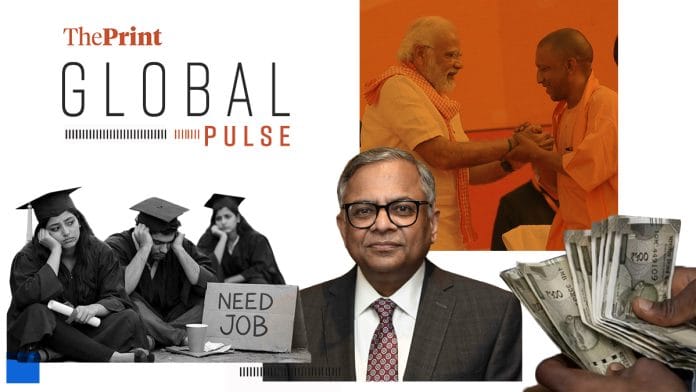

New Delhi: Uttar Pradesh, India’s most populous state, will go to elections in 2027, and as Chief Minister Yogi Adityanath seeks a third term, the Financial Times looks at the ‘Hindu monk’s’ quest to “reshape” India’s biggest state.
Michael Stott, Andres Schipani, and Jyotsna Singh of FT report on Adityanath’s journey and governance mode. Ruling a state which is more populous than Brazil, Yogi has built a reputation of being one of the “doughtiest advocates of Prime Minister Narendra Modi’s Hindu-first agenda”.
“Yogi, as he is universally known, is now the favourite to win a third consecutive term in state elections early next year, a victory that would propel him into the front rank of potential successors to Modi, who is 75,” the FT writes.
“Yogi-ji is a mirror image of Modi,” a senior national government official told the FT. The report also notes how Adityanath has cultivated an image that closely resembles Modi’s. “Like the prime minister, Adityanath comes from humble stock and cultivates a hardworking, man-of-the-people image,” the report says.
However, as the report also points out, critics have often pointed out his “divisive” nature and his communal rhetoric. “In 2020, he told the BBC that Muslims ‘did no favour to India by staying’ after the partition of the subcontinent following independence from British rule,” the report adds.
Much like Modi, Adityanath has also mastered the art of shaping the narrative. It says, “Adityanath has also mastered 21st-century communication. His 80-strong social media team posts clips of the saffron-robed chief minister delivering fiery speeches and inaugurating public works.”
In an interview with the FT, he said, “Monastic life is not different from community life. It is a medium for us to understand society and its problems.”
Another factor, which makes parallels between Modi and Adityanath possible, is the development-oriented governance approach, the report says. “Uttar Pradesh was for decades one of India’s least developed states, but the monk — flanked by figurines of Hindu deities, and one of Modi — reeled off with satisfaction figures for kilometres of roads built, dollars of investment won and companies created since he took office in 2017.”
The report also notes that while official data shows that Uttar Pradesh only reflects national growth figures, residents of the state credit him with outpaced economic growth and significant drop in crime rate.
And while the chief minister had his fair share of differences with the Central government, “these days, Adityanath stresses his loyalty to Modi and avoids discussing his own ambitions. He is more careful about his remarks to foreign media,” the report notes.
Alex Travelli and Showkat Nanda of The New York Times look at the dismal state of India’s graduates despite a boom in private universities. The correspondents note that students and their families pour hundreds of thousands into their education, but only two things are guaranteed: debt and disappointment.
“Families are draining their savings to attend schools that have proliferated across the area’s five Knowledge Parks over the past decade. The flood of graduates the schools are producing vastly outnumbers the availability of well-paying jobs,” the report notes.
The report says that while the protests against India’s education system ended with the education minister’s resignation, the underlying frustrations have not. The report says that India’s working-age population, already the world’s largest at nearly one billion, grows by about 12 million people a year. “For families with money to spare, education is one of the few apparent routes out of low-paid farming and wage labor,” it says.
And for those who cannot crack into the cluster of the top few government colleges, private colleges are the next best option. India has been witnessing a boom in this sector since Modi became the prime minister in 2014. “The number of private colleges tripled in the decade after Mr. Modi became prime minister in 2014,” the report says.
However, well-paying jobs have not increased at the same rate. Hence, student, and their families ended up spending disproportionately more on education, while taking several years after graduation to repay loans.
Veena Venugopal writes in India Business Briefing newsletter in FT about the many problems that plague the Tata Sons group. “The boardroom troubles at India’s largest conglomerate show no sign of resolution, as several characters in the saga appear to be tied up in regulatory and personnel issues,” she writes.
Tata Sons was supposed to hold a meeting on 18 August, even as the company’s key shareholders, the Sir Ratan Tata Trust, has been unable to nominate its representative due to the restriction placed by the charity commissioner of Maharashtra. And without a representative from the trust, the group falls short of the quorum required to hold the meeting, Venugopal writes.
This comes after a year-long boardroom battle regarding the succession in Tata Trust with N Chandrasekaran not seeking another term after his tenure ends in February 2027. The group is facing other problems too.
“Most prominently, the group’s golden goose, Tata Consultancy Services, is going through a significant upheaval as India’s IT industry tries to find its footing in a world being reshaped by AI,” the newsletter says.
“It is safe to say that the boardroom tussle at Tata Sons has distracted it from the important task of steadying the ship and settling the group’s future strategy,” Venugopal adds.
Zoya Mateen and Dilip Kumar Sharma report for the BBC about the Indian activist who has been jailed after taking on a luxury hotel plan.
Pranab Doley was set to be released from jail on 30 July, after protesting against a proposed luxury hotel near Kaziranga National Park. However, the government then invoked the National Security Act, effectively denying Doley bail. Kaziranga National Park is a Unesco World Heritage Site whose grasslands and forests are home to elephants, tigers and the world’s largest population of one-horned rhinos, the report says.
The government’s order draws on nearly a decade of allegations against Doley, citing 13 criminal cases registered since 2017 and “a pattern of unlawful assembly, intimidation, obstruction and violence”, the report says.
Doley’s case has drawn attention to the protest he took part in, and has triggered wider debate over land, conservation and development around Kaziranga.
Anup Roy of Bloomberg writes about India’s cash demand that does not seem to slow down despite billions of UPI transactions every year. “India’s rapid adoption of digital payments has failed to curb demand for cash, making it harder to predict how much currency will be needed,” Roy writes citing RBI Deputy Governor Shirish Chandra Murmu.
Calling it a “cash paradox”, Murmu added that “currency in circulation continues to grow at double-digit rates even as cash’s share of individual transactions declines”.
The continued use of cash also means the central bank needs banknotes to last longer, the report says.
Citing what Finance Minister Nirmala Sitharaman said in Rajya Sabha, Roy notes that the government has approved the introduction of one billion polymer notes each in 10-rupee and 20-rupee denominations.
While the demand for cash already spikes during the three-month long festive season starting September, it could further rise if the government concretises the merchant rate on UPI transactions.
(Edited by Ajeet Tiwari)
Also read: ‘Second Republic’? Global media sees Vande Mataram push as part of India’s new political order