





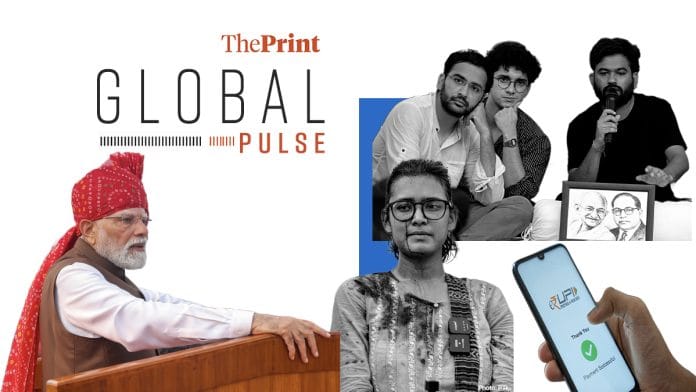

New Delhi: Prime Minister Narendra Modi’s Independence Day speech from the ramparts of the Red Fort has caught the eye of global media.
The Economist starts by referring to the push by the BJP-led government to bring ‘Vande Mataram’ at par with the national anthem, to the point that it was sung before ‘Jana Gana Mana’ this Independence Day. As ‘Vande Mataram’ was played, it mentions,“an air-force helicopter flew past with a banner commemorating 150 years of the song’s composition”.
The display marked BJP’s years-long quest to boost the song’s status, which the column says was “passed over for anthem status in part because its invocation of Hindu deities was seen as excluding Muslims”. Just last month, Parliament criminalised any ‘disruption’ to the song.
“Mr Modi spoke of India’s achievements as it enters its 80th year of independence. He looked ahead to its glorious centenary. Such pronouncements acknowledge that India gained freedom from the British in 1947,” the column notes.
It also quotes Carnegie senior fellow Milan Vaishnav who refers to the new political order as India’s “Second Republic”.
“In the eyes of the BJP’s leaders, the India they inherited [from 1947] was too effete, too anglophone and too accommodating of minorities,” says the column.
It goes on to add that this “Second Republic” needed a new identity. And that identity meant disposing of the anti-colonial symbols introduced following Independence in 1947. “In recent years the government has changed to saffron—a colour associated with Hinduism and the party itself—its flagship train service, the logo of the public broadcaster and, last month, the uniform of the men’s national hockey team,” the column notes.
Last year, India’s landmark employment guarantee scheme’s name was changed to refer to the Hindu deity Ram instead of M.K. Gandhi. The BJP also needed a “new origin story”, according to the column. While the Independence movement made it difficult to make 2014 the new starting line, the column says that the BJP took another route: changing the prominent faces of the freedom struggle in the country’s national consciousness.
India’s first Prime Minister Jawaharlal Nehru, The Economist says, was “demoted from nation-builder to incompetent, entitled scion of the elite”.
“In his place the BJP’s myth-makers built up Sardar Vallabhbhai Patel, Nehru’s home minister, who they insist was robbed of the top job,” it adds.
However, the column argues that despite the party’s efforts to reboot India’s Independence narrative, it has largely failed to do so, which was clear during the youth protests over the National Eligibility-cum-Entrance Test (NEET) paper leak. “Students carried copies of the Constitution. They displayed photos of B.R. Ambedkar, its architect; Bhagat Singh, an anti-colonial revolutionary; and Gandhi. They chanted slogans dating to the freedom struggle.”
Rachel Millard, Andres Schipani, and Jyotsna Singh report for the Financial Times that India’s night-time cooling is putting pressure on its renewable energy ecosystem.
Citing figures from the International Energy Agency (IEA), they wrote that summer night-time temperatures have risen about twice as fast as those in the day, with temperatures that can approach 30 degree Celsius across the country.
“India’s peak night-time electricity demand has climbed by about 40 percent to 252 gigawatts since 2019, the IEA said, with air conditioning accounting for as much as one-third of night demand,” the report says.
The surge, it notes, can be attributed to the “urban heat island effect”, in which fewer trees are present to cool the air, tall buildings trap heat, and AC units shoot warm air out. India has the third highest solar capacity in the world, powered by the investments made by Adani and Tata groups.
“But the country’s combined wind, nuclear, hydropower and battery storage resources are not enough to cover night-time demand, meaning that once the sun fades more coal-fired power stations have to kick back in.”
Citing data from the global energy think tank Ember, the report says thermal generation, mostly coal, supplied nearly 80 percent of India’s night-time power demand during May and June, the report notes. This throws a wrench in PM Modi’s pledge to make India a zero-net emission country by 2070.
The BBC looks at the government’s proposal to charge a nominal fee on UPI transactions. Soutik Biswas takes a look at how it could impact the UPI economy of India, one that is truly unique in terms of the scale it functions at and its design.
“Scan a QR code, tap a few buttons and the money moves instantly. There is no card machine, no cash, and – most importantly – for the user, no visible fee,” he writes.
An “experiment in free digital payments”, the UPI allowed hundreds of millions of people to pay or receive money with zero additional charges. As Biswas reports, over 241.6 billion transactions were made using UPI in the last financial year alone. In July alone this year, there were 23.6 billion UPI transactions worth 29.87 trillion rupees, the report says.
“UPI is not merely big. Its design is unusual. Rather than building a closed system around a single dominant app, India created common digital plumbing on which competing companies could operate,” the report notes.
Google Pay and PhonePe may be fierce competitors when it comes to winning users, but their customers can still transact seamlessly with one another because both operate on the same underlying payments infrastructure. The network is managed by the non-profit National Payments Corporation of India (NPCI), while banks and technology firms build the apps and services that users interact with, says the report.
While the government is yet to decide the exact fee and whether it would apply on all transactions to stay limited to bigger ones only, Biswas sees an upside to the merchant discount rate (MDR).
If the policy targets transactions above Rs 2,000 at larger merchants, then the small businesses and low-value payments would remain unchanged. And transactions over that limit, which constitute only 4 percent in volume, but 67 percent in value, would open an entirely new stream of revenue that could easily run into billions of dollars, the report says.
Afterall, making UPI payments is free, but keeping the ecosystem alive and running is not. “Servers have to run, transactions settled, fraud detected and the system protected against cyberattacks,” Biswas adds.
Anupreeta Das of The New York Times reports on the deluge of online hate and threats Indian women were subjected to after attending the youth protests over the NEET paper leak.
“Thousands of young women have participated in nationwide protests demanding accountability from the government for a flawed education system. But in the two months since the demonstrations started, they have been doxxed and bombarded online by people who have called them immoral, threatened sexual abuse and acid attacks, and used artificial intelligence to create demeaning images,” she reports.
The online attacks, Das notes, have been carried out by mostly Hindu men who have assumed the bastion of religious morality. However, what remains noteworthy is that the state joined in.
Actor-MP Kangana Ranaut, in a series of messages, slammed ‘young Hindu women’ for joining the protest, calling them ‘generation gutter’ and ‘ugly’ who could not even make ‘home makers’.
Police officers have also reportedly visited the ancestral home of a student activist and protester, and suggested to her family that she should focus on her studies, the NYT reports.
“Another protest leader had ink thrown in her face. A 15-year-old girl who had used profanities in talking about Mr. Modi during the protests later appeared in a video online apologizing,” Das reports.
Modi, too, called it a cultural shock that Indian women were using curse words during the protest, while Indian men doing the same were overlooked.
Student activist Danish Ali faced brutal online harassment following her role in the protest. Speaking to Das, she highlighted the hypocrisy of Hindu men who worship goddesses yet make rape threats online to women. “There is this binary that is created. Either you are a saint, or you are a slut,” she told the NYT.
(Edited by Tony Rai)
Also Read: From Air India dope test to Solar Mission Aditya-L1, what’s the latest global headlines about India