



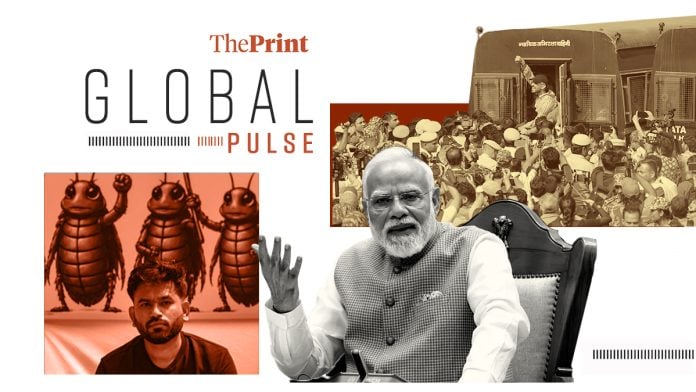
New Delhi: The Modi government’s response to youth-led protests over voter-list revisions has drawn scrutiny from international media, with reports examining the handling of dissent, allegations of voter disenfranchisement and the challenge posed by a movement that has vowed to continue its agitation.
In The New York Times, South Asia bureau chief Mujib Mashal writes that the scenes in Delhi have exposed the limits of Modi’s approach to maintaining power.
“The prime minister has built an image abroad as the popular elected leader of the world’s largest democracy, while at home turf his government has been accused of using state institutions against dissenters,” he writes.
“On Saturday, Mr. Modi’s balancing act broke down as violent scenes across the capital city were beamed to screens around the world, exposing the rough edges of his rule and the limits of his formula for maintaining power.”
Police detained young protesters, journalists, activists and politicians as they demonstrated against what they described as manipulation of India’s voting system. More than 130 million names were removed during a nationwide revision of voter rolls over the past year.
The protesters accuse Chief Election Commissioner (CEC) Gyanesh Kumar of doctoring voter rolls to secure an advantage for the ruling Bharatiya Janata Party (BJP), allegations the party dismisses.
Rajat Sethi, an analyst who formerly advised BJP governments, said that while the protests against the education minister were nonpartisan, the current wave feels heavily influenced by the political opposition. He said he feared the unrest could lead to an upheaval similar to those in Bangladesh and Nepal. “My biggest question is: What is the endgame on this?”
But, the youth movement draws on a cross-section of society, making it harder for the government to dismiss protesters as “anti-nationals” or terrorists, as was done previously.
“The old playbook has become old, it’s tired, it doesn’t work,” Gyan Prakash, a Princeton University historian who has written about the Indian government’s descent into authoritarian rule in the 1970s, says. “And so what do they have now left? They have the police.”
The protests also pose a generational challenge for Modi and the BJP, Mashal writes. The party pioneered the digital political outreach system with a Hindu nationalist ideology, but the current wave of dissent suggests that younger protesters are resisting the government’s stance.
Modi faces a difficult dilemma whether to act on demands for Kumar’s resignation: doing so could be seen as an admission that the voter-list process was improper, while refusing to act risks allowing discontent to grow.
“They are between the devil and the deep blue sea,” Prakash tells the newspaper.
The Wall Street Journal (WSJ) also reports on the security lockdown in Delhi. Police stopped vehicles and pedestrians at yellow metal barricades, while dozens of metro stations were closed and many intercity trains cancelled.
The Cockroach Janta Party (CJP), it says, has backed those protesting the voter-list exercise.
CJP founder Abhijeet Dipke, it writes, posted a video of being taken into custody after their flight arrived in Delhi. “This is dictatorship,” Dipke shouted as police officers entered the plane.
The newspaper reports the concerns of Ishrat Ansari, a 49-year-old social worker, who said she and her two children received notices from election authorities over discrepancies in their records.
Ansari believes her name may have been flagged because it appeared on the 2002 voter rolls with the honorific “Khatun”, often used by Muslim women, which does not appear on her current identification. She fears that she might have received the notice because she is Muslim. “Is it because my name is Ishrat that I was cut?”
Modi’s BJP, the write-up says, has promoted a form of Hindu nationalism that critics say discriminates against India’s Muslim minority. The government denies this, saying its policies focus on the progress of all Indians.
The newspaper notes that the scale of the deletions has made the discontent difficult to contain. “Even people who are alive and standing in front of you have been removed,” Manoj Tak, a Congress party member and local election worker from Rajasthan, tells the WSJ. “If we don’t protest now, when will we protest?”
The BBC News’ India correspondent Soutik Biswas reports that much of central Delhi remained barricaded for a second day, with offices, shops and restaurants shut and internet services curtailed. The BBC witnessed protesters being chased, surrounded and detained before being rammed into detention buses.
Some protesters, however, said the absence of the CJP’s top leadership was affecting the movement’s momentum. “Without them, we’re feeling a little lost,” one protester told the BBC. “But that doesn’t mean we’ll stop our fight.”
The BBC traces the CJP’s origins to May, when Dipke posted after Chief Justice of India Surya Kant comparing some unemployed young people to cockroaches. The movement gained momentum around anger over unemployment, exam paper leaks and government accountability, it reports. The protest has since expanded beyond education reforms to the voter-list controversy.
On Sunday, the Supreme Court ordered the government to restore internet access and ensure that metro and rail services operated normally unless there was a disturbance to public order. It also said that free movement should be permitted and there should be no illegal detention.
Moving away from the protests, The Economist examines the limits of India’s influence through its diaspora, around 37 million, the largest in the world.
The article points to the achievements of Indian-origin figures in business, technology and politics, as well as the wealth of Indian-American households. The median Indian-American household earns $151,000 annually, around 75 percent more than America as a whole.
Such achievements are celebrated in India, where the government has increasingly sought to strengthen ties with overseas Indians, it says. Under Modi, the magazine notes, the prime minister’s foreign trips often include rallies attended by non-resident Indians.
“To the BJP and indeed to many Indians, the success of NRIs is yet another indicator of India’s inevitable rise,” The Economist writes. “But, viewed differently, it is also an indictment of the country’s inability to hold on to its talent.”
The magazine cites a 2023 study that found 36 percent of the 1,000 highest scorers in the 2010 IIT entrance exam were living abroad eight years later. Among the top 100 scorers, the share was 62 percent.
It also points to the limited global presence of Indian companies. Of the world’s 500 biggest firms by market capitalisation, only eight are based in India, compared with 41 in China and 234 in the US. The magazine attributes this in part to family-run businesses and the state’s failure to create the infrastructure and regulatory conditions needed for companies to flourish.
Remittances amount to four percent of India’s GDP, compared with 0.2 percent in China, and support millions of households, the magazine says. But it argues that the diaspora has limited ability to influence foreign governments in India’s favour.
The magazine notes that the Trump administration has tightened migration rules and that Australia and Canada are restricting student visas. It also points to legislation passed by the US Congress allowing 100 percent tariffs on India for buying Russian oil.
“The diaspora may be large and even influential, but it is no diplomatic corps,” The Economist writes.
Modi has hailed overseas Indians as “rashtradoot”, or emissaries of India. But the magazine argues that few in the diaspora want to return to a country where decent jobs are scarce and cities are unlivable. “Celebrating success abroad may feel good, but a real reason for national pride would be for Indians to flourish at home,” it concludes.
(Edited by Tony Rai)
Also Read: ‘Difficult to say’ how protests led to ‘turmoil’ at Punjab’s LPU, says global media