





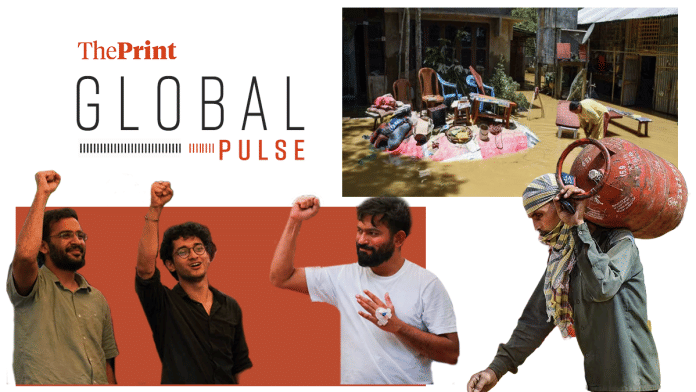


New Delhi: Even as the Cockroach Janta Party called off its protest Saturday after the resignation of Dharmendra Pradhan as Union education minister, the youth movement that mobilised ten of thousands of people at Jantar Mantar in New Delhi and other cities across India continues to hold global media’s attention.
Financial Times asks: What’s next for the CJP?
Michael Stott and Jyotsna Singh report how the CJP-led movement could be inspiring a wave of smaller protests by disgruntled citizens across the country.
As Jantar Mantar gets refurbished, with the erasure of all visible signs of the protest from graffiti to posters, FT notes that the “mark made by the student-led movement on the nation’s politics will be much harder to remove”.
This is most prominently visible in the “copycat movement” the CJP protest has already inspired.
The newly launched E20 Janta Party, named after the government’s 20 percent ethanol-blended fuel, amassed 34,000 followers on X within a day of its debut Sunday and was past the 44,000-mark by Tuesday. It is positioning itself as a political outlet for mounting frustration over the nationwide introduction of E20, which critics say could increase fuel use and damage older vehicles, the report adds. It is demanding availability of 100 percent petrol at all fuel stations, along with the resignation of Road Transport Minister Nitin Gadkari.
Political scientist Pratap Bhanu Mehta tells FT that the CJP has given a “template for a new way” of making demands on the State.
The report notes that demand for Gadkari’s resignation is gaining momentum as his sons operate a family business that produces ethanol. However, Gadkari has denied any conflict of interest and clarified that his sons have less than 0.5 percent of India’s ethanol market.
Political analyst Tehseen Poonawalla, one of the most prominent critics of the E20 rollout, has urged supporters to join a “car march” to Gadkari’s residence Friday. Separately, Delhi taxi drivers have announced a march to Parliament on 4 August to protest the fuel policy.
Meanwhile, CJP spokesperson Saurav Das has said that it would be “better for the government for the next three years before the [next general] election to start listening to people”, the report notes.
Mukul Kesavan of The Guardian lists the factors behind the success of the CJP’s protest movement.
Referring to the first sit-in protest organised by founder Abhijeet Dipke after landing in Delhi, Kesavan writes, “Like other political tourists, I visited Jantar Mantar on 6 June out of curiosity. On that inaugural day it was modestly crowded and not that different from the dozens of demos I had attended over 50 years.”
However, when he revisited the protest site on 20 July, the day CJP had called for a march to Parliament, a lot had changed—“Jantar Mantar was unrecognisable”.
The movement had already started gaining traction over the weekend before 20 July, when Sonam Wangchuk, who was on a hunger strike at the time, was forcibly taken to a government hospital. According to Kesavan, that is where the first miscalculation happened. “The calculation was that his absence would defuse the tension and demoralise the protesters. That didn’t happen.”
He writes, “The government had underestimated the size of the crowd that poured in by bus, train and car from Delhi and beyond.”
Later, the government and police added to that miscalculation by using tear gas and batons on protesting students. Visuals of police crackdown spread through social media like wildfire across Indian households. “In the hands of young digital natives, whose phone cameras were extensions of themselves, it became a gush of online content that brought the violent drama of this confrontation into every home,” Kesavan notes.
He further points out that the protesting students and youth were not Muslims. “There were Muslims among them, but this was a protest about the corruption of competitive examinations, an issue that concerns every middle-class family in India.”
It couldn’t, according to him, be “tarred as an anti-national conspiracy” in the way that the protest for secular citizenship led by Jamia’s mainly Muslim students was.
In the BBC, Dilip Kumar Sharma and Abhishek Dey report on the devastating floods in Assam that have killed at least 68 people and displaced over 6,00,000.
“When Saline Patro watched the rain on 19 July from her home in Jorhat district in the northeast Indian state of Assam, she didn’t know that her life was about to change,” the report reads. However, even as she tried to help her family reach higher ground, within minutes, her house was washed away by the floods. “We had a television, a cupboard and a sofa. Nothing was left. We couldn’t even save a glass to drink water from,” she tells the BBC.
Although Assam experiences floods every year around this time, as Saline is quoted as saying, this year it was different.
Citing experts, BBC notes that flooding has worsened over time because of upstream deforestation, ageing embankments and heavier rainfall driven by climate change. “Exceptionally heavy rain across parts of neighbouring Nagaland and Assam from mid-July triggered this year’s devastating floods, which minister Pijush Hazarika described as the state’s worst in six decades.”
The US-Iran war is affecting South Asia’s favourite staples, and street food that used to be reliable, cheap and easily available is becoming expensive, The New York Times reports.
Muktita Suhartono, Yan Zhuang, Max Kim and Suhasini Raj report for NYT that the renewed conflict has hit Asian economies particularly hard, given their dependence on West Asian energy supplies. The economic shock intensified after an initial ceasefire brokered by the US and Iran fell apart.
Shubham Yadav, owner of Yadav Milk Dairy Lucknow—a city known for its street food—tells NYT that he is “barely profiting” from selling samosas, “the potato-filled savory pastries that are one of India’s most famous culinary exports”. Samosas are among the most widely consumed fast foods in India, a staple for white-collar to blue-collar employees, to daily wage labourers.
Yadav says that the price of the cylinder he uses has doubled to Rs 3,600. As India imports about 60 percent of its LPG, much of which comes through Strait of Hormuz, the war in West Asia has severely disrupted energy supplies to India.
“Mr Yadav said he could not double his prices to match the surging cost of gas, so he had increased the price of each samosa by about 1 cent,” the report says. He is worried he might have to increase the prices further to sustain surging costs.
In South Korea too, Kim Moon-jung has been selling bowls of kalguksu—hand-cut noodles in savoury broth—at her restaurant in Seoul for 9,000 won. Now, she plans to increase the price to at least 10,000 won.
“Residents of the capital are so eager to find affordable meals, and so sensitive to price increases, that earlier this year they created a crowdsourced map to identify restaurants selling meals for 10,000 won or less,” the report says.
Similarly, in Thailand, som tum, or green papaya salad, and popular street food, is costing shop owners more by at least 30 percent, since the war began. “If I didn’t increase the price I couldn’t survive,” says Ridah, who sells gado-gado, a dish of boiled vegetables dressed with peanut sauce, in Jakarta, Indonesia. She has increased the price of her dish by 1,000 rupiah to 18,000 rupiah.
(Edited by Mannat Chugh)