



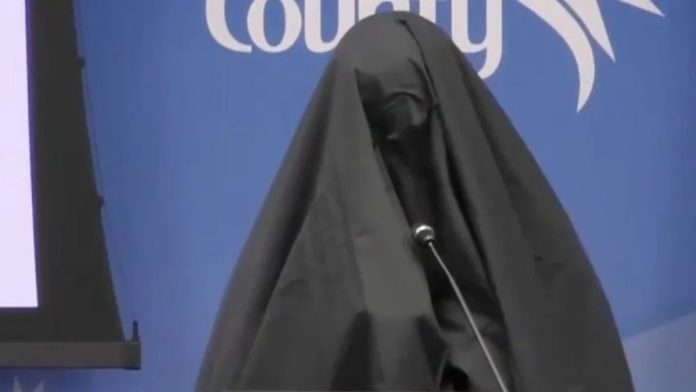
New Delhi: A woman wearing a black face veil played a recording of the Islamic call to prayer at a Florida county commission meeting on 27 October, continuing even after officials asked her to stop.
Identified in media reports as Selene Al Jamal, she played the recording at the public-comment podium during a meeting of the Pinellas County Board of County Commissioners in Clearwater. Chairman Dave Eggers intervened and asked her to turn it off.
“Stop the tape, ma’am,” Eggers said, according to Fox News.
Eggers later explained the decision to the audience.
“We don’t allow taped things. You can record the meeting, but we don’t allow taped activity like that. We ask you to come here and make comments, and that was not a comment. That’s why she was asked to step out,” he said.
The incident took place amid a dispute over plans to expand Masjid Al Rahman, a mosque near Tarpon Springs. The row has raised questions about how local authorities handle building proposals from religious institutions and whether planning rules are applied fairly and clearly.
According to Fox News, the sheriff’s office said Al Jamal was escorted out of the meeting without further incident and would not face criminal charges.
When the dispute began
The dispute began before the public-comment session. On 13 October, the county commission voted 4-3 to approve a land-use amendment for a 2.69-acre property at 2577 Keystone Road, where Masjid Al Rahman operates.
The plan allows the existing building to be replaced with a slightly larger one, including new parking, stormwater or drainage improvements, and removal of the Keystone Road driveway, with access shifted to East Lake Street.
However, county documents described the proposed building as a “community assembly facility” rather than a mosque.
Commissioner Vince Nowicki criticised the wording, questioning why the documents did not clearly identify the project as a mosque.
“Residents read these materials to understand what is being proposed near them, and they should get the same plain description in every case, no matter the applicant,” Nowicki wrote in an email to County Administrator Barry Burton.
County planning officials said zoning rules classify religious buildings as “community assembly facilities”. The dispute is therefore not just about the mosque’s expansion, but also about whether county documents clearly explain proposed developments to residents.
At later meetings, some residents raised concerns about increased traffic and the impact on the neighbourhood. Others defended the mosque, saying it had been part of the community for years.
Also read: More Asian Americans in Harvard’s Class of 2030, fewer Black students
A threat to American values?
The controversy has also drawn wider political attention, with some opponents arguing that the mosque’s expansion threatens American values.
US law protects religious institutions from unfair treatment in zoning decisions. The federal Religious Land Use and Institutionalised Persons Act bars governments from discriminating against religious groups when making land-use decisions.
However, religious institutions must still follow local planning rules. The law requires authorities to apply these rules fairly and not treat religious buildings less favourably than similar non-religious facilities.
At the commission meeting, the issue was also about the difference between the right to express religious beliefs and the rules for speaking at public meetings. Chairman Dave Eggers defended the woman’s removal, saying she had broken the meeting’s rules, and urged those present to remain calm.
“Please. Just please exercise some decorum and kindness of your own,” he said. “We’re all people living together here.”