





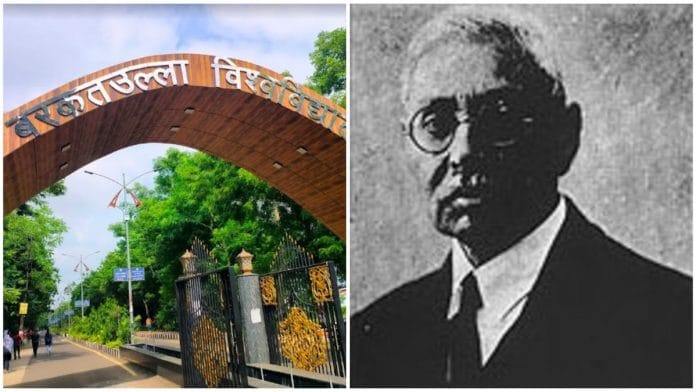


New Delhi: A proposal to rename Bhopal’s Barkatullah University as Vagdevi Bhojpal University has set off a controversy, with critics accusing it of erasing the legacy of freedom fighter Maulana Barkatullah Bhopali.
Barkatullah University’s executive council approved the renaming proposal unanimously at a meeting on 3 June, and it has now been forwarded to Governor Mangubhai C Patel.
The proposal argued that the new name reflected Bhopal’s historical and cultural heritage, and that, compared with Raja Bhoj, Barkatullah had made “no significant contribution” to the region beyond being a resident of the city.
‘Vagdevi’ is another name for the goddess Saraswati and ‘Bhojpal’ nods to Raja Bhoj, the 11th-century king who is said to have founded Bhopal.
Established in 1970 as Bhopal University, the institution was renamed Barkatullah University in 1988 after Mohamed Barkatullah Bhopali, better known by his honorific Maulana Barkatullah.
Born in Bhopal in 1854, he was a nationalist, renowned scholar, and the first Prime Minister of India’s first provisional government-in-exile. Bhopal University changed its name 61 years after his death to honour his contribution to India’s freedom struggle.
Also Read: President in the bathtub. Fakhruddin Ali Ahmed was India’s most controversial head of state
‘An epitome of dedication to the nation’
An active global figure of the independence movement, Barkatullah waged his struggle through journalism and international diplomacy across four continents.
After early education in India, he left for England in the 1880s. There, in 1895, he was invited to work at the Muslim Institute in Liverpool. During his stint in England, he also met Indian revolutionaries such as Lala Hardayal and Raja Mahendra Pratap. In an early tryst with dissent, he responded to British Prime Minister William Gladstone’s racist comments about India with a flurry of articles and speeches. His activities were soon severely restricted.
He subsequently changed geographies, but not the force of his convictions. In 1904, he was appointed Professor of Hindustani at the University of Tokyo. During his years in Japan, he edited revolutionary pamphlets and wrote fiercely anti-British articles in Urdu and English, which were widely circulated and eventually banned in India. He then moved to the United States and began teaching.
A committed pan-Indianist, Barkatullah strongly championed Hindu-Muslim unity. In a letter addressed to activist-poet Hasrat Mohani, he criticised British rule while advocating unity between Hindus and Muslims.
“There are two duties of the Muslims residing in India. One is the duty for the country and the other of their religion. The love for the country demands that one should not shirk in serving the country with wealth and his own life. The history of mankind stands witness that he who has no love for the country is devoid of humanity,” he wrote in Persian, according to professor Iqbal Husain, a scholar and historian of Medieval Indian History. “The religious duty demands that the Indian Muslims on account of Islamic brotherhood are friends to the Muslims of the world. And whenever there is a challenge they should extend all possible support. The fulfilment of these religious and country’s duty depends upon only one action, the complete unity between the Hindus and Indian Muslims.”
Husain, in his article Barkatullah — A Half-Forgotten Revolutionary, also noted that Barkatullah “believed that the unity between the Hindus and Muslims would force the English to surrender the administration of the country to them as had happened in Australia and Canada.”
Barkatullah was one of the founding members of the Ghadar Party in 1913 at San Francisco. Within just six months of its launch, Ghadar newspaper reached over 12 countries, and his efforts helped mobilise nearly 8,000 Indian expatriates who returned to India and joined the freedom struggle.
Barkatullah’s most momentous achievement came during World War I. On 1 December 1915, India’s first provisional government-in-exile was established in Kabul, Afghanistan, with Raja Mahendra Pratap as President and Barkatullah as Prime Minister. He was also the first Indian to meet Lenin in support of independence.
An article on the Barkatullah University website describes him as “an epitome of sincerity and dedication towards one’s nation.” Now, nearly a century after his death in 1927, Barkatullah University and the nation are preparing to forget him all over again.