







Mumbai: At the foot of the Brahmagiri hill and about 28 km southwest of Nashik city lies Trimbak, a small temple town sacred to many Maharashtrians. It is revered as the site of one of the 12 Jyotirlingas and the source of the Godavari, drawing pilgrims from across India for rituals linked to death, purification, and ancestors.
At the heart of the town is the Trimbakeshwar Jyotirling Mandir dedicated to the Hindu god Shiva. It receives the highest number of pilgrims in July and August, during the Hindu calendar month of Shravan, particularly on Mondays.
Water is central to the temple’s ritual life. Within the premises is Amrit Kund, a large stone tank also known as Amritavarshini.
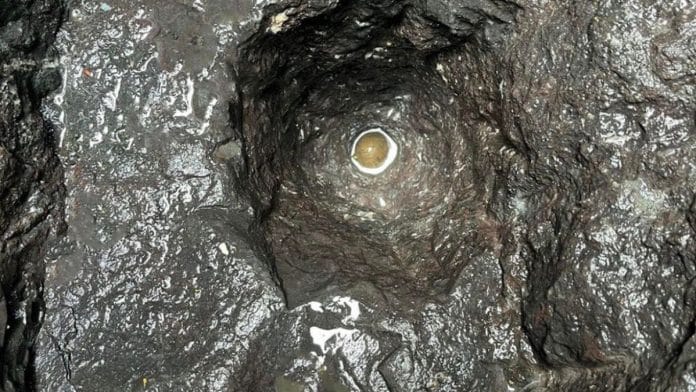
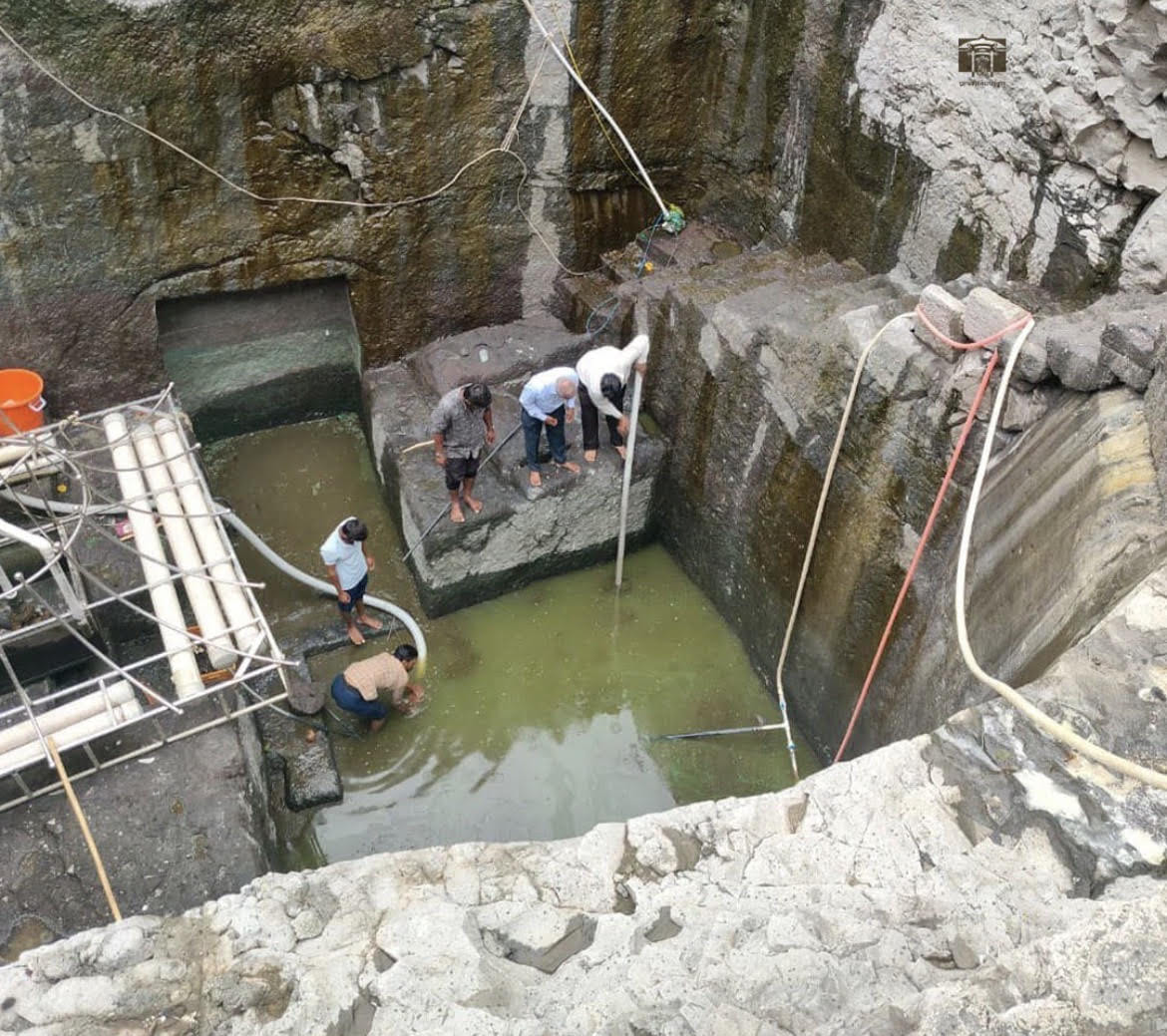
Now, the Amrit Kund has become the site of a conservation discovery. During routine desilting work this week, the Archaeological Survey of India (ASI) found a stone Shivling at the bottom of the nearly 65-foot-deep tank.
The ASI shared the discovery on X Wednesday.
“During the ongoing conservation works by ASI at the Trimbakeshwar Temple, Nashik, a stone Shivalinga was discovered during the desilting of the temple’s historic water tank, locally known as Amrit Kund,” the post read.
The discovery has stirred excitement in a city preparing for the Simhastha Kumbh Mela 2027. Arun Malik, Superintending Archaeologist at ASI’s Aurangabad Circle and in charge of the conservation work at the temple, told ThePrint that the timing is merely a coincidence.
“Ours is routine conservation work. It focuses on structural issues in the temple, such as joints that were opening up and needed to be grouted, along with the cleaning of the whole temple and desilting of water tanks. Our pending work includes cleaning of the tank on the southwest corner,” Malik said.
The present temple structure was built by Peshwa Balaji Baji Rao (also known as Nana Saheb I), son of Peshwa Baji Rao I. Among its notable features is the three-faced Shivling, said to represent the Trimurti (trinity) of Hinduism: Brahma, Vishnu, and Shiva.
The complex also features smaller water bodies, including Bilva Tirtha, Vishnu Tirtha, and Mukunda Tirtha, each part of the temple’s layered sacred geography.
Two possible explanations
Malik told ThePrint that the water tank is located at the northwest corner of the temple.
“The water tank is stone-cut and prone to accumulate silt and debris. We found a circular structure at the bottom of the tank, and upon a closer look, it was found to be a Shivling. That’s about it,” he said.
Anita Joshi, a local historian who has studied Nashik’s temple traditions, said the discovery should be seen in the context of Trimbakeshwar’s older water architecture. Joshi is an Indologist, archaeologist, and co-convener of the Nashik Chapter of INTACH (Indian National Trust for Art and Cultural Heritage).
According to her, the site may have been fed by a natural groundwater spring dating back 2,000 to 2,500 years—long before the water tank came into being. The spring, she noted, could have originated from geological formations linked to volcanic movement in the region.
Joshi listed two possible explanations for why the Shivling may have been placed there. The first, she said, is that it could have been installed by pilgrims to mark the spot as a sacred site. This may have happened even before the main temple was built.
“When people in those days would set out for pilgrimage, they would look for naturally found water bodies and create a pilgrimage site there by making a Shivling and placing it there. It was a usual practice and can be found in ancient scriptures,” Joshi said.
The second explanation lies in historical records that refer to a cremation ground near the Godavari River.
“The confluence of the Godavari River and the Ahilya rivulet is just outside the temple. There are records of there being a cremation ground just over the sangam (confluence). There were customs at the time of placing the Shivling at or near the cremation ground for certain people, in their name.”
Joshi noted that the actual reason cannot be established until the site is excavated or studied further.
The ASI is yet to officially establish the exact age of the Shivling. Officials have not announced whether further documentation, dating, or structural study of the Shivling and the tank floor will be carried out.
The Trimbakeshwar temple is etched in history as one that stood the test of time and changing political climate in the region. Joshi noted that historical evidence reveals multiple temples built in the Deccan region by the Rashtrakuta dynasty around the 10th century, followed by the Yadava dynasty in the 12th century. These powers had a strong presence in and around Nashik.
In the 17th century, the original Trimbakeshwar temple structure is said to have been destroyed by the Mughals during Aurangzeb’s Deccan campaign, and a mosque was built on that land. The Marathas secured the region in the 18th century, following which the Peshwa destroyed the mosque and created the temple in its place.
“Ordinary people never try to build big temples and monuments. That was always left to royal powers. Laymen only built their small shrines for the deities they believed in—whatever was possible for them—prayed at the site, and went back. The Shivling discovered now seems to be one such structure,” Joshi said.
(Edited by Prasanna Bachchhav)