



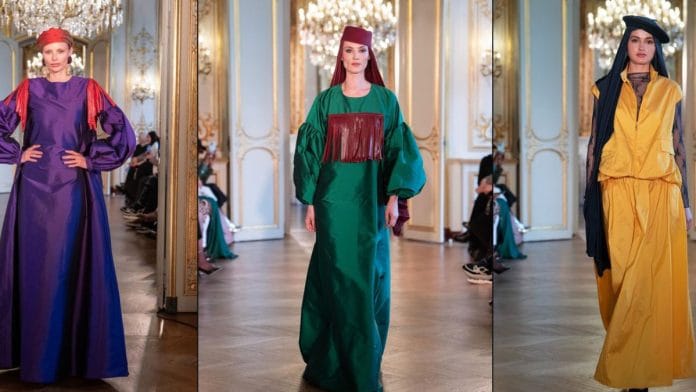
New Delhi: Paris held its first-ever Modest Fashion Week from 16-18 April. It featured close to 30 designers presenting outfits designed to cover the arms, legs, and sometimes hair, commonly worn by many Muslim women as part of their faith.
Modest Fashion Week (MFW) was founded by Özlem Şahin Ertaş in 2016. Since its debut in Istanbul, MFW has expanded across key fashion capitals, including London, Dubai, Jakarta, Amsterdam, Riyadh, and Abu Dhabi. Through these global editions, MFW has hosted hundreds of industry participants and reached an audience of over 2 billion people.
Paris as a venue is significant for many reasons. France has a Muslim population estimated between 5 and 7.5 million. But more importantly, the country has had long-standing debates and regulations surrounding the hijab and religious attire. It banned conspicuous religious symbols, including headscarves, in state schools more than two decades ago. More recently, abayas were also prohibited in schools. Burkinis remain banned in most public swimming pools, though they are still permitted on beaches.
For Fatou Doucouré, founder of Soutoura, presenting her collection in Paris was deeply personal. Having once struggled with wearing a hijab in the country, she now sees it as no barrier to success. Doucoure views her presence in Paris as a powerful statement that modestly dressed Muslim women belong in every sphere of society and can pursue any path they choose.
Also read: Dear Ralph Lauren, my DU college aesthetic is not your costume
Floral, earthy hues
At Hôtel Le Marois, near the Champs-Élysées, designers showcased collections rich in florals and organic colour palettes. Turkish designer Hicran Önal of Miha highlighted romance as the defining element of her work, presenting flowing designs in watery blues and teals accented by delicate pink florals. Indonesian designer Nada Puspita explored similar inspirations but opted for sharper, more streamlined silhouettes.
From Australia, Asiyam’s Aisa Hassan interpreted nature through a warmer lens, incorporating earthy greens and autumn-inspired rust reds. She added a bucket hat to the collection to honour her Aussie heritage. Her soft, fluid designs contrasted with the more athletic, streetwear-driven aesthetic.
The streetwear influence was evident in French labels Soutoura and Nour Turbans, whose collections featured structured, boxy shapes, synthetic fabrics, and darker tones.
Nour Turbans stood out by layering a beret over a headscarf, weaving cultural elements with contemporary styling.
Over the past decade, modest fashion has grown into a major global market, with spending expected to exceed $400 billion, according to DinarStandard. Once targeted primarily at Muslim women, modest fashion now resonates with a wider, more diverse audience.
(Edited by Theres Sudeep)