





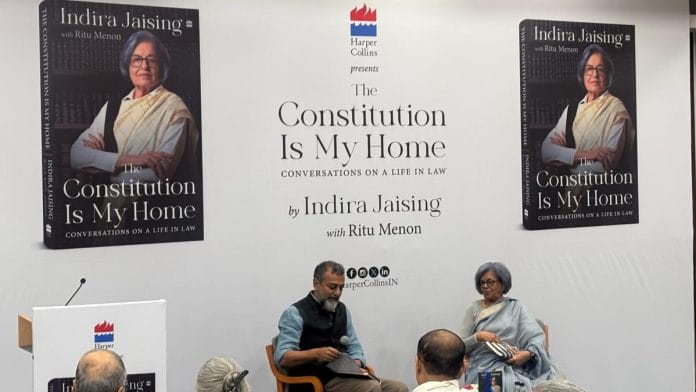


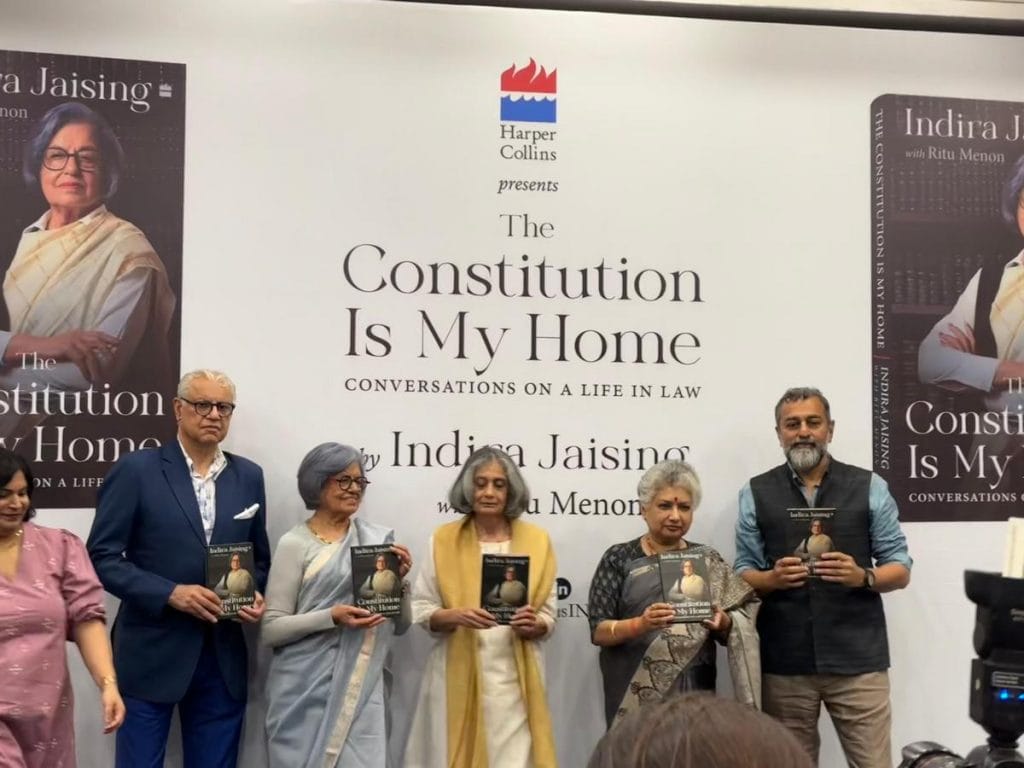
New Delhi: For decades, women in India’s legal profession have had to fight first to enter the courtroom, then to be heard inside it, and finally to lead it. But if there was an old boys’ club, there is now also a sisterhood. That long thread of persistence and mentorship ran through the launch of senior advocate Indira Jaising’s memoir The Constitution Is My Home.
“Rarely do we think of the Constitution as a home,” Chief Justice of India Surya Kant said in a video message at the event. “Yet only a few metaphors could capture Indira Jaising’s legal journey with such depth and accuracy.”
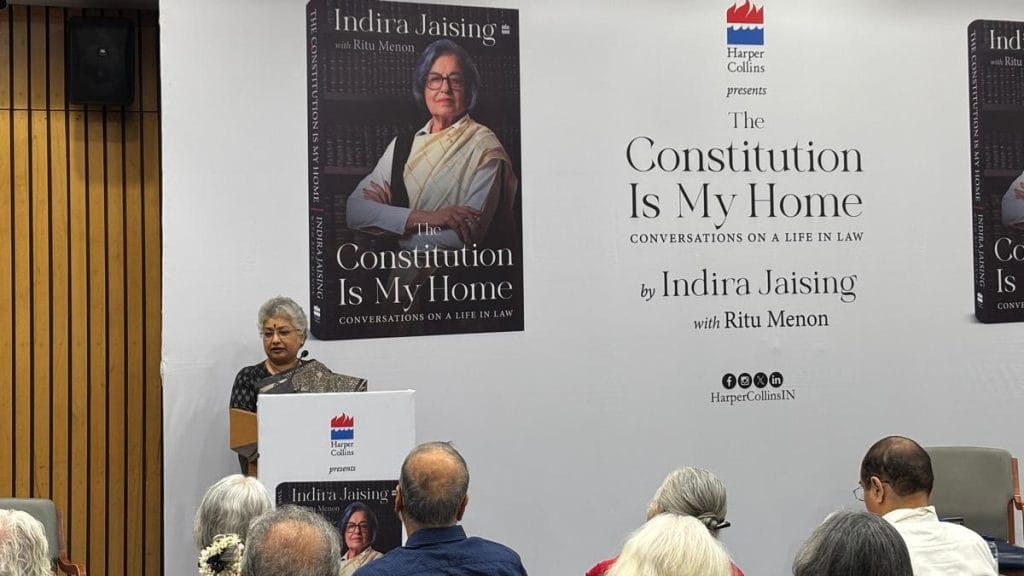
The memoir, published by HarperCollins India and written as a conversation with Ritu Menon, was launched on 21 May at Delhi’s India International Centre before a packed auditorium of senior advocates, judges, law students, academics, and journalists. The evening opened with Kant’s video message, followed by remarks from Justice B V Nagarathna and a conversation between Jaising and senior journalist Sreenivasan Jain.
Nagarathna spoke not just about Jaising’s legal legacy, but about the generations of women who carried each other through a profession long dominated by men.
“For generations men in the legal profession have benefited from social networks… almost a kind of brotherhood,” she said. “That is why sisterhood in the profession is very important.”
It set the tone for an evening in which Jaising’s career became a way into larger questions about constitutional law, feminism, and the state of India’s institutions.
Jaising was a forerunner in cracking the country’s legal glass ceiling — the first woman designated senior advocate by the Bombay High Court, later India’s first woman Additional Solicitor General, and today among the country’s most recognisable constitutional lawyers.
“With each generation, the burden became a little less onerous,” said Nagarathna.
Also Read: India’s trauma conversations can’t rely only on Western psychology
Making the Constitution personal
Over five decades, Jaising has stood at the centre of some of India’s defining legal battles: Mary Roy’s inheritance case, Olga Tellis and the right to livelihood, the Vishaka guidelines on workplace sexual harassment, the Bhopal gas tragedy litigation, triple talaq and Sabarimala.
Nagarathna described Jaising as a lawyer who insisted courts must “touch the lives of ordinary people” –women, workers, pavement dwellers, prisoners and minorities, rather than remain distant institutions accessible only to elites.
“There is a thread connecting all these cases. In each case, people pushed to the margins of society claimed the full protection of the Constitution,” she said.
The memoir itself returns repeatedly to that same idea: the Constitution not as an abstract legal document, but as a site of belonging.
“The Constitution is very personal to me,” Jaising said in conversation with Jain. Recalling her family’s migration from Pakistan and her Sindhi refugee identity, she spoke about growing up with a lingering sense of displacement.
“And after a long introspection, I found the answer. I belong to the Constitution of India.”
Jaising described constitutional values as the basis of her connection with fellow citizens. “It’s the values of the Constitution which I identify with,” she said.
The discussion also turned toward the role courts have played in expanding social and economic rights over the decades.
“It was only in the 70s and 80s that people started using courts proactively,” Jaising said. “Not just as a shield, but also as a sword.”
Earlier generations of liberals, she argued, often failed to recognise the courts as spaces capable of producing social change. “It was not seen as an instrument to make social change,” she said.
‘We have gone past the Emergency stage’
The evening, however, was not merely nostalgic. Much of the discussion centred on the state of constitutional institutions today, the judiciary’s relationship with power, and what Jaising described as the slow transformation of the republic without any formal rewriting of the Constitution itself.
“All governments, regardless of which party they belong to, have tried to shake the foundations of the Constitution,” Jaising said.
Jain repeatedly returned to the question running through Jaising’s memoir: whether the judiciary had succeeded in acting as a guardian of constitutional values or had increasingly failed to resist executive power.
Drawing a distinction between the Emergency and the present political moment, Jaising argued that the current moment was in some ways more difficult to confront because constitutional change was happening invisibly.
“During the Emergency, the Constitution itself was used,” she said. “But right now every other kind of transformation is taking place without changing the written text. We have gone past the Emergency stage.”
Yet, despite her sharp criticism of judicial institutions, Jaising returned to the idea that constitutional courts could still correct themselves. Even as she spoke about the judiciary relinquishing parts of judicial review and failing to consistently stand up to executive power, she insisted she remained “an eternal optimist”.
“If all of us who believe in democracy abandon constitutional courts, then it is all over for us.”
Also Read: Two journalists spent a decade in Rajasthan. What they found about caste, feudalism & RSS
‘Ruling powers are dissenting’
Jaising offered a pointed critique of the legal profession itself, from opaque judicial appointments to the crushing cost and delays of litigation.
She criticised the lack of transparency in the collegium system and argued that judicial deliberations around appointments should be made public. She was equally unsparing about the culture of adjournments that feeds India’s endless “tareekh pe tareekh” cycle, saying lawyers routinely accept more work than they can realistically handle.
The bigger failure, she argued, was the absence of a robust legal aid system capable of making quality legal representation accessible beyond the wealthy.
Jain directed the discussion toward the shrinking space for dissent within the judiciary. He noted that constitutional lawyers and critics of the judiciary increasingly face backlash for speaking publicly.
Jaising rejected the idea that constitutional lawyers were “dissenters”.
“We are claiming the right to affirm the Constitution. It is the ruling powers who are dissenting from the Constitution,” she said.
(Edited by Asavari Singh)