







New Delhi: A patch of grass outside Amsterdam’s Van Gogh Museum is an unlikely place for a Bengali folk song to find a global audience.
Yet that is exactly what happened when an undated video showed tourists from different countries singing and dancing to ‘Tomar Ghore Bosot Kore Koy Jona’, a Bengali folk favourite that has travelled far beyond the villages and small-town gatherings where such music traditionally thrived.
The clip quickly went viral, drawing praise online and prompting RPG Group Chairman Harsh Goenka to tweet.
“A Bengali song bringing together people at Van Gogh Museum. Culture is spread best when it creates joy, not disruption,” he wrote on Tuesday.
The song has since piqued the internet’s interest.
With so many reels of our tourists behaving badly abroad, here’s a lovely exception. A Bengali song bringing together people at Van Gogh Museum. Culture is spread best when it creates joy, not disruption. pic.twitter.com/PFb0lZJ84K
— Harsh Goenka (@hvgoenka) June 9, 2026
What is the song about?
Widely attributed to lyricist Zahid Ahmed, the deceptively simple folk song has been recorded and performed by countless artists across Bangladesh and West Bengal.
At first listen, ‘Tomar Ghore Bosot Kore Koy Jona’ sounds like a philosophical riddle. The title translates roughly to: “How many dwell inside your house?”
But the “house” is not a house at all. It is the human mind.
Throughout the song, the narrator asks the listener to look inward. One person paints a picture, another colours it. Yet another destroys it. One creates music, another keeps rhythm, and someone else turns it into discord. The recurring question remains the same: who are these different inhabitants living within us?
The song speaks to the contradictory selves that coexist within every human being — the disciplined and the reckless self, the creator and the destroyer, the dreamer and the cynic.
It can be interpreted as a commentary on inner conflict, identity and self-awareness. The lyrics never offer a neat answer. Instead, they leave the listener wrestling with the question long after the song ends.
Also Read: Bengali film industry is switching sides after BJP’s win. New scripts on Hindu causes
Rooted in the Baul tradition
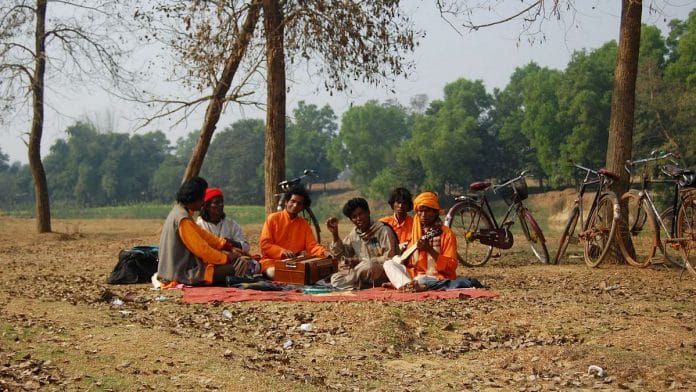
The song is steeped in the language and imagery of Baul music, Bengal’s mystical folk tradition.
Bauls were wandering minstrels and spiritual seekers whose songs blend elements of Sufi, Vaishnav and folk philosophies. But their music is less concerned with organised religion than with understanding the self and discovering the divine within.
Questions rather than answers are at the heart of the musical tradition. The topics ranged from identity to self-discovery to purpose in life.
‘Tomar Ghore Bosot Kore Koy Jona’, like all Baul songs, turns inward, treating the human mind as a crowded house filled with competing voices and desires. Like many folk songs, this too has no single definitive version.
‘Tomar Ghore Bosot Kore Koy Jona’ has been sung by folk performers, reinterpreted by independent musicians, covered by bands and shared endlessly on social media and found crores of views.