



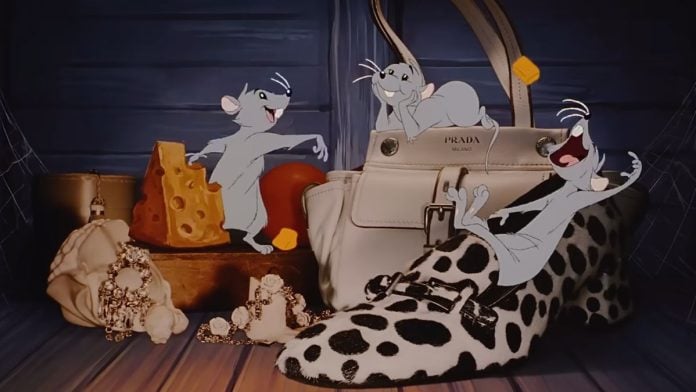
At a time when brands are racing to create AI-generated commercials, Prada chose to slow things down. They did the unexpected and brought animators to create their 2026 holiday campaign.
The result is a winter wonderland filled with animated creatures and illustrated scenes.
The campaign features actors Sadie Sink, Maya Hawke, Chen Haoyu, Luther Ford and Kelvin Harrison Jr., with animation by John Pomeroy. Each frame has been drawn by hand, with the characters placed within live-action scenes photographed by Glen Luchford.
A snow lynx has his eyes on a miniature Avoir handbag, mice carry the black-and-white dotted shoes, and a snowball finds its way into Harrison Jr.’s nylon backpack.
Pomeroy’s approach begins with the characters themselves, imagining their personalities, desires and motivations before bringing them to life. As Pomeroy puts it, “There’s a very distinct and purposeful reason to do hand-drawn animation, and that’s to see that there’s value in the human touch.”
If anything the ad is a reminder that technological progress does not have to mean abandoning the techniques that made visual storytelling magical in the first place.
Also read: Priyanka Chopra backs Indian short film We Were Here. ‘Refreshing and witty’
Advertising is on autopilot
The timing plays a key role in the chatter around Prada’s campaign. This ad wouldn’t hold the same significance at any other time than it does now.
Lately, AI-generated advertising is no longer an experiment at the fringes of the industry. It is a part of the mainstream creative process mainly because brands want faster production, lower costs and the ability to generate visuals at scale.
But somewhere in the rush for efficiency, some campaigns have demonstrated what happens when technology fails creativity.
Coca-Cola’s AI-generated Christmas advertisements faced criticism after its 2024 festive campaign revisited the Holidays Are Coming concept using AI. They didn’t learn from their mistake and returned with another AI-generated holiday film in 2025. This time, they leaned heavily on animated animals.
McDonald’s Netherlands 2025 Christmas advertisement, built using AI-generated clips, tried turning festive-season chaos into comedy. Instead, viewers criticised its unsettling visuals and awkward sequences. The company eventually pulled the advertisement after the backlash.
AI can generate an image of a snow-covered street, a Christmas tree or red trucks in a blink of an eye. But producing a technically convincing image is not the same as creating a memorable piece of advertising. And, we have gotten so used to watching AI ads, that something as simple as hand illustration grabs the attention. Its like a breath of fresh air.
That is what Prada’s campaign gets right.
But, human craftsmanship should not become a novelty that brands rediscover only when audiences grow tired of synthetic imagery.
The point is not that everything made with AI is bad, or that traditional animation is superior. It is that creative decisions should be driven by what a story needs, rather than what a tool can produce.
In an advertising landscape, which is getting more crowded with visuals that can be produced at the click of a button, something as basic as illustrations and animations has the potential of being remembered.
(Edited by Janaki Pande)