





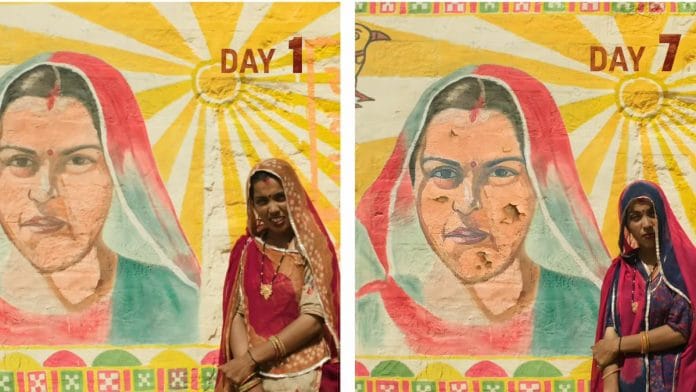


Pond’s latest campaign, Sun Portraits, has sparked debate across the advertising and marketing industry, raising questions around ethics, consent, and how effective purpose-led storytelling really is.
Created by Ogilvy, the campaign was executed in Phalodi, Rajasthan, with the objective to raise awareness about skincare. It featured large portraits of local women painted on their home walls using UV-sensitive material. As the sun exposure increased, the images faded gradually, to showcase long-term effects of sun exposure on skin.
However, what was meant to be a powerful visual metaphor has instead drawn criticism across social media. People are asking the brand about its intent and questions are also being raised around compensation, long-term support, and accountability.
Veteran PR and communications professional Dilip Cherian, also known as India’s ‘Image Guru’, called the campaign “diabolical.”
“At a time when many markets are privileged enough to access the most advanced research on the impact of ingredients in routine sunscreen products and reject mass manufactured protection, this is a desperate and clever marketing move. This is clearly a move to try to retain global market share and ensure their basic formulations get a new lease of life,” he said.
“Good marketing can often be very effective.That doesn’t mean that it is selling a good product,” Cherian added.
On social media, there is growing scepticism about the campaign’s intent. Many users said it seemed to be designed more for award recognition than real impact, with remarks implying that “anything is done for Cannes.” Given Ogilvy’s strong legacy at the Cannes Lions International Festival of Creativity, speculation around award-driven storytelling has only intensified.
This isn’t it. People are also questioning the campaign’s on-ground impact. Some asked whether the women received anything beyond a single sachet of sunscreen, while others argued the brand should have focused on education around sun protection and skin cancer.
‘Poor aftertaste’
Delhi-based brand expert Vishakha Talreja said that the campaign succeeds at first glance, drawing viewers in with a strong hook and engaging storytelling that feels easy to accept. However, as it unfolds, it begins to raise more questions than it answers.
She pointed out that it prompts a deeper reflection — “Are rural women working in extreme 51-degree heat truly preoccupied with how their skin looks and feels, or is the narrative being shaped to align with the product being promoted?”
In her view, if the concern were genuinely rooted in authenticity, the brand could have explored the issue with greater depth, focusing on the real consequences of prolonged sun exposure and investing in meaningful awareness and education, rather than leaning on visually striking yet somewhat gimmicky UV-sensitive portraits.
Talreja acknowledged the evident effort behind the storytelling but described the overall impact as “mixed”. While the idea appears powerful on the surface, it doesn’t fully translate into something that feels credible or enduring. The turning point, she noted, comes with the distribution of small sunscreen sachets, an element that feels jarring and diminishes the campaign’s intent.
“Visually, it feels transactional and even a bit cheap, almost as if the entire effort culminates in distributing sample-sized products rather than delivering real value. Perhaps this was just an oversight in the edit, and maybe full-sized products were actually given. But what the viewer sees is what they take away and here, it leaves a rather poor aftertaste,” she said.
Talreja further argued that this disconnect is intensified by the broader brand context. For purpose-driven storytelling to resonate, a brand must first establish a genuine commitment to people and move beyond outdated, problematic beauty narratives often rooted in patriarchal ideals. Building such credibility takes time and consistency; without it, campaigns like this risk appearing performative, undermining their own intent despite strong conceptual foundations.
Also read: Dettol’s new ad shows why emotional storytelling still sells
‘A highly sensitive market’
Adding another layer of critique, Cherian questioned the campaign’s underlying research on sun-induced skin cancer. He said that the narrative lacks nuance, particularly when considering populations that have long lived in extreme climatic conditions. According to him, there may be physiological adaptations or differing levels of risk that are not being acknowledged.
“Those who wander into the sun, unprotected after living lives completely screened from any exposure to daylight, let alone sunlight, the consequences could be materially different from those in Rajasthan, who are currently being targeted,” he said.
According to him, the anxiety is actually about chemicals and the necessarily cheap formulations that giant companies like Pond’s are likely to push in their efforts to create markets where none exist at the moment.
“These markets are highly price-sensitive, so their products are likely to include many chemicals that will not stand the test of time or the testimonies of markets where these are now being rejected, often in favor of a whole new range of options and better formulations,” he added.
This isn’t the first time a campaign has faced such scrutiny. In 2017, Pepsi drew backlash for an ad featuring Kendall Jenner that was criticised for trivialising protest movements, leading to its withdrawal. In 2018, H&M faced global outrage over a “racially insensitive” image of a Black child on its website. It later took down the photo and apologised.
Similar controversies have unfolded in India too. Fabindia, in 2021, had to withdraw its “Jashn-e-Riwaaz” Diwali campaign after backlash over its festive positioning.
Dabur removed its 2024 Karwa Chauth ad featuring an LGBTQ+ couple following strong opposition, and Tanishq had to take down its interfaith wedding ad in 2020 amid widespread debate over cultural sensitivity.
Brand: Pond’s
Creative Agency: Ogilvy India
Views are personal.
(Edited by Aamaan Alam Khan)