





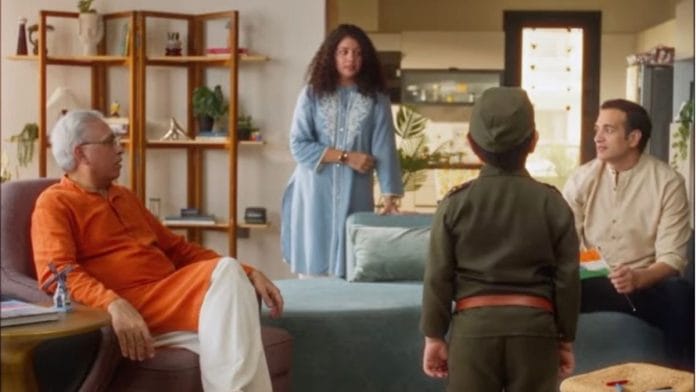


In a pointed call to break free from the everyday “chalta hai” attitude, Orient Electric’s #ChaltaHaiSeAzaadi campaign argues that the small compromises adults make can quietly become habits for the next generation.
The 60-second commercial shows a young boy learning “chalta hai” from his family. His father bribes a traffic cop after he is caught breaking a rule. His mother quietly slips a damaged Rs 200 note into a payment at a shop. His grandfather casually throws a packet on the ground. Each time, the boy watches and questions them, only to be told, “chalta hai”.
The lesson eventually reaches an uncomfortable extreme. The boy is about to place the Indian flag on the floor when his parents object, but he responds with the same words he has heard from all three of them: “chalta hai”.
The ad then turns the phrase on its head: “Chalta tha, ab nahi chalega.”
Moving away from the usual Independence Day ad
Directed by Karan Chawla and produced by Akankksha, the commercial is a welcome departure from the familiar Independence Day advertising playbook. Brands often reach for patriotism, the freedom struggle or grand declarations of national pride during the season. Britannia’s 2023 campaign, “1947% More History”, for instance, took audiences back to the freedom struggle through stories of India’s last living freedom fighters. Ambuja Cement’s “Saare Jahan Se Achha” brought religious harmony into the familiar imagery of the Tricolour, with two neighbours discovering that both green and saffron are needed to complete the flag.
Orient Electric chooses a smaller battleground: everyday behaviour.
The ad’s argument is simple. Breaking a traffic rule, being dishonest or bending the rules for convenience may seem inconsequential in isolation. But children learn by watching adults. When every small compromise is dismissed with a “chalta hai”, the phrase can become a way of life.
That is what makes the flag moment work. It is deliberately jarring because the boy is not suddenly behaving badly; he is simply applying the lesson he has been taught. The parents are forced to confront the fact that their own casual compromises have shaped his understanding of what is acceptable.
The commercial closes with the line: “Aaj ka ‘chalta hai’ kal ki aadat ban jaati hai. Chalta hai ab nahi chalega.”
The campaign does not pretend to solve a larger social problem,. Its proposition is modest: if we want things to change, we have to stop excusing our own small lapses first. And it doesn’t complicate the standards of patriotism by presenting it as a grand emotion or an act of sacrifice. It is only showing something much less glamorous — being honest, responsible and less willing to take the easy way out.
It also does not aggressively push the Orient Electric brand and its product does not hijack the message. At the end, a table fan from the brand sits behind the national flag, its breeze making the Tricolour flutter.
That is a smart choice. At a time when appliance brands are often busy telling consumers why their fans, wires and other products are superior to the competition, Orient Electric keeps its product in the background and allows the idea to take centre stage.
There is a larger shift behind this kind of Independence Day advertising. As advertising moved from newspapers and radio to television and, eventually, social media and reels, brands gradually moved beyond simply celebrating the nation. The 1980s had public-service messaging such as Doordarshan’s “Mile Sur Mera Tumhara”. Liberalisation in the 1990s opened the door to more overtly brand-led Independence Day campaigns. By the 2000s, brands were increasingly using the occasion to talk about civic responsibility, social change and contemporary India.
Orient Electric takes that evolution a step further by making freedom feel almost mundane. There is no freedom fighter, historical recreation or sweeping patriotic set piece at the centre of “Chalta Hai Se Azaadi”. There is just a family, a child and a series of small compromises. The commercial’s cleverest idea — that the “chalta hai” attitude is something adults teach their children without realising it — is perhaps a more uncomfortable Independence Day message than another reminder of how much we love the country.
(Edited by Prashant Dixit)