



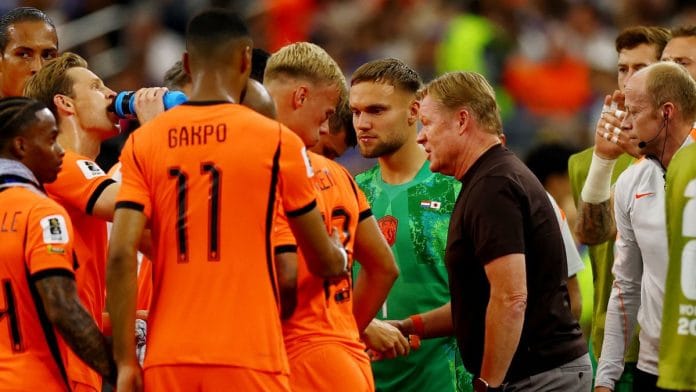

The 2026 World Cup’s mandatory three-minute hydration breaks could be easily called ‘Americanisation of football.’ The rule amendment has sparked discussion online, with many fans accusing broadcasters of prioritising ad revenue over the rhythm of the game. For critics, it’s proof that commercial interests in the US are shaping the world’s biggest football tournament.
FIFA had announced the hydration break policy in December 2025 for this year’s World Cup. Under the rule, every match will have two mandatory three-minute breaks, one in the 22nd minute and the other in the 67th minute. The breaks will be implemented across all 104 matches of the tournament.
FIFA said the decision was taken to help players cope with the summer heat in North America, where the tournament is being held. Several host cities, including Miami and Dallas, are known for high temperatures during this period.
What made the announcement unusual was that the breaks were made compulsory for every match, including games played in air-conditioned stadiums with closed roofs and in cooler cities such as Seattle. In previous tournaments, referees decided whether hydration breaks were needed based on weather conditions. This time, the breaks are mandatory regardless of the venue or temperature.
The decision led many to question whether commercial considerations had also played a role in introducing the policy.
So, the hydration breaks divide a football match into four quarters, rather than two. It mimics the structure of basketball. The match clock continues to run during the stoppages, as the lost time is added at the end of each half.
Players aren’t keen
One week into the tournament, and the players are not particularly in support of the hydration amendment.
Netherlands defender Virgil Van Dijk said, “If it’s really hot, obviously it will be good to put them in. But I think you have to look at it in every game separately, in my opinion.”
According to Belgium’s Youri Tielemans, “In some cities, it’s not that hot, and maybe we shouldn’t do it. But at the end of the day, if you do it in some cities, you should do it for everyone.”
From a weather aspect, very few of the games have actually met the level required to need a hydration break so far, according to weather expert Everton Fox.
Also read: What if men were judged for their vests like women are for their bras? XYXX’s new ad asks
Cannot ignore commercial appeal
The commercial appeal of these hydration breaks cannot be ignored.
Fox Sports and Telemundo together paid around $1.25 billion (that is over Rs 10,000 crore) for the US broadcasting rights to the 2026 World Cup, making it the most valuable territorial rights deal in World Cup history.
According to some reports, Fox and Telemundo are expected to generate around $850 million (Rs 7,400 crore) in advertising revenue from the tournament.
And, the way broadcasters handled the hydration breaks have only angered the fans. During the opening weekend of the tournament, Fox cut away to full-screen advertisements during the breaks.
The decision quickly drew criticism after the Mexico-South Africa match, when the network returned from a commercial after play had already restarted, causing viewers to miss several seconds of live action.
FIFA’s guidelines require broadcasters to return to the match at least 30 seconds before play resumes. On at least one occasion, Fox failed to meet that requirement.
Telemundo took a different approach. Rather than switching to commercials, the Spanish-language broadcaster stayed with the live feed, showing player discussions, coaching instructions, replays and studio analysis during the stoppages. The network turned this viewer-friendly approach into a selling point.
In India, the tournament is being streamed live on Zee5 online and Unite 8 for TV viewers. Unlike some international broadcasters, Zee5 has not used the hydration breaks to show advertisements. Instead, it fills the window with promotions for its own programming and returns to live coverage before play resumes, allowing viewers to watch players re-enter the field.
The reaction from fans on social media was swift. Many criticised the broadcasters for prioritising advertising revenue over the viewing experience, calling them greedy. For fans, the new commercial breaks are unnecessary, intrusive and something that breaks the momentum of the game.
Also read: Visa’s new ad only works because of Shah Rukh Khan. Nothing else matters
Are channels minting money?
Former Manchester United and England defender Gary Neville told The Overlap that the hydration breaks are a “stealth advertising break” with US broadcaster Fox using the hydration break to run commercials.
For now, though, the additional advertising opportunities created by the hydration breaks remain relatively small. Fox did not heavily promote the new ad inventory to advertisers before the tournament, and many media buyers had not planned for it because such breaks did not previously exist in football.
However, the value of these slots could rise sharply in future tournaments.
The 2022 World Cup final between Argentina and France attracted an estimated 1.42 billion viewers worldwide, far exceeding the audience for the Super Bowl. Given that a 30-second Super Bowl commercial can cost more than $10 million, some analysts believe World Cup hydration-break advertising could eventually command similar prices.
For decades, football has stood apart from many American sports because of its uninterrupted flow. By comparison, an average NFL game, as per a 2010 Wall Street Journal calculation, contains around 20 commercial breaks and more than 100 advertisements. Roughly one-third of a typical NFL broadcast is devoted to advertising.
That said, there has been no indication from world football’s governing body that hydration breaks are here to stay at World Cups.
Views are personal.
(Edited by Saptak Datta)