



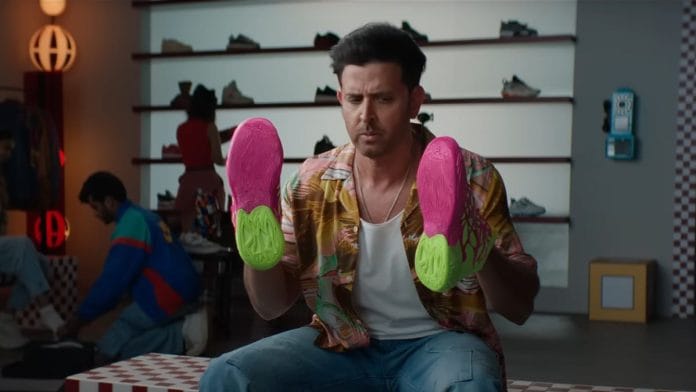
There are good ads and bad ads. Then there are some that shouldn’t be released. Hrithik Roshan’s recent collaboration with RuPay falls into the third category.
There are one too many issues with the commercial, starting with the collaboration itself. Hrithik and RuPay just don’t sync well. One can imagine the actor advertising things related to fitness, energy, dance, and style. RuPay card services? Not so much.
Brands must realise that the social media generation isn’t delusional. They won’t buy that Rani Mukerji uses Dabur Amla Hair Oil.
When TVS Jupiter got Amitabh Bachchan on board, the campaign failed. The audience wasn’t able to connect the grand image of Bachchan with the everyday, middle-class appeal of the scooter. Similarly, Rajdhani Besan recently made what can be called the worst brand collab when they teamed up with Ananya Panday and Karan Johar to advertise its product—besan.
A brand must choose a celebrity whose personal brand and popular image align with its own. Only then can a commercial connect with the consumers. For instance, Ayushmann Khurrana’s everyman image has worked well for Amazon Pay and Meta to advertise their services and security features.
Authenticity is key.
Protean, which develops e-governance solutions, successfully teamed up with Pankaj Tripathi to showcase the impact the Digital Public Infrastructure (DPI) has had on people’s lives. The storyline in the commercial was inspired by the actor’s real-life journey from humble beginnings to the peak of his career.
Spending crores to bring a high-profile star on board when there is no alignment between their persona and the brand’s identity is as ineffective as not running the ad at all.
It’s high time advertising teams and agencies realise that the blind charm of celebrity no longer carries the impact it once did.
Script is the culprit
RuPay rolled out a series of commercials to market the battle between Hrithik and Gen Z, portrayed by actors Mihir Ahuja and Rasha Thadani.
Both Mihir and Rasha are seen convincing “sir bro” Hrithik not to do the RuPay credit card ad. Raha says it’s because she wants “concert tickets and sneaker drops”, not “cassettes and CDs”. Mihir, on the other hand, just thinks Hrithik is too “Y2K”.
RuPay has placed its ‘instant payments and UPI-linked credit card’ in this chaotic setup, positioning it as a modern feature. But the script is so bad that one needs to watch the commercial several times to figure out the link.
The ‘Hrithik vs Gen Z’ storyline and RuPay card services are two ends of a spectrum that will never connect—making the commercial a textbook example on how not to advertise your services in a commercial.
Hrithik is the butt of the joke, an attempt to position the brand above the celebrity—except it doesn’t really work. The script aims to portray him as the fool, but it’s the entire commercial that ends up looking foolish.
Meanwhile, Mihir and Rasha are shown to be witty and relatable through Gen Z slang, but it comes across as incredibly forced and unnatural. Peppering the script with terms such as ‘drip’, ‘salty’, and ‘slay’ fails as a move to portray Gen Z culture.
Brands must move beyond slang and put their grey cells to good use if they want to actually connect with the younger generation.
Also read: Parle is trying to be Amul of Marie biscuits. But its ads lack the pun(ch)
Gen Z ad rulebook
Every brand wants to target Gen Z because they are the spenders in a household.
Brands are aware that most members of Gen Z wouldn’t think twice before taking the ‘add to card’, ‘make payment’, and ‘order placed’ route. Spending money is their way to cope with a heartbreak, celebrate even the smallest achievements, or simply deal with boredom.
The obvious route is stirring the done–to–death ‘millennial vs Gen Z’ debate. But when it comes to targeting Gen Z, are brands actually doing justice?
Most advertising agencies follow a rulebook when it comes to portraying Gen Z. It includes slang, hair colour, crop tops, baggy jeans, and a viral meme moment.
Some brands have followed the rulebook to roll out hit commercials. Think Myntra’s FWD commercial, featuring chess grandmasters Viswanathan Anand and Gukesh Dommaraju, or YouTube India’s Ganji Chudail makeover video.
But now, it’s old news. RuPay’s attempt to replicate those hits has created an ad that users of all generations will prefer to just ‘skip’.
Views are personal.
(Edited by Prasanna Bachchhav)