





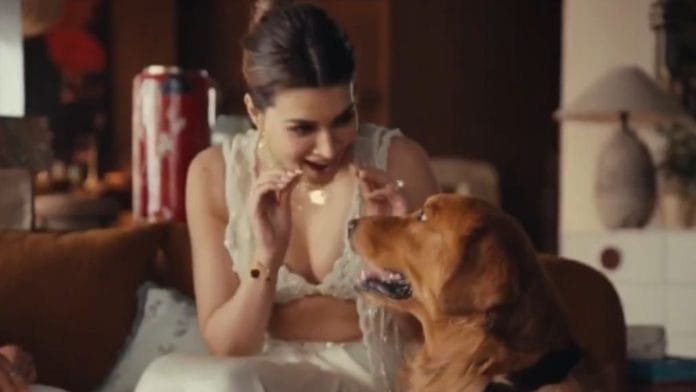

There is a new national emergency in advertising: a low neckline and a dog in a Raksha Bandhan ad. Somewhere between jewellery, outrage, and the internet’s moral-policing department, Giva seems to have lost the plot.
I am more disappointed in the brand than amused by the controversy. Not because Giva made the advertisement. But because when the predictable outrage unfolded, the brand didn’t seem to have the courage to back their own creative or the backbone to stand by Kriti Sanon, who very rightly said, “Culture is in the heart, not the neckline.”
You cannot claim to believe in an idea only until the comment section gets angry. The advertisement was a creative decision made by the brand. Once Giva approved, produced, and published it, the responsibility to defend that creative choice was as much the brand’s as anyone else’s. Sanon should not have been left to individually defend a campaign that she was hired to be part of.
Instead, the brand chose the safest route. And safe advertising rarely brings a change or makes anyone remember the brand for the right reasons.
What is traditional clothing?
The advertisement starring Sanon came under fire after several people on the internet claimed it was “hurting religious sentiments”. Some users criticised Sanon’s outfit, arguing that her blouse was too revealing for a family celebration. In the ad, Sanon is wearing a bralette-style blouse with a plunging neckline. Some even had a problem with Sanon tying a rakhi to a dog.
The outrage over the outfit raises a question: what qualifies for traditional Indian clothing?
For much of Indian history, there was no fixed concept of a fitted and covered blouse or a salwar-kameez as we know it today. Women commonly wore a single length of unstitched fabric, sometimes leaving the upper body bare or loosely covered. This is not me, the feminist, saying it. This is visible across centuries of temple sculpture, from Sanchi and Bharhut in the early centuries BCE, through the Gupta period, to the temples of Khajuraho and Konark, where women, including deities and celestial figures such as apsaras and yakshis, are depicted in similar draped styles.
The stitched blouse that covers the upper body as a standard garment is a much later development. Its widespread adoption is often associated with colonial-era ideas of modesty in the 19th century.
That said, there is no pressure to like the ad. Advertising can be criticised. Creative choices can be questioned. But such intense pushback for a piece of clothing is absurd.
Brand expert Vikrant Pandey called Giva’s “rakhi for pets” proposition a great idea, but felt the brand goofed up with Sanon’s outfit. According to him, it became a “confused ad with misplaced focus”, thereby losing what could have been a great opportunity.
On this particular point, I do agree with Pandey.
The brand was clearly trying to connect with pet lovers, and that isn’t exactly a questionable marketing strategy. Scroll through social media for five minutes and you’ll be bombarded with videos of pet parents treating their dogs and cats as their own children. The emotional bond people share with their pets is very real, and Giva was hardly wrong for trying to tap into it.
The problem, according to Pandey, was Sanon’s outfit, which ended up overpowering “the whole essence of the pet as a saviour.”
“The ad surely managed to increase their brand recall, if that was the sole purpose of the ad. The whole proposition of pets was lost. Would it lead to sales? It is a big question unanswered. Possibly with the negative feedback, most prospective customers would shun the brand,” Pandey said.
Also read: Berger Paints’ new ad proves you don’t need a celebrity to stand out
A long, exhausting history
Indian advertising has a long and rather exhausting history of running into the “hurt religious sentiments” backlash, particularly when advertisements involve interfaith imagery, festivals, religious rituals or attempts to reinterpret tradition.
Tanishq’s 2020 Ekatvam advertisement showed a Muslim family hosting a traditional South Indian baby shower for their pregnant Hindu daughter-in-law. The tagline described it as a “beautiful confluence of two different religions, traditions and cultures.”
Within a day, #BoycottTanishq was trending on Indian social media. The company faced accusations of “hurting” Hindu sentiments, and critics labelled the advertisement “love jihad propaganda”, referring to the unsubstantiated claim of a coordinated campaign by Muslim men to convert Hindu women through marriage.
Tanishq ultimately withdrew the advertisement within 48 hours, saying it was “deeply saddened with the inadvertent stirring of emotions” and that it was withdrawing the film keeping in mind the sentiments and wellbeing of its employees, partners, and store staff.
A year later, Fabindia found itself in an almost identical storm.
The brand named its Diwali collection “Jashn-e-Riwaaz”. Then-BJP Yuva Morcha president Tejasvi Surya called it a “deliberate attempt of abrahamisation of Hindu festivals”, objected to the styling of the models, and demanded that the brand “face economic costs for such deliberate misadventures.”
Then came Manyavar/Mohey’s ‘Kanyamaan’ campaign featuring Alia Bhatt. The advertisement reimagined the Hindu ritual of kanyadaan, traditionally understood as the father “giving away” the bride. Bhatt’s character questioned the patriarchal framing of the ritual.
For this, she was accused of “performative wokeness” and of hurting Hindu religious sentiments. Kangana Ranaut, a usual suspect, also weighed in, urging brands not to “use religion, minority, majority politics to sell things” and accusing the campaign of mocking Hindus and their rituals.
This just shows absolutely anything can hurt religious sentiments. Show a Hindu-Muslim relationship or question a ritual, use a festival differently or show a woman wearing something some people consider too revealing — everything leads to a controversy. And, now even a dog needs to pass the cultural sensitivity test.
So, the next Giva campaign should just have a necklace, a completely covered woman, and absolutely no dogs. At least then we can all sleep peacefully, secure in the knowledge that Indian culture has once again been saved from a plunging neckline and a Labrador.
Views are personal.
(Edited by Aamaan Alam Khan)