





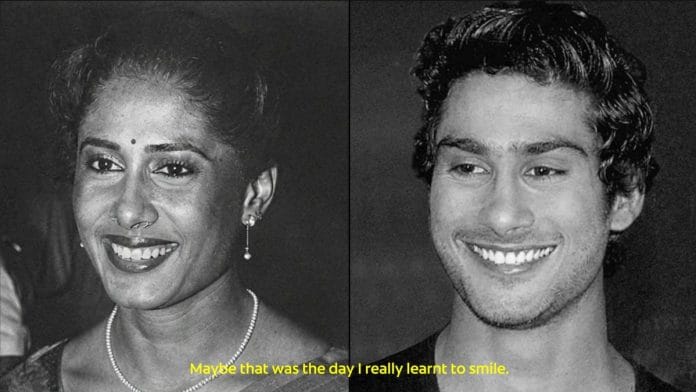


Colgate’s advertisement featuring Prateik Smita Patil feels less like a conventional commercial and more like a video essay unfolding through snippets of his childhood. The ad opens with Smita Patil’s iconic smile playing on a 90s TV set, with the text “Smita Patil had one of the most beautiful smiles in Bollywood.”
Colgate’s “The Boy Who Learnt to Smile” is steeped in both India’s collective nostalgia for Patil and her son Prateik’s personal memories (or lack thereof) of her. He delivers the first dialogue in the 2-minute-video in an extreme close up shot—“She died giving birth to me.”
Prateik speaks about growing up with only his mother’s photographs and the memory of her smile for company. He weaves through sadness, longing, frustration and joy as the camera captures him in a house filled with black-and-white photographs of Patil
In the ad, created by Ogilvy India and directed by Amit Mishra, Prateik watches her on a theatre screen. It’s a personal experience for him and a callback for a generation who grew up admiring Patil.
He shows his photos as a child, how he used to smile, and recalls his nana (mother’s father) asking him to smile like her.
“Of course I have her blood running through my veins, but I never met the woman, you know,” he says.
Prateik takes the audience to the “day he really learnt to smile.” It was after his first film, Ekk Deewana Tha (2012). Headlines from reviews fill the screen, comparing Prateik to his mother.
Prateik never utters the brand name, but instead alludes to Colgate’s core message—of taking care of one’s teeth.
The screen cuts to images of Patil next to a box of the toothpaste and Prateik says, “I’ll tell you what, the woman had a damn good smile. And I better take care of it.”
Also read: Why Pond’s is facing heat over its new sunscreen campaign
Storytelling over science
The ad uses memory and emotion to connect the audience to the brand instead of exaggerating the brand’s unique selling point.
It stands out from other Colgate ads—where white lab coats and the “kya aapke toothpaste mein namak hai” tagline reign supreme.
Here, they’ve relied on storytelling over science. Through Prateik’s narration, Patil no longer feels like a legend Bollywood has lost; she feels alive in recollection.
The ad belongs to a genre of advertising that builds the brand’s image as opposed to selling its products. That’s why its success lies in talking less about toothpaste and more about how a smile can become immortal, surviving through stories, photographs, and the people left behind.
Also read: Dettol’s new ad shows why emotional storytelling still sells
Long-lasting trust
Nostalgic storytelling is one of the most-used tools in advertising, but it’s not always done right. Prateik’s story works because it’s not just those who remember Patil that it will connect to. It’s a sentiment that everyone who’s lost someone can relate to.
But nostalgia doesn’t always have to be sad.
In 2011, McDonald’s advertised their Mc Aloo Tikki in an ad with Sara Arjun. Once the actor’s popularity skyrocketed after Dhurandhar, they brought her back for a recreation of the ad in 2026. This time selling the new Buddy Meal. The frame, location, and vibe remain the same; only the characters have grown up. All the while McDonald’s slogan remains unchanged “I’m Lovin’ It.”
Coca-Cola India relaunched 80s favourite RimZim soda with the beats of RD Burman’s iconic song Duniya Mein Logon Ko, playing in the background. In this case, both the product and the ad are steeped in nostalgia.
Ads that rely on nostalgia blur the lines between the present and the past. This is often done to show how a brand remains everlasting and trusted in the memory of its target audience.
(Edited by Theres Sudeep)
While using real name and people.. is Prateek accepting he is using this specific product brand?
Else… He is into making money over dead peoplea name