





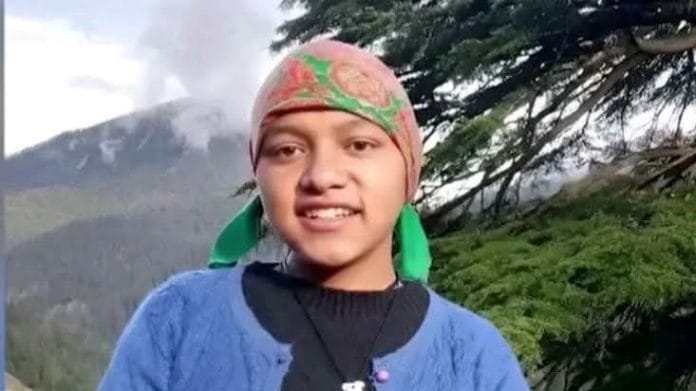

New Delhi: BJP MLA Bhupal Ram Tamta met Sumitra’s family in Uttarakhand’s Chamoli district on Tuesday, two days after the 19-year-old’s body was recovered from the Nandakini river, around 20 kilometres downstream from her village. Tamta spoke about the family’s grief and said her death was linked to a ritual that forces menstruating women to leave the village to bathe.
“They are grief-stricken. It was the ritual that killed her, whether the family admits to this or not,” Tamta, who represents the Tharali Assembly constituency, told ThePrint.
On 15 August, Sumitra, from Sutol village in Chamoli district’s Nandanagari block, was swept away by a local stream. The Nandakini river, swollen by monsoon rains, carried her downstream. Her body was recovered on Sunday.
Sutol, a village of roughly 150-160 people across about 20 families, follows a tradition that bars menstruating women from bathing in the village’s local water bodies. They are instead required to walk several kilometres outside the village to bathe and wash their clothes. Sumitra was menstruating and was forced to leave the village.
The practice is linked to Bhumiyal Devta, an ancient and revered deity in the region. The presence of menstruating women in areas associated with the deity is considered impure and offensive. As a result, women are expected to leave the village during menstruation to attend to basic hygiene.
A police officer, speaking to ThePrint on condition of anonymity, said Sumitra’s family had initially lodged a missing-person complaint after she disappeared. Her body was recovered the following day. The family performed her last rites on the riverbank, the officer added.
“This has been the case with many communities in Uttarakhand. This practice is very prevalent. Women need to bathe in this river, which is much further away, in order to rejoin society after they are done menstruating,” said Aranya Ranjan, a social activist and president of the Uttarakhand Jan Jagriti Sansthan.
What happened in Sutol sits within a much larger regional pattern of exclusion and social taboo. Activist and postdoctoral candidate Shiwani Pandey described how, in parts of rural Uttarakhand, women are required to eat separately, avoid touching other family members and even sleep apart.
A 2019 study of the Pindar Valley, close to Chamoli, found that more than 90 per cent of women slept in cattle sheds or near animals while menstruating. Even in Kullu, Himachal Pradesh, a survey found that women were confined to cattle sheds in 91 of the district’s 204 panchayats.
“Toilets have been made by the government for ages, but women are not allowed to use those. Now they are in a dilapidated condition and are unusable,” Pandey recalled growing up in the region while speaking to ThePrint.
“History remembers women like Sunita Williams. But who will write the history of women in rural India who are dying because of traditions like these? We celebrate a pregnancy but not the process that makes it possible,” Pandey said.
(Edited by Prashant Dixit)