





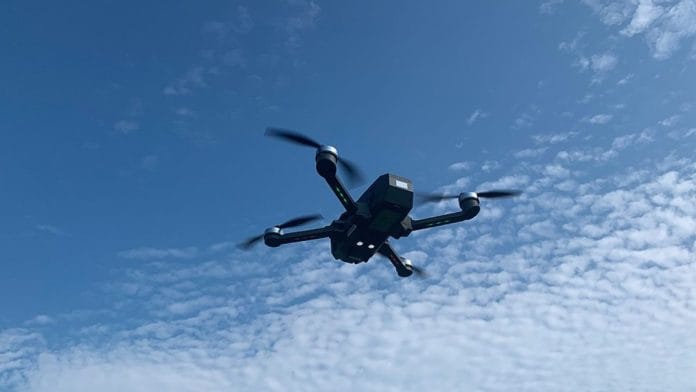


New Delhi: Several institutions in the US are installing pepper-spraying drones to counter the shooters at a time when school shooting incidents are on the rise in the country. As of now, the system, which is inspired by drone warfare tactics in Ukraine, will be implemented in four schools in Georgia, three in Florida, and one in Colorado.
The drones, designed and manufactured by Campus Guardian Angel, a Texas-based security startup, can also break through windows and ram into offenders at 60mph.
“Most victims are shot within two minutes,” the company states in a demo video. “Our drones can confront the shooter in 15 seconds, buying critical time for first responders to arrive. Our drones cruise at 30mph to 50mph inside the building and sprint at 100mph outside. (It) can cross a high school campus in 8 seconds, two minutes faster than an officer on foot. We place multiple boxes of 6 drones at locations throughout the school.”
The drones will be using digital twin technology. It uses high-tech sensors and cameras to scan the school building. They import this data into software to build an exact virtual map of the campus. During an emergency, the company’s Austin-based operators open this digital model. The software overlays live video feeds, sensor streams, and the real-time locations of teachers, students, and the drones directly onto the 3D map.
“Once I get the drones on you, you just can’t escape them,” Bill King, co-founder of Mithril Defense, the parent company of Campus Guardian Angel, told The Washington Post.
Founders of Mithril Defense confirmed that the widespread use of First-Person View (FPV) drones in the Ukraine War inspired them to build a school defence system.
Khristof Oborski, tactical operations director of the company, told Barron’s that King closely observed the raw effectiveness of small, agile drones used on Ukrainian battlefields.
“He started thinking about how can you introduce this type of system to be able to combat a growing problem in the United States – with school shootings,” Oborski added.
‘First 120 seconds are crucial’
Teachers will have two distinct tools to summon the drones during an emergency: a mobile application and classroom panic buttons.
According to Justin Marston, CEO and founder of Mithril Defense, the project was inspired by the 2022 massacre at an elementary school in Texas, where 19 students and two teachers were killed while law enforcement waited over an hour to enter the classroom.
“The first 120 seconds are incredibly critical, because that’s when most of the shooting happens,” Marston told The Washington Post.
Not all are, however, in support of deploying drones inside school buildings.
“These drones aren’t patrolling – they just pop up when needed. So that’s part of the problem. We need to focus on the prevention piece rather than the reaction piece,” a school shooting victim’s father told WPTV.
Meanwhile, critics and safety advocates have raised serious concerns about the drones stunning children and being hacked by malicious actors.
Jaclyn Corin, a survivor in the 2018 Florida high school shooting, said,
“School districts have finite budgets and limited attention. If we spend significant resources on technologies designed to respond after shooting begins, we have to ask what we’re not investing in instead.”
Also read: The curious case of India’s tiger paradox. Tiger numbers are rising, so are deaths
‘Traumatised children’
According to The Washington Post Tracker, since 1999, 435 school shootings have exposed nearly 4,00,000 students to gun violence.
“Beyond the dead and wounded, children who witness the violence or cower behind locked doors to hide from it can be profoundly traumatized,” states the tracker.
Additionally, the tracker also points out that children of colour experience campus gun violence at higher rates, with Black students facing over three times the exposure and Hispanic students more than twice the exposure compared to White students.
“Almost all the deadliest assaults were committed by White gunmen, a reality that has left much of the public with the false impression that school shootings almost exclusively affect White students,” states the tracker. “At schools with majority Black student bodies, shooters typically target a specific person, limiting the number of people shot — and the subsequent media exposure.”