



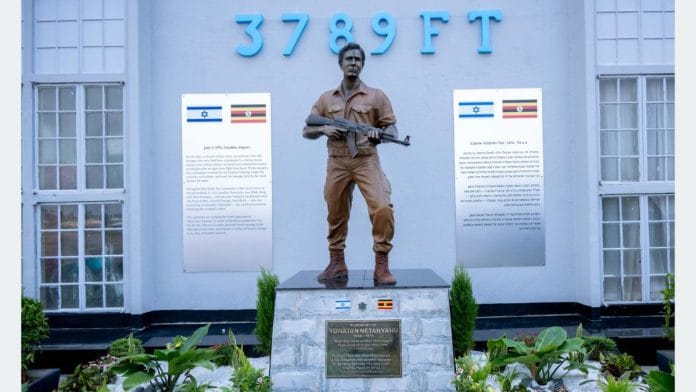
New Delhi: Uganda’s military unveiled a statue of Yonatan Netanyahu, the older brother of Israeli Prime Minister Benjamin Netanyahu, at the old Entebbe airport terminal in early August. This is happening nearly 50 years after he was killed while leading an Israeli hostage-rescue operation there.
The bronze statue, depicting the younger Netanyahu standing with a machine gun, was unveiled by Uganda’s army chief Gen Muhoozi Kainerugaba, who said that he has commissioned the monument to mark the 50th anniversary of the Entebbe raid.
The ceremony came days before Uganda’s parliament approved the deployment of Ugandan troops in Gaza as part of the controversial International Stabilisation Force, according to Middle East Eye.
“Today, this memorial stands not only in remembrance of a distinguished soldier, but also as a tribute to the enduring values he embodied: courage in the face of danger, unwavering commitment to protecting innocent lives, and steadfast devotion to duty,” Kainerugaba said at the ceremony, according to the Associated Press.
Kainerugaba also described the monument as carrying significance beyond the commemoration of one soldier.
“Monuments are more than stone and bronze. They preserve memory, teach history, and inspire future generations,” he said.
Also read: South Indian states need their own CAQM, says study
Israel-Uganda changing nature of ties
The Entebbe raid had taken place in July 1976 after an Air France flight travelling from Tel Aviv to Paris was hijacked by two Palestinian and two German militants and diverted first to Libya and then to Uganda. The hijackers separated Israeli and Jewish passengers from the others and demanded the release of Palestinian prisoners held by Israel. Most non-Israeli hostages were subsequently released.
Israel then sent special forces to Entebbe without the consent of the Ugandan government. The commandos stormed the airport on 3 July and rescued more than 100 hostages. Yonatan Netanyahu, who commanded the Israeli assault force, was the only Israeli soldier killed in the operation. Dozens of Ugandan soldiers were also killed.
The raid became one of the defining military episodes in Israeli history. Benjamin Netanyahu has previously said his brother’s death changed the course of his life, while the operation itself became a central part of Israel’s national narrative.
In Uganda, however, the operation has historically been viewed differently. Uganda and the Organisation of African Unity, which had condemned the Israeli raid at the time, had described it as an assault on Uganda’s sovereignty and territorial integrity. This is why the statue’s unveiling has therefore prompted criticism from some Ugandans.
Asuman Kiyingi, a former minister of foreign affairs for regional affairs, called the symbolism “troubling” and urged that the monument be removed. Writing in The Observer, he questioned the decision to honour the commander of a foreign military operation while Ugandan soldiers who died defending the airport received no comparable recognition.
“It reinforces a hierarchy in which foreign military power is glorified while African sovereignty is diminished,” Kiyingi wrote, according to Middle East Eye.
Kainerugaba, however, also acknowledged the Ugandan soldiers who fought during the raid.
“We also recognise today the Ugandan soldiers who fought valiantly that day in what they believed was a justified cause,” he said.
He added that Idi Amin’s government was “a brutal dictatorship which did not represent the Ugandan people in any way”.
The monument comes against the backdrop of steadily deepening Uganda-Israel relations. Israel had developed close ties with Uganda after its independence, including cooperation in infrastructure, military training and education. Relations deteriorated after Idi Amin took power and Uganda severed diplomatic ties with Israel in 1972.
Under President Yoweri Museveni, ties gradually improved. Museveni visited Israel several times and, in 2016, joined Benjamin Netanyahu at Entebbe to mark the 40th anniversary of the raid. Museveni said at the time that Israel had been right to rescue the hostages, while also supporting Palestinian statehood.
Meanwhile, Uganda continues to back Palestinian statehood and has supported UN resolutions critical of Israel, even as it maintains cordial relations with Tel Aviv.
In September 2024, Kampala had voted for a UN General Assembly resolution demanding an end to Israel’s presence in occupied Palestinian territory within 12 months. However, it has not joined South Africa’s International Court of Justice case against Israel.
(Edited by Ratan Priya)