





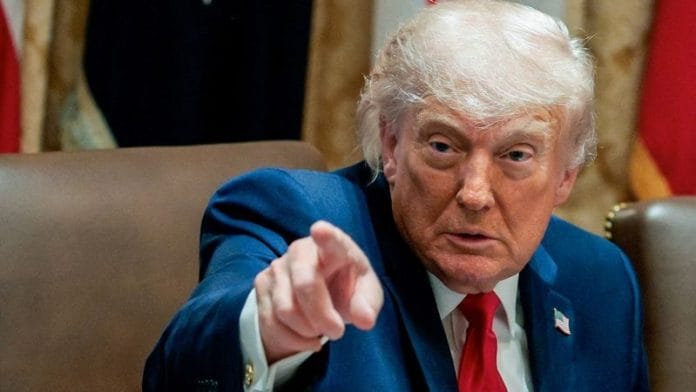


New Delhi: US President Donald Trump on Wednesday suggested that artificial intelligence companies could return benefits directly to the public.
Speaking to reporters in the Oval Office, Trump said, “I am going to have meetings with the top 12 or 15 executives very shortly, and we’re talking about giving back something to the public, and if we do that, the public will become very rich”.
“I think they’ll do that, and I think it’ll make it very popular,” he added.
Trump did not elaborate on what form such a public benefit would take, but his remarks come amid growing debate in Washington over whether the economic gains generated by AI should be shared with the public.
The idea has also been promoted by OpenAI CEO Sam Altman. According to a recent report by NOTUS, Altman raised the concept with Trump last year, and discussions between OpenAI and the administration have intensified in recent months.
Additionally, last week, Bernie Sanders, an independent senator from Vermont, proposed the creation of a sovereign wealth fund that would take significant stakes in leading AI firms. Sanders argues that AI is built on the accumulated contributions of society and that the public should therefore have a share in its profits.
“The American people understand that the economic system is rigged,” Sanders told The Washington Post. “The rich are getting richer, working people are going nowhere in a hurry.”
Republicans’ concerns
The proposal has since sparked debate across political lines and has drawn scepticism from many Republicans who have expressed concern that government ownership of private AI companies could undermine free-market principles.
Senator Mike Rounds warned that government investments in specific companies could skew competition.
“I’d rather have open competition and not have the government favour one particular type of product because they have a stake in it versus another,” Rounds told NOTUS.
While Senator Tim Kaine said he was open to discussion, he also questioned whether government ownership could compromise fair bidding processes for governmental contracts.
“I would be open to the discussion. Here is the issue. … The [Defense Department] has done a deal or two in this space and it makes many other companies feel like, ‘well, wow, in the bidding process, we’ll never win that, because they’ll always put their thumb on the scale for the one where they have the stake.’ So how do you square something like that with the virtues of the bidding where people ought to be able to compete and if they are the best product, win the competition?” Kaine told Semafor.
Even Senator Josh Hawley, who has supported a stronger government role in AI regulation, expressed reservations.
“I’m not a huge fan of government ownership where you have big government owning Big Tech,” Hawley said, while indicating that he was more receptive to the idea of a sovereign wealth fund.
Conservative economist Stephen Moore, former senior economic advisor to Trump, also criticised the proposal.
“There’s a lot of angst over this idea of the government taking shares in private companies,” Moore said. “It’s not the proper role for the federal government.”
Also read: Judges, minister went to London badminton event. Who’s heeding Modi’s austerity call?
What the tech industry says
So far, other major technology companies appear to be treating the proposal cautiously.
Speaking at a policy event in Washington, Joel Kaplan, Meta’s Chief Global Affairs Officer, said that the company has not focused heavily on Trump’s suggestion. Instead, Kaplan said, Meta’s discussions with government officials have centred on policies that would support AI development and help the US compete with China.
“Honestly, it’s just not something that I’ve spent — we’ve spent a ton of time on,” Kaplan said during POLITICO’s Energy Summit in Washington when asked about the notion of the federal government taking a “sizable equity stake” in Meta or other AI developers.
(Edited by Aamaan Alam Khan)