


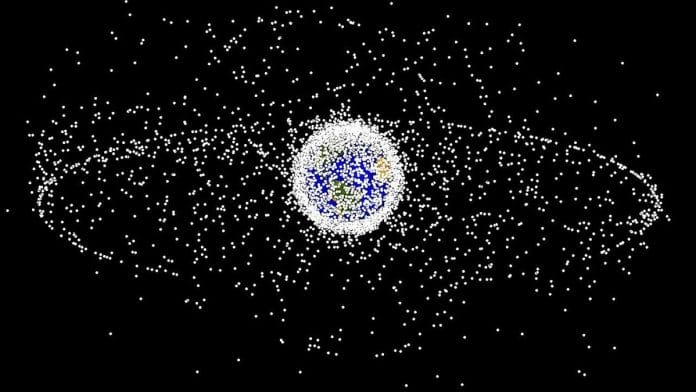
New Delhi: A new report released by the European Space Agency (ESA) has warned that not enough satellites are leaving heavily congested orbits in space at the end of their operational lives, increasing the risk of collisions in the future.
In its 2026 Space Environment Report, ESA warned that the Earth’s orbital environment was becoming increasingly congested as commercial satellite constellations continued to expand.
The space agency highlighted that countries will need to focus on active debris removal to ensure that the growth in orbital objects do not lead to collisions in the future, which would cause more space debris. Scientists described this as the Kessler syndrome, which refers to a scenario where the density of objects in low Earth orbit becomes so high that a single collision triggers an unstoppable chain reaction of more collisions and space debris.
“ESA’s Space Environment Health Index, designed to summarise long-term sustainability with a single figure, found that in 2025, the long-term effect of current space activities became an order of magnitude worse in one year,” the report, produced by ESA’s Space Debris Office, read.
The ESA Space Environment Report is an annual exercise aimed at providing an overview of global space activity and assess whether international debris-mitigation measures undertaken by different countries for improving sustainability of spaceflight, were actually being implemented. The 2026 report was based on data collected up to the end of 2025, excluding the projects still being prepared for launch, the space agency said.
More satellites are entering Earth’s orbit
In its report, ESA also pointed to the changing behaviour of constellations, including a trend of constellations shifting altitude significantly with each year. The report introduced a new metric in the 2026 document, which focused on the on-ground casualty risk of reentries.
“The probability (of on-ground casualties) remains low relative to everyday risks, but has increased in recent years due to higher levels of traffic,” the report read.
The report said that more than three intact satellites or rocket bodies were re-entering Earth’s atmosphere each day on average, while around ten new payloads were launched daily. Its projections show a “worrying” year-on-year deterioration, with expected numbers of objects and collisions in low-Earth orbit rising sharply, even after shortening its projection horizon from 200 years to 100 years.
While the report acknowledged that the interest and the adherence to debris mitigation measures had increased in recent years, these efforts need to be more consistent and reliable.
(Edited by Aakriti Handa)