




New Delhi: Lawyer Jayashree Parihar powered through a punishing circuit of sprints, heavy sled drags, and burpee broad jumps. The former track athlete had spent weeks training for her debut at Hyrox, a branded international fitness competition. By the end, she and her partner Kunal Nath were on the podium with a third-place finish in mixed doubles, but she couldn’t shake a sense of deja vu.
“It was like it had taken me back to my school sports day,” she said of the first Delhi event last July. It is this ‘familiar’ nature of Hyrox, when coupled with hefty fees, that has led to a heated social-media discussion around the brand in India. It’s packaged as a fitness contest for “every body” and can look like a glorified gym routine, yet is still priced like a five-star luxury experience.
The debate flared up after Hyrox Bengaluru on 11 and 12 April this year, where more than 8,000 participants paid roughly Rs 9,000 each to compete, though fees varied across categories. While many flexed their accomplishments on Instagram, there was scepticism too. In a viral tweet, Ankit Kedia, who describes himself as ‘Negotiation faculty at INSEAD’, claimed the event minted “Rs 8.1 crore in a single day” and noted it “feels less about fitness and more about validation”.
Among the over 300 comments, some agreed, while others argued that the criticism was unfounded, noting that people spend much more money for “validation” anyway, including on weddings or buying a car. “Less than $100 bro to have fun,” said one.
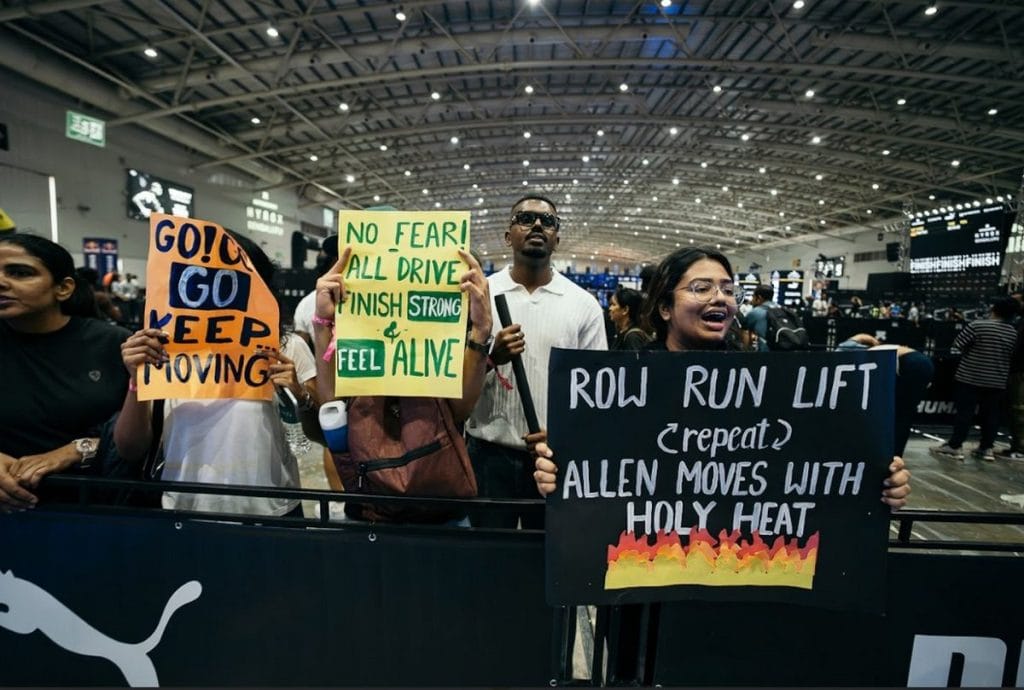
Hyrox, a global fitness competition launched in 2017 in Germany by sports entrepreneurs Christian Toetzke and Moritz Fürste, is now held in over 85 cities in 30 countries, with more than 650,000 participants in 2025 alone. It positions itself as bridging the gap between traditional endurance events and functional fitness to create a race format that’s accessible for all.
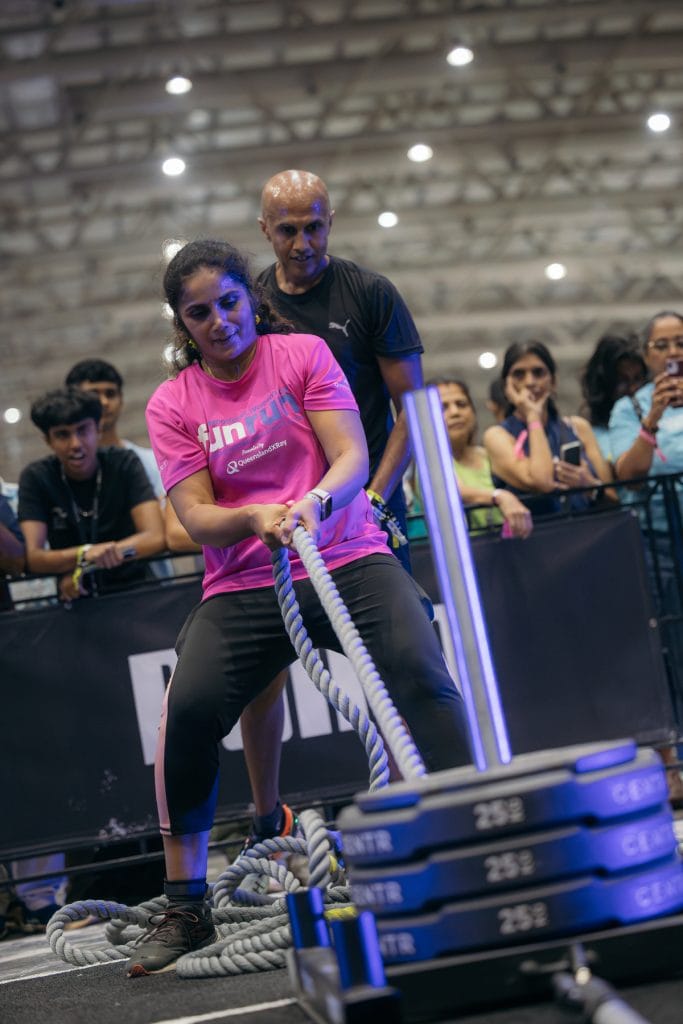
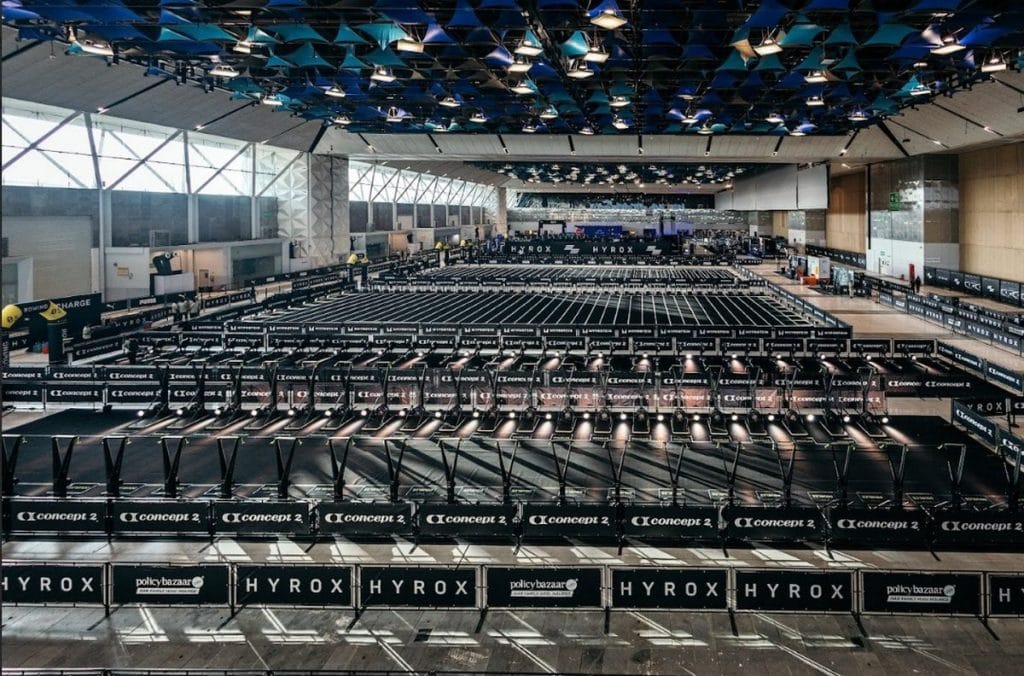
The format is fixed: a 1-kilometre run followed by a functional workout station, repeated eight times. The stations cycle through SkiErg, sled push, sled pull, burpee broad jumps, rowing, farmer’s carry, sandbag lunges, and wall balls, with weights scaled across Open, Pro, and male and female categories. Races are held indoors, typically in exhibition grounds, and are structured across four main categories — Open, Pro, Doubles and Relay. The age groups range from 16 to 85-plus, and no prior qualification is required.
Since its 2025 India debut in Mumbai and Delhi, the scale has ramped up. The upcoming Delhi edition (July 24-26) has expanded from a one-day event to a three-day competition. While there were 2,600 athletes in Delhi last year, Bengaluru’s ‘Ultrahuman Hyrox’ saw 8,200 participants this month.
“We’re anticipating about 10,000 to 10,500 participants,” said Deepak Raj, country head of Hyrox India, referring to the upcoming Delhi edition.
For him, the format fills a gap in India’s fitness ecosystem as a competitive and community-building outlet for gymmers.
“Runners have marathons, endurance athletes have Ironman, team sports have leagues. But the gym-going public never really had a race to work towards,” he said.
Also Read: The secret lives of young India in small-town gyms. Dumbbells, desire, freedom
Not about money or medals
Shivangi Tawade is in it for the long haul. Having finished third in the Open Women’s Relay category at Delhi Hyrox 2025, the full-time lawyer is already gearing up for the next edition.
“It’s to keep my reputation, because I already got a podium once,” she said.
Strength-training has been part of her fitness routine for years, but she prepares rigorously for Hyrox three months prior to the race. Hyrox is a personal yardstick for her, a way “to judge yourself and see how far you’ve come and where you stand.”
She added that barriers to entry are still relatively low, although the Pro category—the only one with prize money—attracts professional athletes from across the world, edging out others. The last Delhi event saw competitors from 39 countries.
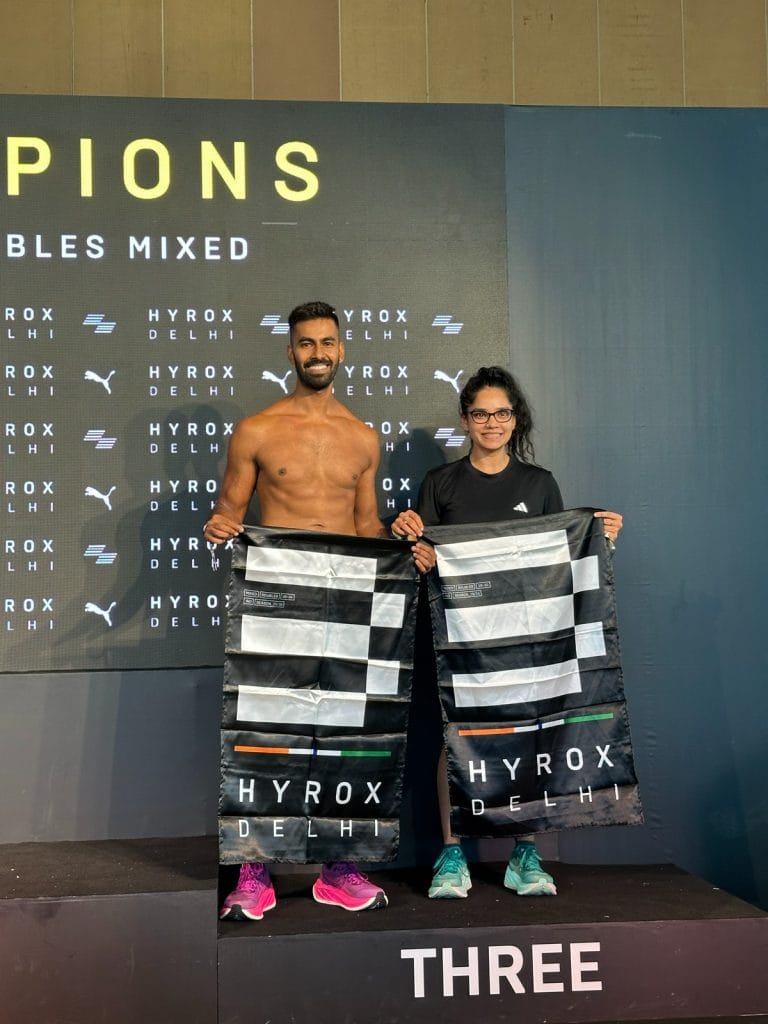
For Parihar, too, it’s all about the challenge. In mixed doubles, she has to lift weights equivalent to the men’s open category, rather than the lighter loads in the women’s division.
“From a women’s aspect also, I want to keep testing myself, how fast I can be, how strong I can be, and what is it that I have to do more in order to compete in a setup like mixed doubles,” she said.
Balancing Hyrox with a full-time job comes down to discipline. While she trains as a runner throughout the year, she begins specific Hyrox preparation five to six weeks before competition. It also means getting the same amount of work done at her job in less time.
“Time management is the most crucial aspect,” she said. “I need to ensure that I’m way more efficient in my job also.”
Beyond competitive zeal, the camaraderie of the event is also what keeps her hooked.
“Everyone’s suffering, everyone’s in pain, and it’s literally everyone putting their best foot forward,” she said.
Inclusivity is built into the structure of the race itself. To ease the fear of “coming last”, participants from different age groups start in staggered intervals every 10 minutes throughout the day, allowing a three-hour athlete to finish alongside a sub-60 athlete.
“Most people show up to get better, to beat their previous time, to be fitter, and to be part of a community,” added Raj.

The lack of a traditional payoff has not hurt its appeal. There is no prize money or even medals at the event—just a flag for those who make the podium. Cash is reserved only for the top 15 at the World Championship level.
The absence of a traditional medal is intentional.
“You can’t wear a medal all year,” Raj said. Instead, participants receive patches and memorabilia that can be displayed more visibly. And then there are the photos, which become a kind of badge of honour on social media.
Fitness at a premium
In India, Hyrox sits at an uneasy intersection. It is marketed as an “inclusive” race, yet it comes with its own obstacle course of access barriers.
The average ticket price, excluding add-ons and GST, stands at Rs 7,242 for an individual participant, Rs 6,953 for doubles, and Rs 567 for spectators. In comparison, marathon registrations in India typically range between Rs 1,000 and Rs 5,000.
Training for Hyrox also requires access to specific equipment, including SkiErg machines, sleds, rowing machines, sandbags, and wall balls, available only at select gyms. That often means signing up at affiliated or specialised centres. In Delhi, a Hyrox-affiliated gym in Janakpuri offers packages ranging from Rs 5,000 a month to Rs 8,000; by contrast, usual memberships cost around Rs 3,000.
Those who are serious about competing can set themselves back by tens of thousands of rupees. At DopaFit in East of Kailash, training can cost Rs 13,000 per month for a three-month programme with sessions three days a week. At NinjaX in Hauz Khas, Hyrox-focused classes run at Rs 1,000 per session, alongside regular memberships of Rs 7,000 per month. In Gurugram, Bosmiso operates on an annual membership of Rs 30,000, with additional simulation sessions.
Parihar acknowledged that the costs do rack up, though she expects that to even out over time.
“Our gym, Knox, has the equipment for Hyrox but not too many gyms do. So you will have to pick an additional price to ensure that you have access to that kind of amenity. But right now, the ecosystem is not yet developed fully. So that just adds on to the costing aspect of it,” she said.
Raj, however, pushed back on the idea that Hyrox is inherently exclusionary. He pointed to participation data to argue that the sport is broader than it appears, with athletes from 150 to 200 towns and cities, women making up roughly a third of participants, and age groups ranging from 16 to over 70.
“That, to me, is inclusivity,” he said. “People often look only at the registration fee, but fitness itself is an investment across sports. You can run anywhere, you can train with bodyweight, and gym memberships exist at different price points. Accessibility has to be looked at holistically.”
Also Read: Inside a night walkthrough at Delhi’s National Museum—ghosts, Buddha, and Mughal paintings
Pulling no punches
On social media, the debate is polarised. One critic cited the event as an example of “class inequality”, noting that the same demographic grumbling over Rs 20,000 wages for domestic workers is happy to shell out Rs 9,000 for a race.
If you want to truly understand the utterly bizarre class inequality in India, we're currently seeing 2 big discourses:
1. Paying ₹9000 for a Hyrox race is not insane & fair price
2. Domestic labours demanding wage hike to ₹20000/month is greedy & unfair to the employer class
— Non-anxiety Magnet (parody) (@goesonrants) April 14, 2026
Conversely, psychiatrist Dr Mridul Deepanshu questioned why the word “scam” is used for an event representing “consistency, personal growth, and a commitment to health,” while money poured into “alternative medicine and mystical practices” goes unquestioned.
It’s strange how easily we accept some things and question others.
People don’t call it a scam when crores are poured into astrology platforms like AstroTalk, or when alternative medicine and mystical practices are packaged and sold with little scientific backing. These… pic.twitter.com/huzPC9mUpn
— Dr. Mridul Deepanshu (@MridulDeepanshu) April 18, 2026
Even for those on the floor, the experience is not without friction. Kunal Nath, Parihar’s doubles partner and a fitness coach, pointed to inconsistencies in officiating.
“People need to be educated more about Hyrox rules so that everything is fair,” he said. “At some stations it was very strict, at some it was not. It needs to be uniform.”
As for the premium label, many watching from the sidelines are sanguine. As one commenter on Kedia’s post put it: “People have money, bhai… and they clearly want to spend it fast! Let them. Meanwhile, we middle-class legends will keep running for free on the streets like true warriors… just pure desi cardio.”
Mrinalini Manda is a TPSJ alumnus currently interning with ThePrint.
(Edited by Asavari Singh)