





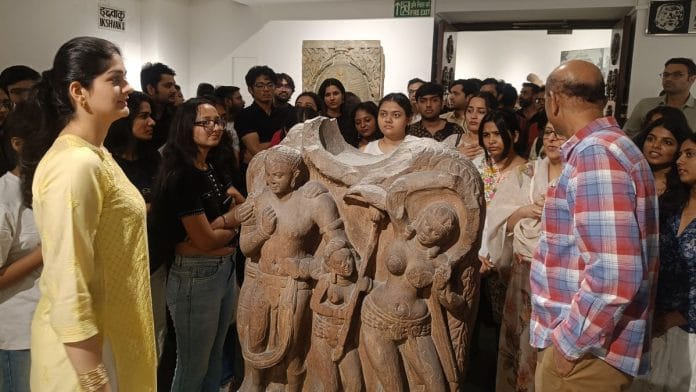


New Delhi: For the first time in 66 years of its history, the National Museum in Delhi opened its doors at night to the public on World Heritage Day on Saturday.
“The National Museum is the storehouse of our national identity and this is who we were for thousands of years before colonisation,” said Kudrat Singh, co-founder of the youth-driven Indian history platform Itihāsology, during the walkthrough titled Night at Museum: An after-hours walk with history. She added that it would take three years to go through all the artefacts at the museum if a person spent two minutes each with all of them.
Singh and Eric Chopra, public historian and also the founder of Itihāsology, led the walkthrough, guiding over 50 visitors. They two took the audience on a journey across centuries — from the Harappan Dancing Girl, Gandhara Buddhas to Mughal paintings — to show how India’s past is layered, contested, and deeply interconnected with global influences. Blending storytelling with sharp questions, they started conversations about interpretation, preservation, and repatriation of artefacts, arguing that history is not a fixed narrative but a shared, evolving legacy shaped as much by cultural exchange as by modern-day responsibility.
At the Harappan gallery, Chopra began with the ‘Dancing Girl’ of Mohenjo-daro, which he called the “first diva” of the museum.
“The first diva of this place in Indian history was discovered in a house in an urban city next to a fireplace,” he said.
He then went on to narrate the story behind the bronze statue’s name, while claiming that it is one of the only sculptures from Harappa that is entirely naked.
When the British discovered the ‘Dancing Girl’ and looked at the sculpture, it reminded them of the allure of the dancing women. “But she was possibly never dancing,” explained Chopra.
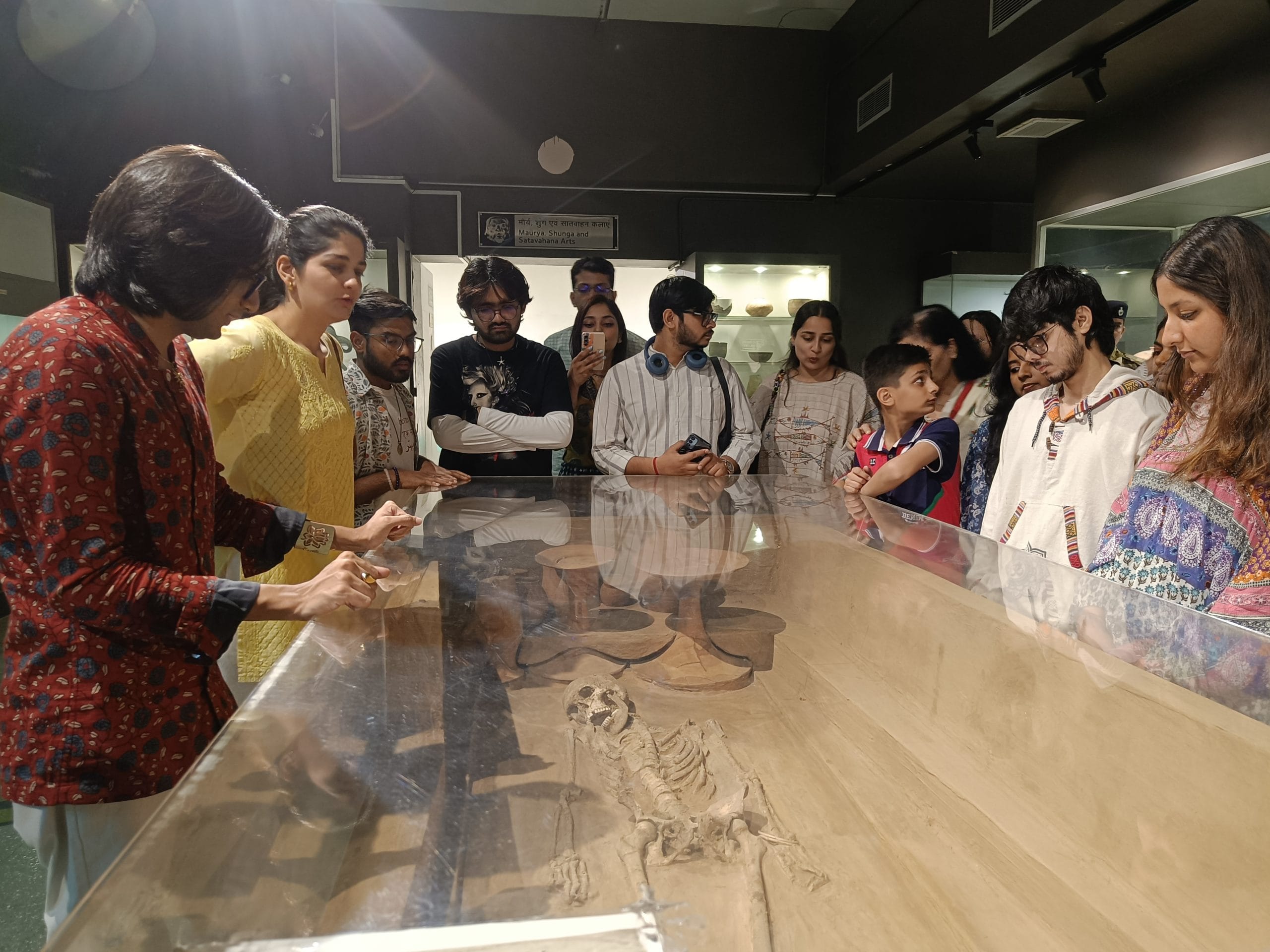
The next stop was the women’s burial from Rakhigarhi, where bodies were buried with many things, suggesting the concept of afterlife.
Chopra elaborated on it by referring to Mesopotamia and Egypt where people not only believed in afterlife but also in ghosts. According to him, if they had a headache, they would believe a ghost had entered their ears and settled in the middle of their forehead.
The making of the Buddha
Chopra and Singh narrated how Siddhartha became the Buddha through a slab from Amaravati, belonging to a few centuries before the common era. The slab did not depict the image of the Buddha since, at that time, the tradition to depict the Buddha in human form had not started.
“Before the human depictions, people made stories of Buddha’s life,” said Chopra, adding that people were using the footprints, the Bodhi tree or any other symbol that was associated with the Buddha to depict it.
But two centuries later, the Buddha started being depicted in human forms with recurrent features, such as a very sleek nose, elongated earlobes, and almond-shaped eyes.
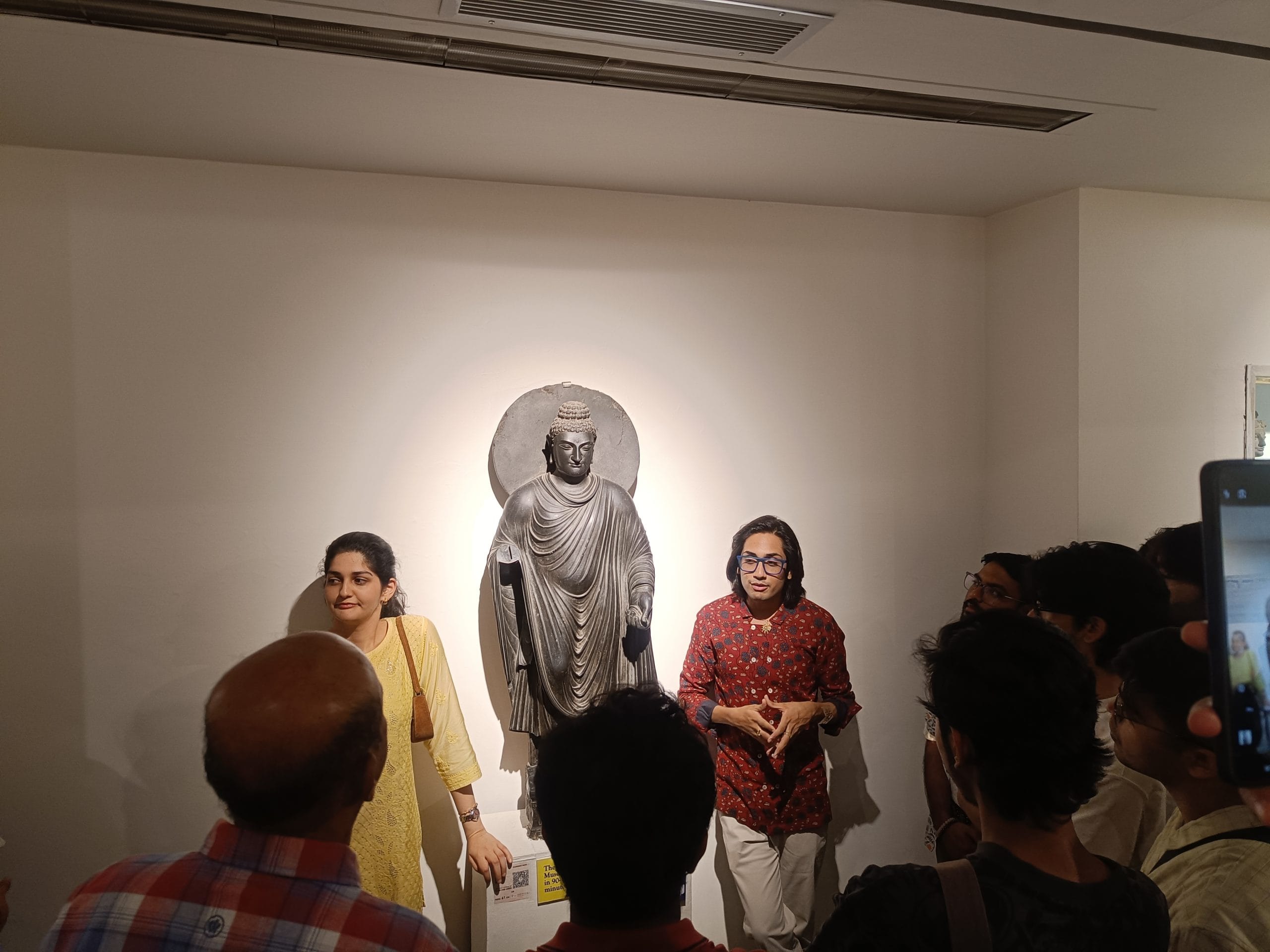
Chopra took the visitors on a journey from the slab with the Buddha’s footprints to a full-blown image of the Buddha in the Gandhara art.
According to him, the followers looked at the Greek images of Apollo and started to model Buddha after him. “Kushan have inherited the legacy of Greco-Roman art form from the predecessors in Gandhara and what they are noticing is that there are a lot of pilgrims crossing the area and they are Buddhists,” said Chopra.
“The most familiar image of Gandhara as you see today is actually an Indo-Greek and Roman creation more than anything else,” added Chopra.
Afterlife of repatriated artefacts
Since 2014, 640 stolen antiquities have been brought back to India. Among them was a 10th-century stone idol of Yogini.
Chopra said the idol was passed through various homes in London and Paris after being stolen in the 1970s from a Yogini temple in a UP village.
He then asked an interesting question about the afterlife of the repatriated artefacts.
“It was very easy to give in to emotions and say these things belong to us. But we are inheritors of a very multifaceted historical legacy which we have given no importance to,” said Chopra.
Chopra said it is an infrastructural problem, an educational problem that goes to its roots.
Also read: Why are blue-tiled monuments found in Pakistan but not in Delhi?
Celebrating history
Chopra tried to cover Mughal history in a few minutes due to time constraints. In a fun way, he said the Mughals did exist and Shah Jahan did make Taj Mahal, referring to a painting of Mughal emperor Jahangir.
In the painting, Jahangir holds a painting in his hand, which is not of his wife Noor Jahan or his mother, but of Virgin Mary, the mother of Jesus Christ.
As curious visitors looked on, Chopra offered an explanation.
“From the late 1500s, at the court of Akbar, Renaissance artists, European diplomats and Jesuits have come with engravings and illustrations and manuscripts. When Jahangir makes this painting of him holding Virgin Mary, he is seeking spiritual legitimacy because he is a cosmopolitan ruler,” said Chopra.
For many of the visitors, it was their first time at the National Museum. “It was an extraordinary experience walking through the galleries at night. The walk leaders chose few antiquities and narrated its story with full of minute detailing and joined its historicity in a larger perspective,” said Prachi Jha, who visited the museum for the first time.
Concluding the night tour, Chopra urged the visitors to remember that they are inheritors of a multifaceted and diverse history.
“That is what we truly celebrate. Let’s not make history a game of who’s right and who’s wrong,” he said.
(Edited by Aamaan Alam Khan)