



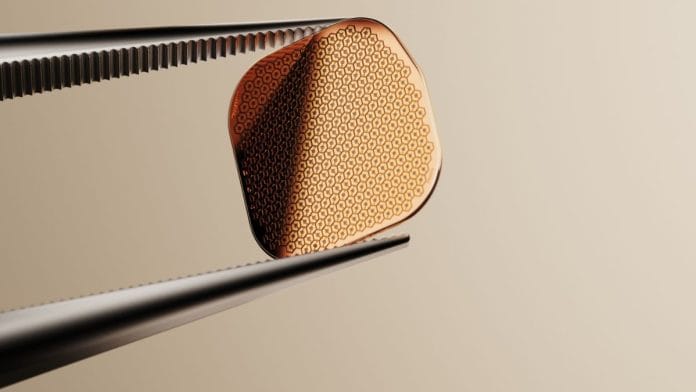
Bengaluru: A retinal implant that partly restores sight has received approval for use in Europe. Meant for people blinded by a common form of age-related vision loss, it’s the first such device to be approved anywhere in the world, New Scientist reports.
The device, called PRIMA, is made by Science Corporation, based in Alameda, California. It has received a CE mark under EU Medical Device Regulation, allowing its use across the European Union and the UK.
“We’ve had patients who could recognise the face of the Queen and others who’ve drawn the Sydney Opera House through the device,” said Darius Shahida of Science Corporation.
PRIMA restores central vision in people with geographic atrophy, a progressive, irreversible form of dry age-related macular degeneration (AMD). It affects an estimated 8 million people worldwide. Existing treatments are limited to two FDA-approved eye injections that slow disease progression but cannot restore lost sight.
“The PRIMA implant is an impressive achievement,” Sunir Garg of Wills Eye Hospital in Philadelphia, told New Scientist. He was not involved in developing the device.
How does it work?
The implant, about the size of a pinhead, is placed beneath the retina and paired with glasses fitted with a camera. The glasses capture images and project them onto the implant using near-infrared light, invisible to the human eye. The chip converts this into electrical pulses that stimulate bipolar cells in the retina—cells typically undamaged by macular degeneration—bypassing the rod and cone cells that the disease destroys. The glasses draw power from light itself, like a solar panel.
“This means patients don’t need a tethered power source,” Shahida said.
In a study published in the New England Journal of Medicine in October 2025, PRIMA restored central vision and improved visual acuity in about 80 per cent of cases. “Normal vision in the US is 20/20 and blindness is 20/200,” said Frank Brodie from Science Corporation. “Patients using PRIMA reached about 20/160, so they went from blind to not blind.”
Most side effects were linked to the surgery and resolved within two months. “The physical recovery is quick, and some people feel better within a day,” Brodie said, adding that patients are then trained to use the glasses, including head positioning and pupil alignment.
Garg said more research on a larger group of patients, with long-term safety data, is needed before the device sees wider use. Researchers also need to establish whether it benefits only patients with specific characteristics, he said.
PRIMA has also received Breakthrough Device and Humanitarian Use Device designations from the US FDA, “an important pathway toward approval in the United States,” Shahida said. The first commercial implants are expected soon in Germany, and in the UK later this year. The company is also exploring the device’s potential for Stargardt disease, another condition affecting the macula.