







New Delhi: The manosphere is more than a movement of men banding together against women. It is a thriving industry. A business that feeds on those who feel angry, isolated and left behind. At its core, it is a monetisation of male loneliness.
Research by global nonprofit Equimundo, titled “The Grift Economy: How Young Men Are Being Sold Fake Belonging and Fake Wealth Online,” traces how internet algorithms funnel such men toward “paid communities, unregulated supplements, crypto schemes and high-ticket coaching programmes.”
“‘Masculinity’ has become a commercial category that is constructed, curated and financially incentivised online,” the report read.
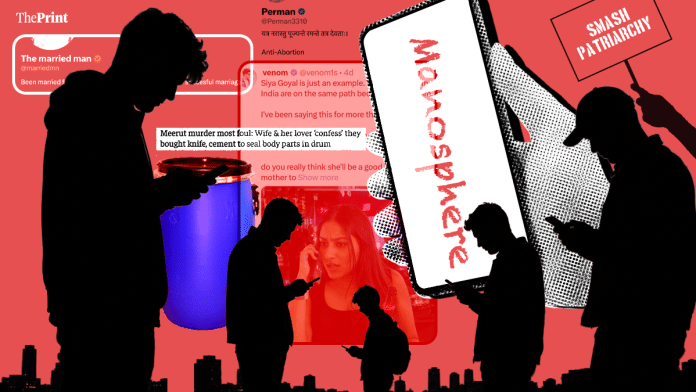
Manosphere is no longer a Western concept. It has spread its tentacles in India and is mostly visible online behind pseudonymous and anonymous handles that use stock images, animated avatars, and images of hyper-masculine men.
A glimpse of this online backlash was visible after the death of Bollywood actor Sushant Singh Rajput, when his girlfriend and fellow actor Rhea Chakraborty was subjected to intense misogynistic abuse and vilification online. With every case involving a woman accused of killing a man, the rhetoric gained further traction and cemented the manosphere’s presence in the country. Its growing reach was again evident after Siya Goyal allegedly murdered her fiancé Ketan Aggarwal.
The manosphere uses these accounts not just for “justice”, but also to vilify women as a whole and rail against feminist ideology. They dismiss the struggle for women’s rights and argue for a return to traditional gender hierarchies. Many of them are also anti-abortion, with millions of followers.
The latest 150-page report tracks how men get caught in the manosphere’s click-baity world that asks them to splurge money to transform their lives. In return, it infuses them with hate, misogyny and intense resentment.
Also Read: Actor Karan Wahi questions women’s idea of independence. Supporters say he ‘cooked feminists’
The ABC of Manosphere
It starts small with men searching for self-help content on dating, fitness and finance. As soon as the algorithm registers their vulnerabilities, several alternative theories pop up on social media. These experience-based narratives slowly evolve into an amateur theory to explain their frustrations. But to learn and better themselves with the help of these influencers, lonely men must pay a fee.
These narratives make men feel seen. It validates their resentment. And soon a community emerges, one which acts as a haven for the “misunderstood.”
The study cites examples of a verified business account on X that used real economic data to “falsely claim that the high rate of youth unemployment is only affecting men.”
“By framing credential competition and labour market dynamics as a coordinated attack on men, this operation converts genuine economic anxiety — which is real and documented — into resentment with named targets: women, immigrants, foreign workers,” the research states.
That’s how a community of men is created who feel together in this world of “victimhood and betrayal, and hostility toward a mutual enemy.”
The paper also dissected the income of the infamous manosphere influencer Andrew Tate. The study found that Tate makes roughly $184 million in annual gross revenue just from his subscription-based “Real World” education platform. The platform costs $99 per month.
“Recycle content, affiliate pyramids, deliberate cancellation barriers and deceptive testimonials characterise the industry’s flagship products,” the research notes.
Also Read: Inside India’s manosphere: Rhea Chakraborty sparked it, Siya Goyal is firing it up
How lonely men get duped
The paper estimates that the global top-tier influencers such as Adin Ross earn between $30,000 and $50,000 an hour from streaming alone.
Public figures such as podcaster Joe Rogan demand “speaking fees of upwards of $200,000.” The study estimates that top manosphere creators can rake in anywhere between $1 million and $10 million “through multiple income streams, including platform payouts, sponsorships and other commercial deals.”
Gary Barker, founder and CEO of Equimundo, said that men are “being duped.”
“They deserve to be getting straight information on products that actually do what they say they do, and not be swindled out of their money,” said Barker, whose platform advocates gender equality and positive masculinity.
(Edited by Insha Jalil Waziri)