





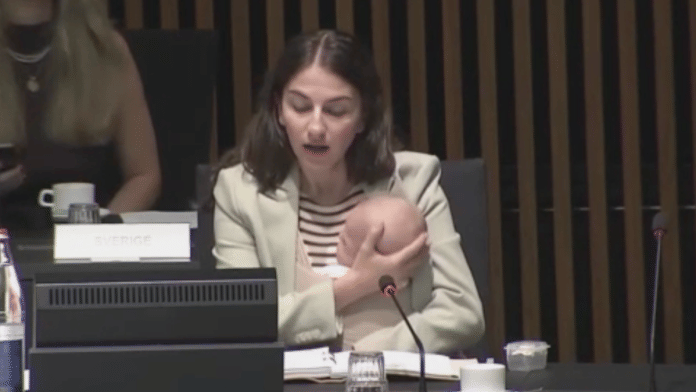

New Delhi: Sweden’s climate minister Romina Pourmokhtari brought her three-month-old son to an EU council meeting in Luxembourg on 25 June, while making a point about work-life balance.
Pourmokhtari, 30, arrived at the meeting in Luxembourg with her infant son Adam, strapped to her chest. It was the first time that a baby had attended a meeting of EU ministers.
Earlier, in 2010, Italian MEP Licia Ronzulli had brought her infant daughter to the European Parliament, but for the EU Council it was a first.
Pourmokhtari, who became Sweden’s youngest-ever government minister when she took office in 2022, had just returned from parental leave and wanted to demonstrate that working mothers need not choose between career and family.
“I wanted to showcase being an example of not having to make that choice. Which, of course, also requires having a partner that’s not a dinosaur, someone who’s quite modern and up for it to tag along,” she told Reuters.
Her husband is currently on parental leave until Sweden’s election in September and travelled with her to Luxembourg to care for Adam during the meeting.
The move was welcomed by fellow ministers. Her French colleague Monique Barbut gifted her baby a onesie, while Spain’s climate minister Sara Aagesen welcomed the decision to bring “little Adam” in a social media post, calling him “the best illustration of why we are here: working today to leave a better planet for those who will inherit it tomorrow.”
For Poland’s deputy climate minister Krzysztof Bolesta, having a baby at a political meeting was no trouble at all.
“I think it’s great,” he told Reuters. “It’s not a handicap, it’s just a part of life.”
‘Dad months’
The couple’s arrangement is made possible by Sweden’s parental leave system. Parents receive around 16 months of paid leave in total, with 90 days reserved exclusively for each parent, which cannot be transferred to the other. Days left unused are forfeited.
The reserved days, known as “dad months,” were introduced to nudge fathers into taking a greater share of childcare.
The policy has become a flashpoint in Sweden’s upcoming election campaign, amid broader debate over the country’s high-tax model that funds such benefits.
Pourmokhtari credits the structure of the policy, alongside support from her team, with making it “much less controversial” for her husband to take on primary care duties while she works. But she argued that generous leave periods alone are not enough, urging governments to also pursue flexible leave-sharing rules and affordable childcare.
“It’s creating a lot of value that shouldn’t be underestimated. Value that might not always be economic—but in the end, might also be economic, in not having burnt-out workers,” she said to Reuters.
Preksha is a TPSJ alumnus currently interning with ThePrint.
(Edited by Insha Jalil Waziri)