



Arundhati Roy, who wrote and acted in the film, In Which Annie Gives It Those Ones, once pirated the 1989 film to a bookshop owner who was a fan. Directed by Pradip Krishen, the film was telecast on Doordarshan late at night, unlike other television films, which were mainly telecast during the daytime. With little publicity, it quietly disappeared, much like the concept of television films.
Set in an architecture college in Delhi where students are encouraged to get creative with their own versions of freedom, the film follows Anand Grover, aka Annie (Arjun Raina), a final-year student who has been facing suspension for years. The film was shot during the summer vacation at the School of Planning and Architecture.
Like Annie, everyone around him is unique. Roy plays Radha, a free-spirited student who challenges conventions through both her art and her assignments. In her memoir, Mother Mary Comes to Me (2025), Roy recounted that she wrote the script in three weeks and presented it to the new Doordarshan chief, who loved the character Annie and got a small budget to make the film.
“It was enough for us. It was exactly what those scruffy characters in the script deserved. A big budget would have ruined them,” she wrote.
The film also stars Rituraj Singh, Divya Seth, and Raghuvir Yadav, while Manoj Bajpayee and Shah Rukh Khan also made cameo appearances.
Most television films of the era, such as Tapan Sinha’s Aadmi Aur Aurat (1984) and Govind Nihalani’s Tamas (1987), dealt with serious social issues. Some, like Mahesh Bhatt’s Janam (1985) and Daddy (1989), occupied a space between mainstream cinema and television drama, with their dramatised dialogue and family-centred narratives. In Which Annie Gives It Those Ones, however, stands apart from these traditions.
The film was not interested in making a social statement through a conventional narrative. It found its story in the ordinary, often ridiculous business of being a college student.
The conversations in the film sound straight out of a college canteen. One moment, the students are debating Karl Marx, the next, they are arguing over cigarette prices or playing table tennis as though their lives depend on it. They take every argument seriously, even as their hostel rooms remain messy and their priorities scattered. One is busy building muscles, another is constantly eating junk food, while someone else is trying to impress a girl. The most relatable moment comes when they scramble to finish their assignments the night before the deadline.
The characters do not speak as though they are delivering rehearsed lines. They sound like real college students talking to one another, casually slipping between Hindi and English, interrupting each other, and letting conversations unfold without dramatic pauses or perfectly placed full stops. The dialogue flows.
In her memoir, Roy wrote that during the first screening at Max Mueller Bhavan in Delhi, she was eager to see the reaction of the audience. Within minutes, the audience was roaring with laughter and whistles rang through the hall.
“They recognized themselves, their langauges, their jokes, their silliness, and were delighted to have been deemed worthy of cinema. I was dazed. Thrilled,” she wrote.
Also read: Paar laid bare caste oppression in 1984. Four decades later, its truth still stings
Agony in ‘Annie’
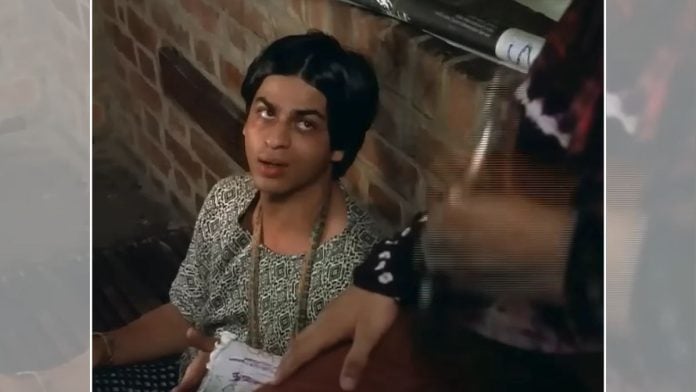
Shah Rukh Khan is credited as Senior in the film. This may be the only film in which Khan’s character has no name and does not really matter to the story. He appears in just two scenes, wearing a wig and speaking in a completely modulated voice, mostly gossiping about other students. This was before Khan became Bollywood’s Badshah. In the following years, he appeared in Fauji (1989) and made a few appearances in Wagle Ki Duniya (1988) and Umeed (1989), before his first film, Deewana, was released in 1992.
One of the most intriguing characters in the film is Yamdoot, the college dean played by Roshan Seth. His actual name in the movie is YD Billimoria, and he is the only humourless character around. While everyone around him is joking, he maintains a poker face. Creativity, freedom, and sustainability mean little to him. He represents the establishment, constantly reminding students to adapt to the existing world rather than trying to change it.
Set in 1974, a year before the Emergency, the film captures a generation of students negotiating their relationship with authority and institutions.
The film won two National Film Awards, Best Feature Film for Pradip Krishen and Best Screenplay for Roy. She recalled that the citation for her screenplay award read, “for depicting the agony of students”.
“For a minute I thought there had been some mistake and that I had walked away with someone else’s award, because agony does not make even a guest appearance in Annie,” she wrote.
As the film ends, an epilogue reveals the fate of the characters. Annie is working as an assistant professor of design at the National Institute of Architecture in 1977, a year after Yamdoot’s retirement, while Radha pivots toward writing but dies in 1976, before her first novel is published.
In Which Annie Gives It Those Ones endures, but not because of this epilogue. The film is not particularly interested in whether its students eventually become successful architects or change the world. It captures them at a time when arguments over Marx, unfinished assignments, cigarettes, friendships, and impossible ideas seem equally important.
(Edited by Prasanna Bachchhav)