



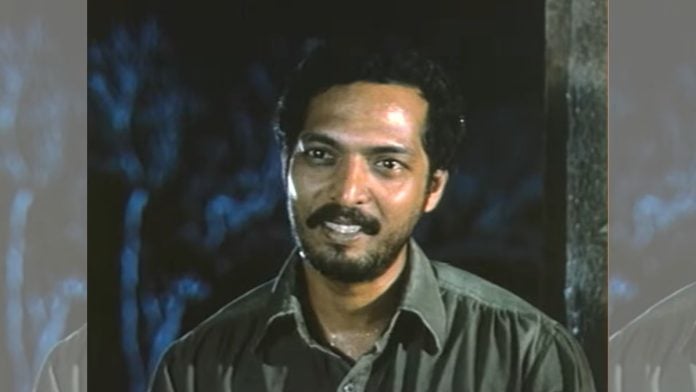
What happens when Mr Everyman Amol Palekar directs the angry soldier of Bollywood, Nana Patekar? In Thodasa Roomani Ho Jayen, Patekar plays a conman who speaks in poetry, makes promises of rain and, almost without meaning to, helps a woman see herself differently. At the centre of Palekar’s 1990 film is Binni, played by Anita Kanwar, a woman who can fix cars and do just about anything the men in her village can, but cannot escape their belief that she is unfit for marriage. The film’s conversations unfold like verse, but its real subject is more grounded: what happens when a woman doesn’t check boxes and refuses to become the person everyone else wants her to be.
As Palekar belongs to the Basu Chatterjee world of cinema, where ordinary people and their everyday lives become the centre of the story, his direction reflects the ideas he learned from Chatterjee. From Rajnigandha (1974) to Chhoti Si Baat (1976), every character has an important dialogue, a hidden character arc, and a role to play in the film. Palekar brings that sensibility into Thodasa Roomani Ho Jayen. The theme of the film is also said to be inspired from the 1950s American play The Rainmaker written by N Richard Nash.
In the film, the village becomes an important part of the Binni’s life. Her father and two brothers have very little problem with the way she works or the way she behaves. They have accepted her as she is. But the whole village has taken upon itself the responsibility of making her feel like the odd one out. At parties, at shops, while buying eggs, almost everywhere she goes, she is reminded that she is different, can not be loved and married.
The film moves slowly, giving every character enough time to exist and reveal something about themselves. It cannot exactly be called a typical musical, but the conversations carry their own rhythm.
There is a scene where a woman from the village comes to Binni’s house to complain to her father about her being unmarried. The father argues that they do not want to marry Binni off until she finds someone she can love. In the middle of this conversation, her father says, “Jaha Mahatma Gandhi road par bikti sharab hai, waha sirf Binni ke wajah se pure sheher ka hajma kharab hai.”
It is funny, affectionate, and oddly moving at the same time. Palekar gives the moment enough space to breathe, allowing the characters to speak rather than rushing them toward the next plot point.
Also read: Sagar Sarhadi’s ‘Bazaar’ stripped marriage of its romance in 1982. It showed women being sold
Men at the centre
Nana Patekar’s versatility becomes evident when you look at the characters he played around this period. In this film he plays Natwarlal, a conman who claims to be a magician. Around the same time, he played Anna, the ruthless gangster in Vidhu Vinod Chopra’s critically acclaimed Parinda. One was a man who could kill without hesitation, the other was a man who could talk his way into a family’s heart with poetry, wit, and a promise to make it rain.
By the 1980s, Hindi cinema was moving toward a different kind of storytelling. Films such as Ardh Satya, Jaane Bhi Do Yaaro, Aakhree Raasta, Kalyug, Karz and Namak Halaal explored men, their ambitions, and their place in society. While these films differed greatly in their themes and treatment, many placed men at the centre of their social commentary. Palekar, however, turns his attention to a woman and the gendered and societal expectations imposed on her. Even educated men of the village, including collector Jaideep played by Vikram Gokhale, are not free from orthodox ideas about how a woman should conduct herself.
Natwarlal’s arrival offers the village something it desperately needs: hope. While Binni is struggling to find a place in a society that refuses to accept her, the village is struggling to survive a months-long drought.
Natwarlal, with his quick wit and poetic declarations, convinces the family that he can bring rain for Rs 5,000. Binni, though, is not impressed.
Like Binni, Natwarlal knows what it means to be dismissed by society. Both have been made to feel that they are not good enough. But, while Natwarlal becomes confident, Binni internalises the village’s judgement of her appearance. She cannot see herself as beautiful.
Nana Patekar’s character Natwarlal offers a glimpse of a side of the actor that audiences would not necessarily associate with his more celebrated roles, such as Mustafa in Ghulam-E-Musthafa (1997) or Major VS Chavan in Prahaar (1991). Yet long before he stepped into those roles, he played Natwarlal with wit, humour, and romance, long before Welcome (2007) introduced audiences to his comic timing.
In Thodasa Roomani Ho Jayen, Natwarlal repeatedly tells Binni that she must recognise her own beauty before she can feel confident about herself. Eventually, she begins to believe him, breaking into the song ‘Main Sundar Hoon, Main Jaan Gayi, Main Pehchaan Gayi’ sung by Chhaya Ganguly and written by Kamlesh Pandey.
For much of the film, Binni is seen in a blue checked shirt, dressed in a way that sets her apart from the other women. Toward the end, she wears a suit and dances through a field of flowers, imagining herself as beautiful. Her transformation is not simply about dressing differently or finding a man who loves her, it is about beginning to see herself outside the village’s definition of a desirable woman.
(Edited by Aamaan Alam Khan)