





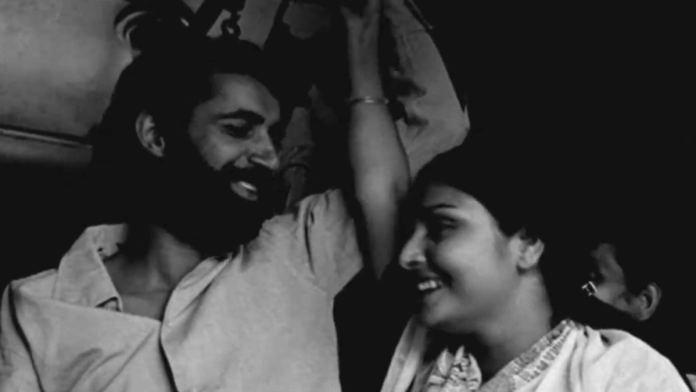


New Delhi: Bollywood had largely moved beyond the aesthetics of black-and-white cinema by the early 1970s. Yet filmmaker Awtar Krishna Kaul revisited realism in his only feature film, 27 Down.
Released in an era dominated by romantic dramas such as Seeta Aur Geeta (1972), Amar Prem (1972), Pakeezah (1972) and Roti, Kapda aur Makan (1974), Kaul’s film stood out for its monochrome cinematography, which gave it an almost documentary-like sense.
The 1974 film revolves around Sanjay, played by MK Raina, who as a child dreams of becoming a ticket checker in the Indian Railways. But after his father, portrayed by Om Shivpuri, loses the ability to walk while working on a train, Sanjay begins to hate trains.
As he grows older, his father compels him to take a job in the railways. Ironically, the very thing he once hated becomes the centre of his existence. Through countless journeys, his hate turns into attachment. He begins to live on trains—eating, sleeping, bathing and spending nearly every waking moment on a carriage.
Life is a train, get on board
The film is based on Ramesh Bakshi’s Hindi novel Atharah Sooraj Ke Paudhe (1965).
Kaul shot most of the film on actual trains with a handheld camera. The opening sequence begins with the sounds of a steam engine and rattling wheels. An adult Sanjay lies on a berth, reflecting on the course of his life. While fellow passengers travel with destinations and purposes in mind, he travels through a stream of thoughts, moving from one memory to another, unsure of where his own life is headed.
Sanjay goes on to find love in the very place he once hated. On one of his journeys, he meets Shalini, played by Rakhee Gulzar, the sole breadwinner of her family. The two gradually grow close, though they never explicitly label their relationship. They wander through Mumbai’s streets, holding hands and spending evenings along Marine Drive, talking about love, family and life.
As the narrative progresses, Sanjay’s father, with whom he shares a strained relationship, arranges his marriage to a young woman portrayed by Rekha Sabnis after discovering his relationship with Shalini. The marriage is rooted more in social expectations and dowry than in affection. Sanjay, however, attempts to build a life with his wife, but her suspicion regarding his past love slowly eats away at their marriage.
In the end, Sanjay loses control of his life. He distances himself from his friends, family and wife, and begins travelling from city to city. The film ends where it begins, suggesting that he is trapped in an endless journey.
Kaul’s 27 Down is similar to the 1966 classic Nayak, directed by Satyajit Ray, another film centred around trains. But while Nayak’s protagonist is famous and in control of his life, Sanjay has lost everything. They feel like two opposite identities travelling through the same universe.
The song ‘Koi Aata Nahi Koi Jaata,’ sung by Pandit Hariprasad Chaurasia and Bhubaneswar Mishra, is about how life moves in a railway station and life in general.
Also Read: Slapstick comedy is back. Bollywood is laughing out loud again
Building life on a train
By the time the film was released, Rakhee Gulzar was already an established star. She had appeared in films such as Jeevan Mrityu (1970), Lal Patthar (1971), Daag (1973) and Banarasi Babu (1973), sharing screen space with some of the biggest names in Hindi cinema, including Rajesh Khanna, Dev Anand and Sharmila Tagore. Yet, she agreed to work in 27 Down because she loved the story.
The film was made on a budget of around Rs 8 lakh, of which Kaul personally invested Rs 3 lakh, while the remaining amount came from the National Film Development Corporation (NFDC).
Shooting on real trains and railway stations presented logistical challenges. Unlike the comforts associated with mainstream productions, Rakhee Gulzar performed without makeup and even brought her own sarees for the shoot.
On 20 July 1974, the film was awarded the prestigious National Film Award for Best Feature Film in Hindi and Best Cinematography.
The film was also India’s official entry to the Locarno Film Festival in Switzerland and won the Ecumenical Award.
The same year, Awtar Krishna Kaul died in an accident. Kaul’s filmmaking career lasted barely four years, from 1970 to 1974, yet it left behind one of Indian cinema’s most distinctive works.
(Edited by Insha Jalil Waziri)