





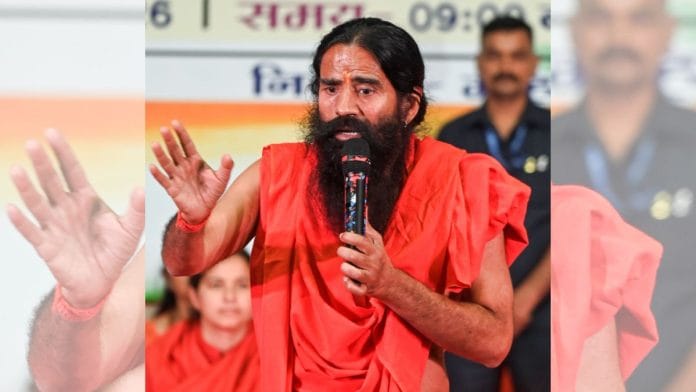


New Delhi: Yoga guru and businessman Ramdev used an Independence Day address in Haridwar Saturday to launch a sharp critique of India’s education and government recruitment systems. He also warned against the growing climate of hatred in public life. Speaking to the press at Patanjali Yogpeeth, he warned that protests could intensify if “stupidity” in the system is not fixed.
Ramdev condemned what he called the growing enmity between Indians, saying people from different castes and communities had begun to stand against one another.
“Brahmin, Kshatriya, Vaishya, Shudra, Dalit, Adivasi, Vanvasi, Hindu, Muslim, Sikh, Christian, Jain, Buddhist have stood before one another with such enmity and opposition as if they are thirsty for each other’s blood. We have to break all these walls of hatred in the country,” he said, arguing that hatred based on politics, caste, class and community was not befitting the citizens of an independent nation.
He also criticised the deterioration of public discourse, saying elders no longer respected the young and the young did not respect their elders. Abusing and using foul language, he said, was not Indian culture.
“We do not have to become abusers; we have to become skilled,” he said, calling instead for Indians to become knowledgeable, virtuous, and people of high character.
‘Fix stupidity in the country’
Ramdev pointed toward students protesting across the country over the lack of basic facilities in schools and colleges, including teachers, electricity, water, and toilets.
“If we have teachers, we don’t have books. If we have books, we don’t have teachers,” he said.
He also referred to paper leaks and alleged irregularities in recruitment.
His sharpest criticism was reserved for government job interviews. Ramdev alleged that corruption and money power influence the selection process, claiming that “90-99 per cent” of factors are unrelated to merit but can determine outcomes in interviews.
He added that candidates are asked for bribes running into “Rs 25-50 lakh per crore” during recruitment. These claims were not accompanied by specific evidence or details of particular recruitment processes in his speech.
Ramdev said such practices amounted to an “insult” to the people and to democracy. In his address, he described dishonesty and corruption as an insult to the martyrs and freedom fighters whose sacrifices made India independent.
“This dishonesty and corruption is hollowing out the roots of India. People all around are crying out in distress, deprived of their rights. Some people have captured power, wealth, and resources. The chasm of inequality and division in society has become very deep,” he said.
He called for corruption to be eradicated and for India to become free from “fear and hunger”.
“This is important. In the country, there is a lot of stupidity. Fix this stupidity. Otherwise, Ramdev will have to protest again,” he said.
The warning is significant, given Ramdev’s own history as a political mobiliser. He rose to national political prominence during the 2011-12 anti-corruption and black-money movements, campaigns that put considerable pressure on then-Congress-led government and helped create political space for the BJP.
His relationship with the BJP has, however, not always been straightforward.
Also read: BJP’s selective outrage over insults reveals a new culture in Indian politics
‘Hate went from streets to Parliament’
Ramdev openly supported the BJP’s 2014 Lok Sabha campaign and backed Narendra Modi’s prime ministerial bid. He subsequently became closely associated with the BJP-led political establishment. In 2015, the Haryana government named him the state’s brand ambassador and had granted him a cabinet minister rank, which he declined.
Ahead of the 2019 Lok Sabha elections, Ramdev had briefly sought to distance himself from electoral politics. In September 2018, when asked whether he would campaign for the BJP, he responded, “Why would I?” He added that he was “with all parties and with no parties”. He also warned that rising fuel prices could hurt the Modi government politically.
By April 2019, however, Ramdev had reversed course. While accompanying then Union minister Rajyavardhan Rathore during his nomination filing for the Jaipur Rural Lok Sabha seat, he had urged voters to back the BJP and said Modi needed to be made stronger for India to become an economic and political superpower.
His Independence Day remarks therefore come against the backdrop of a relationship with the BJP that has combined political alignment with occasional criticism.
Ramdev also used the address to frame his criticism around constitutional and democratic values. India, he said, did not belong only to political parties or powerful office-holders, but to all its citizens.
“The rights and responsibilities of the prime minister and president of this country are equal to the rights and responsibilities of every citizen,” he said, adding that citizens should uphold constitutional, democratic, humanistic, and spiritual values.
He called for India to become the world’s leading economic, political, and spiritual power, with stronger education and healthcare systems and a more robust economy. But he also warned against the growing climate of hostility in public life, saying hatred had spread “from the streets to Parliament”. Political opponents, he said, have been increasingly behaving as though India and Pakistan were standing against each other.
Ramdev said he was not advocating “anarchism” through protests. Yet, his warning that he may have to protest again marks a notable shift in tone from his more recent positioning as a non-political figure.
(Edited by Prasanna Bachchhav)