


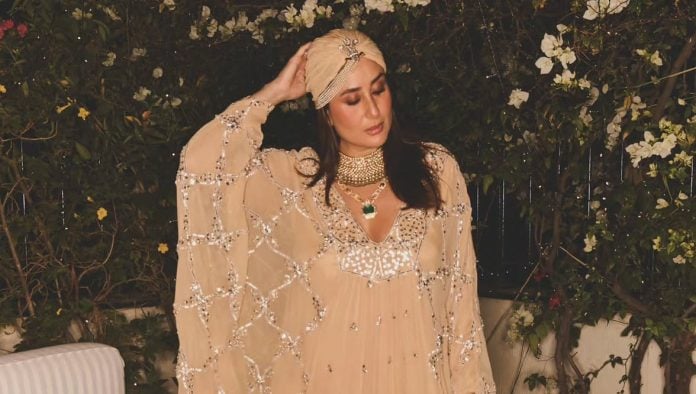
A 30-carat emerald pendant worn by Kareena Kapoor Khan for Diwali has landed the actor in a controversy. The stone, engraved with a verse from the Quran, has prompted a legal notice accusing her of disrespecting a sacred Islamic inscription. But the emerald is no ordinary piece of jewellery. It is a family heirloom with a history stretching back to the royal family of Bhopal.
Congress leader Abbas Hafeez sent the notice to Kapoor Khan and her stylist Rhea Kapoor on Wednesday, 11 November. He argued that the sacred verse, Ayat-ul-Kursi, had been displayed as a fashion accessory without the respect it deserved. He has demanded that the photographs be removed from social media and that both women issue a public apology.
The pendant was part of Kapoor Khan’s Diwali look, which also featured a centuries-old royal ornament.
For Diwali, Kapoor Khan wore a beige kaftan with real silver embroidery and a matching turban by designer Punit Balana. Rhea Kapoor, who styled the actor, identified the emerald as an heirloom belonging to the Begum of Bhopal.
She wrote that Kapoor Khan was wearing the Begum’s 30-carat emerald, carved with Ayat-ul-Kursi, along with a 200-year-old kalgi, a traditional turban ornament, belonging to the Nawab of Bhopal.
The diamond-studded kalgi has also been in Saif Ali Khan’s family for generations. He wore the same ornament at his wedding to Kapoor Khan in 2012.
What is Ayat-ul-Kursi and why is it inscribed on jewellery?
Ayat-ul-Kursi, or the Verse of the Throne, is the 255th verse of Surah Al-Baqarah, the second chapter of the Quran. Regarded as one of the most significant verses in Islam, it describes God’s power over the heavens and earth, and says that neither sleep nor tiredness affects Him.
Muslims often recite the verse for protection. Its use extends beyond recitation, with the verse appearing on jewellery and amulets for centuries.
The practice has a long history in India too. The National Museum in Delhi has a 19th-century carnelian amulet inscribed with Ayat-ul-Kursi. Such jewellery was worn by royalty and nobility, both as a symbol of status and, in some cases, for protection.
The pendant’s royal connection
The emerald Kapoor Khan wore is said to have belonged to the Begums of Bhopal, who ruled the princely state for more than a century.
The connection to Kapoor Khan comes through her husband Saif Ali Khan’s paternal family. Hamidullah Khan was the last ruling Nawab of Bhopal. His daughter, Sajida Sultan, married Iftikhar Ali Khan Pataudi. Their son, Mansoor Ali Khan Pataudi, was Saif Ali Khan’s father.
Hafeez’s objection, however, is not to the pendant’s royal origins but to how it was worn and presented. He told ANI that it was part of the religious heritage of Bhopal’s Begums and should be treated with respect.
He also clarified that he had no objection to Kapoor Khan’s clothes or her celebrating Diwali. He said he would have raised the same objection if she had worn the pendant for Eid.
The controversy also touches on a longstanding debate over whether Quranic verses should be worn as jewellery. There are differing views among Islamic scholars on the practice. Some consider it acceptable as long as the inscriptions are treated respectfully, while others discourage it because of the risk of disrespecting sacred text. The legal notice also refers to these differences.
Hafeez said he issued the notice in his personal capacity, not on behalf of the Congress party.
(Edited By Raunaq Lekhi)