



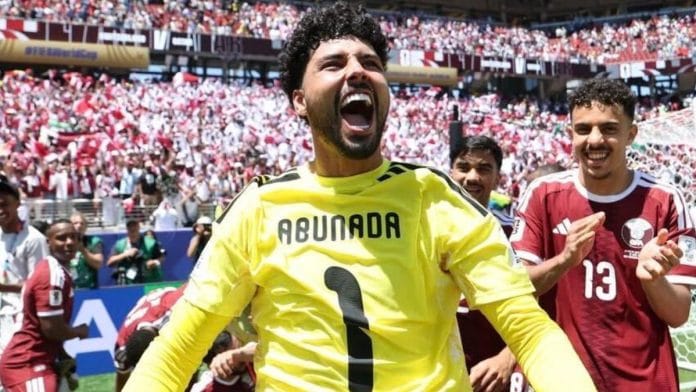
New Delhi: Switzerland failed to secure three points against Qatar at the 2026 FIFA World Cup group stage game at the San Francisco Bay Arena Stadium early Sunday, and all the spotlight was on the latter’s goalkeeper, Mahmud Ibrahim Abunada. His heroics earned a point for the West Asian nation that conceded just one goal in 90 minutes.
Abunada suffered a head collision during a match against Switzerland. The incident sparked concern and criticism regarding the stringency of the concussion checks he underwent on the pitch.
In the 15th minute, Abunada’s head struck against Remo Freuler’s thigh after he charged to a loose header, which was preyed upon by the Swiss midfielder. The 26-year-old was left momentarily unresponsive on the pitch. And, the “leniency of the pitch-side concussion check” has raised a debate among football fans and football analysts.
It was said that despite the severe, direct impact on his skull, Abunada was permitted to continue playing after a very brief assessment on the pitch.
Incidentally, that charge from Abunada led to a VAR-checked penalty, which Switzerland converted after a low, controlled drive from Breel Embolo. The penalty, which came due to a fraction of a second late tackle, is the only thing that went against Abunada.
“Qatar goalkeeper Mahmud Abunada took a hefty blow to the head in a collision with Switzerland’s Remo Freuler — and conceded a penalty for his troubles,” The Athletic had posted on X.
Abunada received equal praise.
“At the end of this match, the salaries of the entire Qatari team should be gathered and given to Abunada. Yes he caused the penalty for the initial goal, but with 4 saves, 2 punches & 1 high claim so far, he’s prevented Switzerland from running away with this game, an X user had posted.
The head injury did not bother Abunada as he went on to put up an absolute baller of a performance for the remainder of the game. Switzerland enjoyed a 70 per cent possession in the match with 20 shots, of which seven on target. And, Abunada saved six of them. The compact, wide defence line assisted in drawing the pace away from the match.
“Abunada has been outstanding when it came to 1 on 1. He is undoubtedly the player who has performed for Qatar, along with a disciplined defence,” Baichung Bhutia, former Indian football team captain and one of the analysts at the Z5 channel, said during the half-time.
‘Head injuries make you feel weak’
The fear of a head concussion, however, in the middle of the pitch isn’t new. This has sparked debate in the football world several times.
In the 2014 FIFA World Cup, Christoph Kramer suffered a severe head collision with Argentina’s Ezequiel Garay during the first half. He played on for 14 minutes in a completely disoriented state, even approaching the referee to ask if he was playing in the World Cup Final before finally being substituted.
In the same tournament, France’s Raphaël Varane sustained a major concussion during the round-of-16 match against Nigeria. He played the remainder of the match on “autopilot” and later revealed he had no memory of the rest of the game.
“As footballers playing at the highest level, we are used to pain, we are a bit like soldiers, tough guys, symbols of physical strength, but these symptoms are almost invisible,” Varane had said. “If your leg hurts and you limp, everyone sees it. But with head injuries, it immediately feels weak to say that you are tired, that you have migraines or eye fatigue … So at first, we tell ourselves that it will pass.”
Fearing more injuries, FIFA and the International Football Association Board (IFAB) have implemented a comprehensive, highly stricter concussion protocol featuring dedicated “bonus” substitutions and neutral medical oversight.
The Qatar squad, however, could not make any real impact in the game apart from a few shots and a run-against-the-play goal at the last minute. Qatar will look to bounce back and sharpen their attacking edge in their remaining group stage matches at the FIFA World Cup 2026.
“If Qatar want to score, they have to go out in numbers. They cannot have six players deep at their own half,” former India football team coach and another analyst at the panel with Bhutia, Igor Stimac, said.