


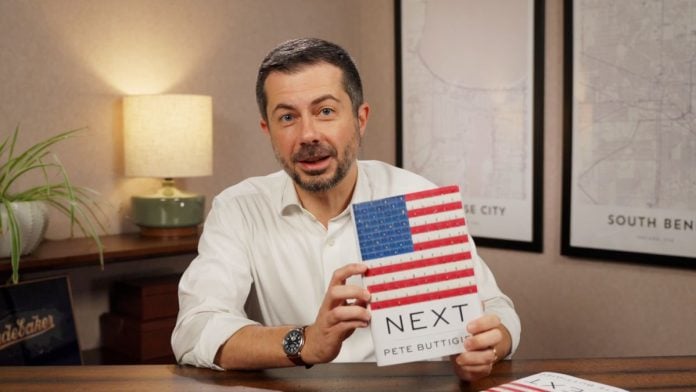
New Delhi: Former US transportation secretary Pete Buttigieg has spent the past 18 months thinking about America’s political future. The result is a new book, NEXT, which will hit bookstores on 26 January 2027.
“In this critical moment for the American project, I’ve been thinking a lot about what comes next. Over the past year and a half, I’ve put those thoughts on paper, and they’ve grown into a book I’m proud to share with you,” Buttigieg said while announcing the book.
The announcement comes as Buttigieg, who served as transportation secretary under former president Joe Biden from 2021 to 2025, remains one of the prominent Democrats being discussed as a potential presidential contender. He ran for the Democratic nomination in 2020, ending his campaign after the South Carolina primary, and has since maintained a national presence through political appearances, interviews and campaigning for Democratic candidates.
Published by Simon and Schuster’s Simon Six and Avid Reader Press imprints, NEXT draws on history, philosophy and his experience as mayor of South Bend, Indiana, and US transportation secretary. Buttigieg examines how America reached its current political situation and what needs to change to build a better future.
“This book is an argument about how we can build something better. It’s not a policy manual; it’s an account of how we got to this point and the principles that could shape where we go from here,” he said in a video announcing the book.
A bid for the US presidency
For politicians with presidential ambitions, a book gives them a chance to explain their ideas, build a national profile and reach voters beyond the campaign trail. There is a precedent for this in former US president Barack Obama. In October 2006, while serving as a US senator from Illinois, Obama published The Audacity of Hope: Thoughts on Reclaiming the American Dream.
Four months later, on 10 February 2007, he announced his bid for the US presidency.
Obama had already attracted national attention with his keynote speech at the 2004 Democratic National Convention. The book helped him build on that recognition. Its publication was followed by interviews, public appearances and a book tour, giving him an opportunity to reach a wider audience. He also travelled across the country campaigning for other Democratic candidates ahead of the 2006 midterm elections.
Like Obama, Buttigieg has contested a presidential election, served in a Cabinet position and built a national profile. His book gives him another opportunity to share his ideas about America’s future and reach people beyond the political circles he usually engages with.
But Buttigieg has already given some indication that he is considering another presidential run. In an August 2026 appearance on Steven Bartlett’s podcast, The Diary of a CEO, he was asked whether he was more or less inclined to contest the 2028 election.
“I think I’m more inclined than not, but there’s so much we don’t know,” he replied.
Also read: The Gilded Age is TV’s most perimenopausal show, says Washington Post
‘It’s not a policy manual’
The ideas in NEXT are also important. Rather than offering a detailed election manifesto, Buttigieg wants to look at how American politics and government work and what needs to change.
The book touches on democracy, freedom, faith, patriotism and finding common ground in a divided country. It also proposes major changes to the way the government functions, including constitutional amendments and reforms to Congress and the Supreme Court. Buttigieg also questions whether the country’s two-party political system needs to be rethought.
Another important theme is time. Buttigieg argues that a better standard of living should not be measured only by how much people earn or how fast the economy grows, but also by how much time they have for themselves and their families.
The publisher describes NEXT as a fresh take on the American dream, asking how the country can improve people’s everyday lives. It also introduces ‘Project 2050’, an effort to look beyond immediate political concerns and think about America’s long-term future.
“It’s not a policy manual; it’s an account of how we got to this point and the principles that could shape where we go from here,” he said.
(Edited by Saptak Datta)