



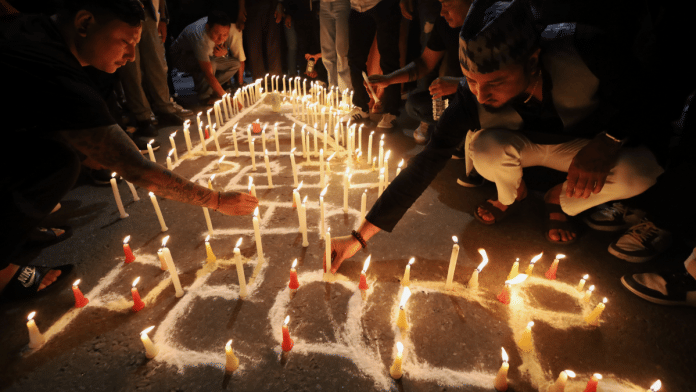
New Delhi: The Nepal government has declared two new consecutive public holidays in September — one to commemorate Gen Z Martyrs’ Day in memory of those killed during last year’s youth-led uprising and the other as a national day of mourning for victims of the devastating flood of 26 August.
The decisions were taken at a Cabinet meeting in Kathmandu. While 8 September will be Gen Z Martyrs’ Day, 7 September will be a day of mourning for flood victims. On 7 September, Nepal’s national flag will be flown at half-mast at government offices across the country and at embassies and diplomatic missions.
The announcement, however, has been met with scepticism from some quarters, including criticism over Nepal’s growing number of public holidays and the decision to place the Gen Z uprising and the flood tragedy on a similar footing.
At least 1,259 people have died and 5,083 remain missing after the 26 August flood struck the Bhote Koshi River, with rescue operations still underway.
The Gen Z protests of 8 and 9 September 2025, meanwhile, left 76 people dead, most of them young students. Of these, 45 were declared martyrs by the Nepal government last November.
Also Read: Miraculous rescue in Nepal: 2 workers found alive in Trishuli tunnel 9 days after floods
Mixed reactions to Gen Z Day
A report from the Nepali media outlet myRepublica questioned the announcement in an article headlined ‘Flood tragedy brings mourning day, but Gen Z uprising gets public holiday’. It noted the distinction between the two events.
“The floods were a natural disaster that caused grief across the entire country. The Gen Z uprising, by contrast, was a political event,” the report said. It also pointed out that while agitators were subjected to state violence, they too had carried out “acts of arson and destruction”, including at heritage sites.
Meanwhile, Nepali journalist Radha Krishna Katwal criticised the Balen Shah government — referring to it as the “Chameli government”, after a song sung by former rapper Shah — for handing out too many holidays at taxpayers’ expense.
“To celebrate the formation of the Chameli government, a public holiday ‘every Sunday’! Now Bhadra 23 too is apparently a public holiday in the name of Gen Z Day!” he posted on X.
चमेलीकाे सरकार बनेको उपलक्ष्यमा "हरेक आइतबार" सार्वजनिक विदा ! अब भाद्र २३ गते पनि जेनजी दिवसका नाममा सार्वजनिक विदा रे ! खाई नखाई कर तिर्ने जनता छदैछन अब दिन बिराएर विदा दे चमेली सरकार !! pic.twitter.com/fkqV2cCRNF
— Radha krishna katwal (@Radhakr07983874) September 3, 2026
Others, though, were more complimentary.
“A generation that is shaping Nepal’s future deserves to be heard, respected, and remembered,” posted @anandanepali99.
Big Breaking: 🇳🇵 NEPAL DECLARES A PUBLIC HOLIDAY FOR GEN Z! ❤️🔥
The Government of Nepal has announced a public holiday on Bhadra 23, dedicating the day to Gen Z and recognizing their voice, energy, and contribution to the country. 🇳🇵✊
A generation that is shaping Nepal’s…
— Ananda Nepali (@anandanepali99) September 3, 2026
Last September, thousands of young people took to the streets across Nepal, demanding a corruption-free government and greater accountability. The protests, which saw massive participation from Generation Z, became known as the Gen Z movement.
The agitation eventually toppled the government of then-prime minister KP Sharma Oli and ushered in a period of political upheaval that culminated in Balen Shah becoming prime minister. However, the new government has also encountered criticism over its style of governance, with opponents and analysts questioning its commitment to parliamentary accountability.
Other Cabinet decisions
At the same Cabinet meeting, the government agreed to accept a $5 million grant from the Asian Development Bank for flood relief and reconstruction. Nepal has said it will need billions of dollars to rebuild areas devastated by the disaster.
Shah’s government also approved tax and customs relief for those affected by the floods, along with risk allowances and meal expenses for personnel involved in rescue operations. Free medical treatment will be provided to those injured during rescue work, while families of personnel who lose their lives during operations will receive one million Nepali rupees in relief.
(Edited by Asavari Singh)