



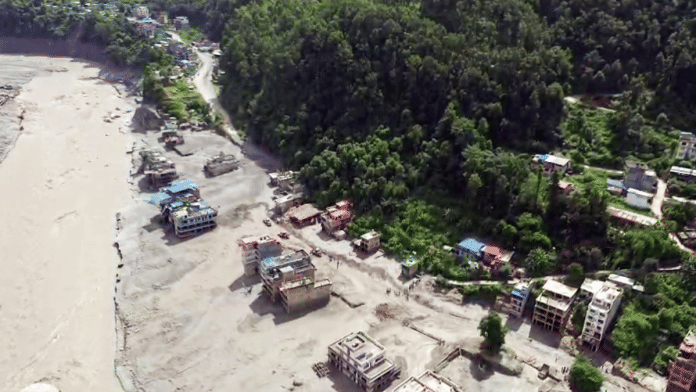
New Delhi: Several months before deadly floods struck Nepal, President Donald Trump had shut down a US-funded programme that helped monitor environmental and disaster risks across the region, reported CNN.
The program titled ‘SERVIR Hindu-Kush-Himalaya (HKH)’ was a joint initiative by USAID, NASA, and the International Centre for Integrated Mountain Development (ICIMOD). It used satellite imagery and geospatial technology to monitor floods and glacial lakes. The program was formally ended after Trump froze foreign aid in January 2025.
Now, nearly a year and a half later, a massive flood triggered by an ice-rock avalanche has swept through Nepal, leaving over 1,000 people dead and thousands more missing.
“DOGE famously used keyword searches for terms like “climate” to terminate federal grants. Nepal is a disaster-prone country (I oversaw USAID’s response to the 2015 quake there). AID worked extensively on disaster risk reduction (DRR) there. DOGE cancelled all 7 other DRR projects there as well,” Jeremy Konyndyk, humanitarian aid worker and president of the Refugees International, wrote on X.
According to the ICIMOD website, SEVIR focused on Afghanistan, Bangladesh, Myanmar, Nepal, and Pakistan. The programme used “cutting edge science and technology” to help countries like Nepal manage climate-related risks independently.
“SERVIR-HKH was not built to generate real-time flood warnings. The program was never an end-to-end flood early warning system; it provided satellite data to map dangerous glacial lakes and maintain glacier inventories. Even so, its core tools and services remain active today through ICIMOD,” Tommy Pigott, spokesperson for the Department of State, wrote on X in response to the CNN report.
Pigott added that the US still supports Nepal’s flood warning capacity through two global initiatives — a grant to the World Meteorological organisation and an interagency agreement with the National Oceanic and Atmospheric Administration.
“Importantly, this was not a forecastable event with the science that exists today. No program of record, before or after the transfer of USAID functions to State, could have forecasted this event,” Pigott added.