





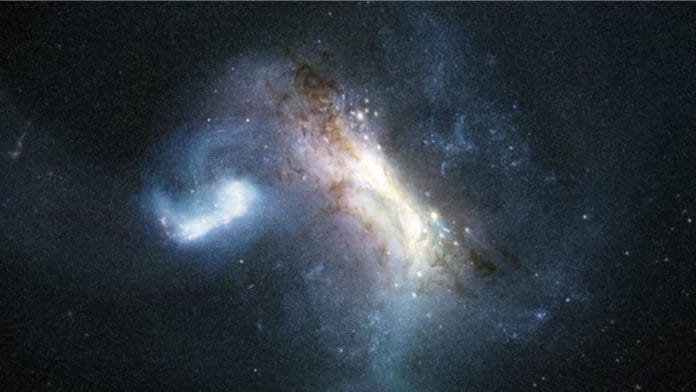


Astronomers using NASA’s Hubble Space Telescope have found definitive evidence of a massive galactic collision that occurred nearly 12 billion years ago. This discovery pushes back the known history of the Milky Way’s growth by 1.8 billion years.
The report, published on 17 August in Nature Astronomy, reveals that a dwarf galaxy named Low-energy-Kraken-Heracles (LKH) merged with the still-young Milky Way about 11.8 billion years ago, just two billion years after the Big Bang. The event contributed a significant amount of stars, gas, and dark matter to the Milky Way, at a time when the galaxy was smaller and more chaotic than it is today.
“Our home is the Milky Way galaxy, but we do not know how our house was built,” said lead author Davide Massari of the Astrophysics and Space Science Observatory of Bologna in Italy. “In this paper we discover where the first significant batch of bricks came from: a dwarf galaxy that we call LKH.”
Hubble traces an ancient merger
Scientists have long known that the Milky Way grew in part by absorbing smaller galaxies. The most recent major merger, which is still ongoing, involves the Sagittarius dwarf galaxy and began more than six billion years ago. Earlier, about 10 billion years ago, the Milky Way absorbed the Gaia-Sausage-Enceladus dwarf galaxy, an event that shaped the structure of the galactic disk.
Observations and computer simulations had suggested an even earlier major merger, but its details remained uncertain. Hubble has now provided some of the clearest evidence yet of the event.
The evidence came from studying globular clusters — dense, spherical collections of tens of thousands to millions of ancient stars that act as cosmic time capsules. These clusters can preserve material from galaxies that the Milky Way has consumed.
Globular clusters offer clues
Researchers examined Hubble observations of 39 globular clusters within 20,000 light-years of the galactic centre. By precisely measuring the clusters’ ages and metallicities — the abundance of elements heavier than helium — and combining the data with measurements from the European Space Agency’s Gaia mission, the team identified three distinct populations of clusters.
One group formed inside the early Milky Way. Another arrived with the Gaia-Sausage-Enceladus merger. The third population was older than the Gaia-related clusters but younger than those formed in the Milky Way itself, regardless of their metallicity. The researchers concluded that these clusters originated in LKH.
The dwarf galaxy contained roughly 500 million solar masses of stars, a substantial fraction of the young Milky Way’s mass at the time. The researchers named it LKH in recognition of earlier studies that had proposed the existence of such an early merger.
“Thanks to the high resolution and depth of Hubble imaging, we could measure the age and the metal content of these clusters with unprecedented precision,” said co-author Chiara Zerbinati of the University of Bologna. “Coupled with measurements from Gaia, this made it possible to distinguish a population of globular clusters that are different from the others.”
What the finding means for the Milky Way
The finding challenges some previous ideas about the Milky Way’s earliest evolution.
“Some past studies have argued that the earliest phases of our galaxy’s evolution were defined by stars born only in our galaxy,” Massari said. “Here, we have shown that stars born in external galaxies also need to be considered.”
The team plans to continue studying previously unobserved globular clusters with Hubble to identify additional ancient mergers and further reconstruct the Milky Way’s turbulent history.
(Edited by Maryam Hassan)