





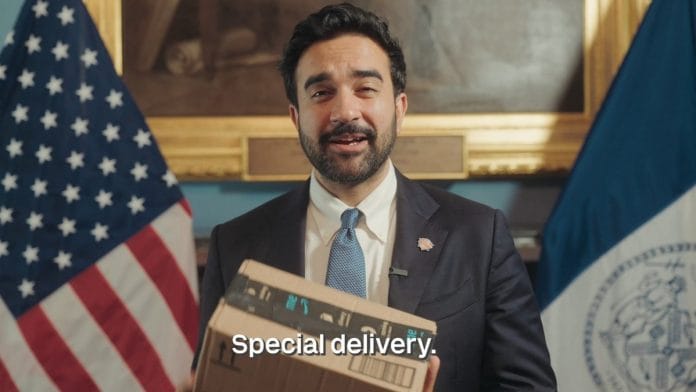


New Delhi: New York City Mayor Zohran Mamdani has backed a proposed law that could force Amazon and other large delivery companies to directly employ the drivers who deliver their packages. The move has escalated a fight over a subcontracting model that Amazon says supports thousands of local jobs.
Mamdani announced his support for the Delivery Protection Act on 10 August and reiterated it on X.
“I’m proud to support the Delivery Protection Act to crack down on exploitative subcontracting and build an economy that works for everyone,” he posted on Tuesday.
If it looks like an Amazon delivery and drives like an Amazon delivery, then it's an Amazon delivery, right? Not according to Amazon.
Big companies like Amazon have built a vast network of subcontractors who deliver their packages while shielding them from accountability.
It… pic.twitter.com/6hQVV8GoNH
— Mayor Zohran Kwame Mamdani (@NYCMayor) August 10, 2026
The bill, introduced by New York City Council member Tiffany L. Cabán, would require certain last-mile warehouses and distribution facilities to be licensed by the city’s Department of Consumer and Worker Protection (DCWP). It would also set minimum safety, training and labour standards for delivery operations.
The proposed legislation would also require operators of covered facilities to employ workers who provide core services, such as delivery. That could upend Amazon’s Delivery Service Partner (DSP) model, under which independent businesses hire drivers to deliver Amazon packages.
Mamdani argues that companies such as Amazon use subcontracting to distance themselves from responsibility for working conditions and public safety while retaining considerable control over delivery operations.
“Corporations like Amazon build billion-dollar business models by insulating themselves from accountability through a system of exploitative subcontracting,” Mamdani said in a statement released by his office.
Amazon has opposed the proposed legislation, saying it would disrupt the local businesses that deliver packages across New York City.
Also Read: Republicans are calling out Mamdani’s city-owned grocery stores. Elon Musk has joined in
Why the last-mile model is under scrutiny
The proposal comes as New York’s last-mile delivery network has expanded rapidly. Since 2017, at least 18 large last-mile facilities have opened across the city, including 11 since 2020, according to the statement released by the Mayor’s Office.
A November 2025 study by the New York City Comptroller’s Office examined traffic around 18 last-mile facilities. It found that injury-causing crashes increased near 14 of them after they opened. Across all 18 sites, injuries within a half-mile radius rose by an average of 16 per cent, while truck-related crashes jumped 146 per cent and truck-related injury crashes 137 per cent.
In Maspeth, Queens, crashes near two major facilities operated by FedEx and Amazon increased by 53 per cent and 48 per cent respectively, according to the analysis.
While the report established a correlation rather than showing that the facilities themselves caused the crashes, Mamdani’s office has cited the findings to argue that delivery quotas, schedules and routes can have consequences beyond the workplace.
“New Yorkers should not be forced to subsidize corporate profits with less safe streets and more precarious jobs,” Mamdani said, adding that workers deserve “dignity, stability and a safe workplace”.
Also Read: Communist or mini-Mamdani? Who is the Democratic Party’s rising star, Abdul El-Sayed
Amazon pushes back
Amazon told city officials during testimony that the bill would prevent it from contracting with more than 40 local Delivery Service Partners, which it describes as small businesses employing thousands of New Yorkers. The company has warned that more than 5,000 jobs could be at risk if the bill is passed.
Amazon spokesperson Kelly Nantel also told Business Insider that the company had invited New York City Council members to visit its delivery stations and meet delivery contractors before voting on the bill.
The bill’s opponents have also raised concerns about wider economic consequences. A study by consultancy AKRF estimated that the proposal could increase annual delivery costs for New York households by about $664, while the New York Delivers coalition has claimed that as many as 10,000 jobs could be at risk.
Mamdani’s announcement has also generated mixed reactions on social media, with supporters welcoming his challenge to Amazon’s subcontracting model and critics raising concerns about jobs, small businesses and potential costs for consumers.
“Getting anything in the world delivered to your doorstep in two days or less sure seems like an economy ‘working for everyone.’ Not sure how you’re going to improve on that,” author and political scientist Richard Hanania posted on X.
The Delivery Protection Act still has to go through the New York City Council. Its eventual effect on jobs, delivery prices and Amazon’s operations will depend on whether it passes and how its provisions are implemented.
(Edited by Asavari Singh)