



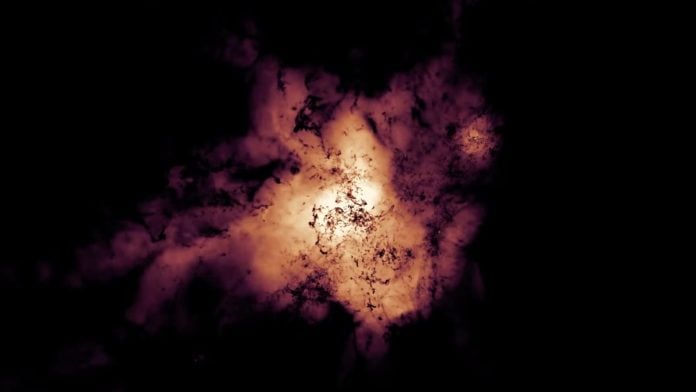
New Delhi: Scientists have developed a large-scale computer simulation that offers an unprecedented look at how the early universe evolved from its cosmic dark ages, tracing the formation of stars, galaxies and large-scale structures over the first two billion years after the Big Bang.
Named Lumina, the simulation was developed by researchers from the Massachusetts Institute of Technology (MIT), the Center for Astrophysics | Harvard & Smithsonian, the University of Texas at Dallas, and the University of Chicago. The research was published in the journal Monthly Notices of the Royal Astronomical Society on 26 October. It tracks the evolution of dark matter, gas, stars and radiation across a vast region of space, while also providing enough detail to examine individual developing galaxies.
The simulation covers a region spanning 500 megaparsecs, equivalent to approximately 1.6 billion light-years across. Its scale allows researchers to examine how structures emerged and interacted during a crucial period in the universe’s history.
Recreating the cosmic dark ages
The universe entered what astronomers call the cosmic dark ages approximately 380,000 years after the Big Bang. As the universe expanded and cooled, electrons combined with atomic nuclei to form neutral hydrogen. This hydrogen absorbed radiation, preventing light from travelling freely through space.
The period lasted until the first stars and galaxies began producing enough radiation to transform their surroundings.
Lumina begins its reconstruction approximately 45 million years after the Big Bang. It follows the emergence of gas-rich structures, the formation of the first stars and galaxies, and the spread of radiation through the surrounding universe.
“We see this is where the first galaxies form,” said Oliver Zier, the study’s lead author and a former MIT postdoctoral researcher now at Harvard University.
How stars and black holes illuminated the universe
One of the simulation’s key contributions is its ability to capture two major transitions in cosmic history: hydrogen reionisation and helium reionisation.
Hydrogen reionisation occurred when ultraviolet radiation from early stars and galaxies became powerful enough to strip electrons from neutral hydrogen atoms. This allowed light to travel more freely through the universe, gradually ending the cosmic dark ages.
Helium reionisation followed a similar process but required more energetic radiation. According to the researchers, this transition was driven primarily by active supermassive black holes, which release enormous amounts of energy as they accumulate surrounding matter.
The researchers say Lumina is the first simulation to capture both hydrogen and helium reionisation within the same large-scale model. MIT physicist Mark Vogelsberger says: “Lumina does everything from small-scale star and galaxy formation to large-scale re-ionization of hydrogen and helium, in a volume that is 100 times larger than previous best simulations.”
Helping scientists understand early galaxies
The researchers hope Lumina will provide a framework for comparing theoretical models with observations from modern and future telescopes. By simulating how galaxies, stars and black holes interacted in the early universe, scientists may be able to better understand the processes responsible for shaping the cosmic structures observed today.
The team has also made the simulation available to the wider scientific community on Lumina Simulation’s official website, allowing other researchers and laypeople to investigate its predictions and compare them with astronomical observations.
(Edited by Prashant Dixit)