







New Delhi: It was a cold November morning in 2023 when neurologist Sushil Razdan arrived in Gurez valley in north Kashmir for yet another medical camp. Before the camp could begin, the officer in charge asked a question: Did Razdan, a Kashmiri Pandit, also treat those who had driven him and his community to exile?
“Especially them,” Razdan replied, without pause. “Healing cannot be selective. They are my people, too. This is my land, my culture, my home.”
The officer’s question emphasised the word ‘exile’. Razdan’s reply focused on ‘healing’ that day. Three years later, a new memoir on him, Healer in Exile, is sandwiched between the two themes. The two words and worlds have come together inextricably.
A doctor by profession, the identity of being a Kashmiri Pandit never left Razdan – nor could it be absent from a book on his life. The book’s title captures that irony: a man who spent his life caring for others, even as he lived in exile himself.
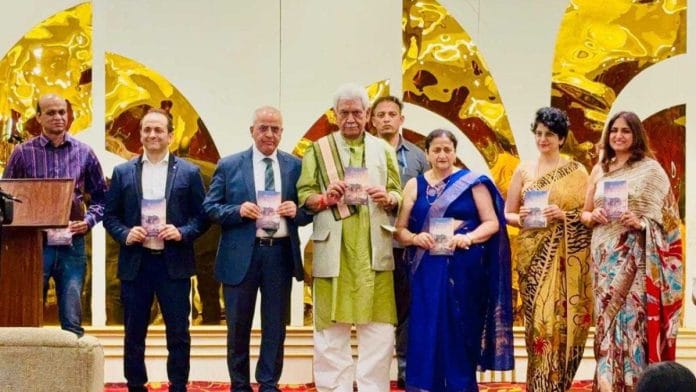
The book, written by his son, Sachin Razdan, was launched in Jammu on 29 April and in Srinagar on 2 May.
Former Chief Minister Farooq Abdullah, BJP leader Ashok Koul, former Union minister and Congress leader Saifuddin Soz, and Peoples Democratic Party (PDP) leader Naeem Akhtar – leaders across the political spectrum were present. So was Hurriyat leader and valley’s chief cleric, Mirwaiz Umar Farooq. And this is what Razdan had made possible: separatists and mainstream political actors sharing the same space.
“And it’s not like the guests didn’t know who all were coming. Everyone knew who all were coming. And they still came for my father,” said author Sachin Razdan.
The book Healer in Exile offers intimate slices of Razdan’s life interwoven with the region’s history. In Kashmir, politics and life are inseparable, shaping not just one’s belief but also, the very texture of everyday existence. From the tumultuous history of the region to a time when Kashmiri Pandits largely aligned with the Congress, from the hanging of Maqbool Bhat in 1984 to the exodus and the life thereafter – the book briefly touches on the major events in Kashmir and how they shaped Razdan’s life.
Razdan has built a loyal following in Kashmir. His style of treatment – being a listener before being a doctor – has earned him deep trust among his patients. His interviews on social media are flooded with comments by those he has treated.
One such comment by Inyatullah read, “Dr Razdan is the rebirth of Shri Bhatt of Medieval Kashmir. During Badsha’s reign in Kashmir, Hakim Shri Bhatt cured Sultan Zinu ul Aabidden of skin disease and bridged the cordial relationship between the two communities. Dr Razdan has played the same role during turmoil.”
But the title of the book has triggered unease among a section. It came to light, after a journalist posted on X, “It will not be an exaggeration to say Kashmiri Muslims extolled Dr Sushil Razdan as much as Lal Ded, for all good reasons. Yet, the title of his book “Healer in Exile” failed to act as a healer that Dr Razdan has been. Instead, it feeds only the current cycle of hatred through the title.”
This is the first time Dr Razdan, through the book, speaks at length about the exodus – leaving Kashmir, the years in Jammu, the hardships and his return to treat patients – parts of his life sidelined from his everyday professional persona yet rooted in his personality and love for the land.
In the book, his son Sachin Razdan writes, “Returning is not the same as coming home. We go now as guests, permitted but not rooted. The land remains sacred. It’s no longer ours.”
Sachin has written the memoir as someone who is in awe of a man and the life he lived, caring for people in a region marked by conflict with his unwavering commitment.
First clinic in exile
It was 1989, and Kashmir was already witnessing the undercurrents of insurgency that would soon force Kashmiri Pandits to flee. It was the winter of November and the author was in Jammu with his grandparents when news of killings arrived. Judge Neelkanth Ganjoo and journalist Prem Nath Bhat had been assassinated.
Sachin pleaded with Dr Razdan to come to Jammu for a few days. But his response was as reassuring as ever: “We’ll be fine, don’t worry. Doctors can’t disappear when sickness rises.”
But not for too long. One day, Dr Razdan called Sachin and said, “We may have to leave. Maybe just for some time.” That’s how the story of exile began.
In their two-room modest house in Jammu’s Bagwati Nagar – which they had already built for refuge in winters – Dr Razdan did what he knew best. He turned the room into a make-shift clinic. But as the word spread of a Kashmiri doctor treating not just diseases but people in Jammu. The patient load increased and that led the family to build a new, small, rudimentary room – Dr Razdan’s first clinic in exile.
Among the patients who came to see Dr Razdan were Kashmiri Pandits grappling with new ailments – constant headaches and strokes brought on by Jammu’s searing heat.
“On 21 January 1990, several Kashmiri Pandits died of heatstroke…Papa barely slept during those weeks. He was always out for visits, often in the middle of the day when the sun was at its worst,” the author writes. “He saw patients collapsing not just from physical stress but from the cumulative weight of everything they had endured: months of fear, sudden migration, economic collapse, cramped living, and relentless heat.”
Soon, cases of anxiety, insomnia, seizures and memory lapses began to trickle in. The freshly migrated Pandits started forgetting names, dates and in some cases, even themselves. In the early 90s, there was a dearth of psychiatrists. Kashmiri Pandits who could not afford consultation fees turned to him, and Dr Razdan treated them regardless.
Also read: Meghalaya doesn’t want samosa tourists. It needs slow, phased development: CM Conrad K Sangma
Refuge for the distressed
Dr Razdan’s medical journey took him to Medanta in Gurugram and then, Paras Hospital in Srinagar, before he returned to his now-famous clinic in Jammu.
“His work in Srinagar is not just professional; it’s personal. Each visit is a negotiation between past and present, duty and distance,” the author writes.
The conflict in Kashmir has scarred all sides. After the 1990s, mental health issues became pervasive across communities. In such times, Dr Razdan — whose professional ethics did not discriminate – became the one-stop refuge for the distressed.
A 53-year-old Kashmiri Sikh woman from Baramulla, who took her father to Dr Razdan for epilepsy treatment, recalls how a single consultation made him noticeably calmer.
“Even before the diagnosis, he would listen patiently, reassure the patient, and then gently explain the condition. Once my father felt understood, half the work was already done.”
Dr Ali Jan, a Kashmiri physician who was widely respected among both Kashmiri Pandits and Muslims, used to be a household name. He had earned the moniker “Luqman of Kashmir.” He died in 1988, when Sushil Razdan was practicing in Srinagar. Over time, Razdan came to be compared with Ali Jan in Kashmir. He was Magaz ka Ali Jan (brain’s Ali Jan). Someone who was not just a doctor but also, a bridge between two communities.
In time, Dr Razdan came to occupy a similar space. When it came to anything related to the brain, his name was the first to come up. In a conflict-ridden Kashmir, where psychological distress is ubiquitous, Dr Razdan became the first point of reassurance.
For Razdan, one cannot remove exile from the life of a Kashmiri Pandit.
“My father’s love for Kashmir is evident in the fact that whenever we plan a trip to Kashmir, he is always excited,” the author said. “We never sold our house; we rented but never returned.”
(Edited by Ratan Priya)