





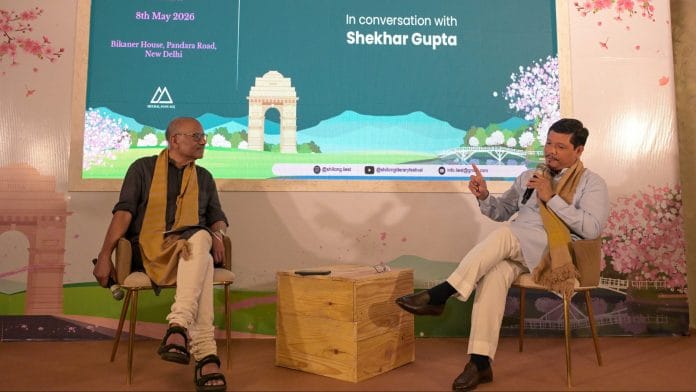

New Delhi: The Delhi Prelude to the Shillong Literature Festival moved seamlessly between rock music, tourism policy, school reform, and jobs on Friday evening.
The packed evening at Pandara Road’s Bikaner House featured Meghalaya Chief Minister Conrad K Sangma in conversation with ThePrint’s founder and Editor-in-Chief, Shekhar Gupta, on the state’s evolving identity. This was followed by a dramatic reading from Vikram Seth’s Beastly Tales from Here and There by veteran actor Naseeruddin Shah.
For a festival rooted in Shillong, the Delhi evening was not only about bringing Meghalaya’s writers, music and landscape to the capital. It also became a way of talking about what the state wants to build, and how slowly it wants to build it.
Sangma, 48, is a musician himself and has his own band. Music is one of Meghalaya’s strengths, he said, adding that the state needed calendar events, not one-off concerts or programmes that came and went without consistency.
“Music is an integral part of culture, of life, not just of Meghalaya, but all of the Northeast,” Sangma said. “Music connects us.”
He spoke of music as something that cuts across tribes, communities, and religions in the Northeast. He also recalled moving back from Delhi to Shillong as a child, and said he “had to pick up the guitar if he wanted to be part of the group in school”. Music, he said, influenced him early enough for him to understand “the power of it in policy”.
Sangma said the state supports close to 7,000 artists and wants to create space not just for foreign-influenced music, which is dominant now, but also for traditional Khasi, Garo, and Jaintia music, fusion music, and original compositions.
Also read: Why indie filmmakers are going back to pre-1950s frame of 4.3 in India
‘Community-led tourism is key’
The idea of building without rushing came back when the conversation turned to tourism. Sangma was asked how Meghalaya could avoid becoming the next Himachal Pradesh or Uttarakhand, where hill tourism has brought crowding, waste, and pressure on local ecosystems. He said Meghalaya could not invite tourists and then shut the gate when they came in large numbers.
The answer, he said, had to be community-led tourism. In Meghalaya, land is owned by communities, which makes development slower, but also gives the state a way to protect local interests.
“We can’t be too fast. We have to take it slow, phase-wise,” he said.
He also spoke of discouraging what he called ‘samosa tourism’, where tourists drive in for a day, bring most things from home, spend little locally, buy perhaps one snack and leave behind waste. Meghalaya, he suggested, did not want fewer tourists as much as better tourism.
On jobs, Sangma said the answer was entrepreneurship, from self-help groups and women making pickles at home to musicians, sportspersons, and small tourism businesses.
The sharpest exchange came when journalist and author Sanjoy Hazarika asked about Meghalaya’s school outcomes and dropouts. Sangma called education a top priority, but described it as a legacy problem: too many schools, too few students in several of them, and teacher politics that made reform difficult.
“Politics is the reason I can’t fix it. I’ll be slaughtered,” he said, explaining that the state could not simply shut or merge schools overnight.
Then something unexpected happened. Sangma said there was a chart in his office that explained the problem, and asked if it could be put on the screen behind him. Within moments, the Lit Fest backdrop disappeared. In its place was a table comparing Northeast states by population, number of schools, teachers, and students.
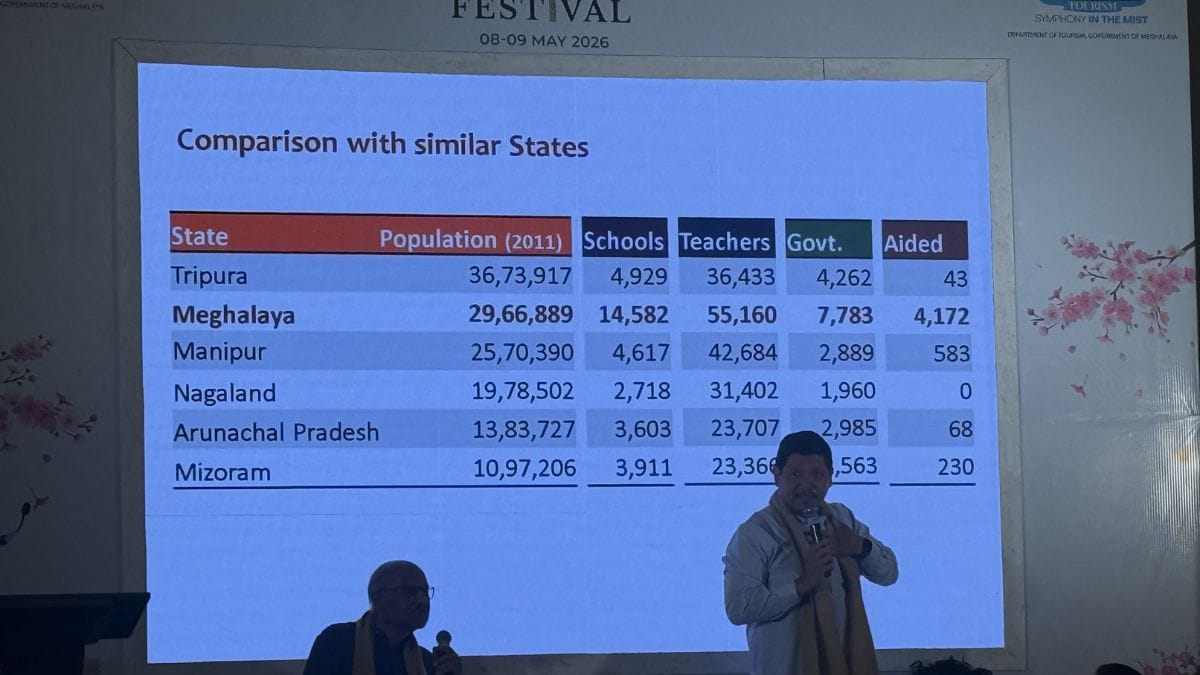
It was a strange sight at a literature festival: a chief minister turning a cultural stage into a policy briefing. Meghalaya was being presented to Delhi through music, festivals, and landscape, but Sangma kept pulling the discussion back to land, data, and the difficulty beneath the image.
Later in the evening, Naseeruddin Shah stood at the lectern and read Seth’s ‘The Elephant and the Tragopan’, the tenth story from Beastly Tales from Here and There. The fable, about a threatened landscape, power, greed and ecological damage, came after a conversation in which Meghalaya had been discussed as a state trying to balance tourism, development and environmental fragility.
Speaking to ThePrint, columnist and author Shobhaa De, called Shah’s reading a ‘masterclass’.
“What could be better than listening to Naseeruddin Shah, the master, reading Vikram Seth, the master.”
Tarini Unnikrishnan is an alum of ThePrint School of Journalism and is currently interning with ThePrint.
(Edited by Prasanna Bachchhav)