



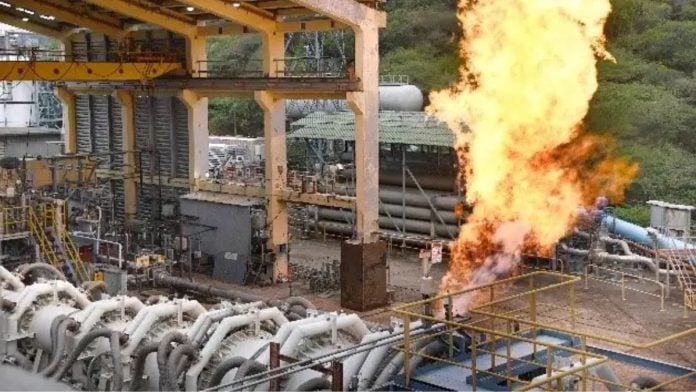
New Delhi: The Indian Space Research Organisation has successfully completed a series of tests of its LOX-Methane Engine, or LME-1100. The space agency said that it is now working toward an integrated LME-1100 engine targeted for the middle of 2027, followed by hot-fire qualification tests.
In a statement, ISRO said it conducted a series of tests in October on individual engine components, culminating in the first ignition test of its full-scale gas generator.
“The integrated LME1100 engine is targeted to be ready by the middle of next year and will be subjected to a series of hot tests to qualify the same for the prescribed operating conditions including different thrust throttling profiles,” ISRO said.
ISRO began developing the engine’s key technologies in 2023. On 9 October, it successfully conducted the first ignition test of the engine’s full-scale gas generator, a significant step toward integrating the complete engine, which is slated for 2027.
What is LME-1100?
ISRO’s LME-1100 is a next-generation rocket engine designed to help power India’s future heavy-lift launch vehicles. Its significance lies not just in its thrust, but in its use of liquid oxygen and liquid methane as propellant — a combination that could support more cost-effective rocket operations and make future reusable launch systems easier to develop.
The engine is set to power ISRO’s Next Generation Launch Vehicle (NGLV) — India’s reusable rocket. Methane propulsion is also relevant to future heavy-lift vehicles intended to support India’s planned crewed lunar landing around 2040.
Also read: Bappi Lahiri Marg. Mumbai names road after Bappi da
How does it work?
Unlike an aircraft engine, which draws oxygen from the atmosphere, a rocket engine needs to carry both its fuel and oxidiser onboard so that it can operate in space. When methane and oxygen burn together, they release energy in the form of extremely hot gases. The engine harnesses this energy to generate thrust, pushing the rocket upward.
The process starts with turbopumps, which force liquid methane and oxygen into the engine at high pressure. These pumps are driven by a turbine that is powered by the engine’s gas generator. The generator burns a small portion of the methane and oxygen to produce hot gasses that spin the turbine. The turbine then drives the pumps, ensuring a continuous supply of propellants to the main combustion chamber. This arrangement is called the gas generator cycle.
ISRO chose methane because it offers a balance between performance, storage requirements, and potential reusability. Compared to liquid hydrogen, methane is denser and requires less space in a tank. As opposed to kerosene, it is also cleaner when it burns, which reduces carbon deposits inside engine components. However, scientists explained that methane still needs to be stored at cryogenic temperatures and the engine requires extensive testing to demonstrate reliable operation before it can be used on a launch vehicle.
“The existing cryogenic engine test facility at IPRC (ISRO Propulsion Complex) was augmented for the purpose of testing the LM20 demonstrator engine and one cold flow test and five hot tests were carried out successfully,” the ISRO statement read.
It added, “With the data obtained from these tests, vital inputs were derived on chill down characteristics, thrust chamber and gas generator ignition, engine starting, combustion and rotor-dynamic systems performance for a LOX- Methane engine”.
(Edited by Aamaan Alam Khan)