



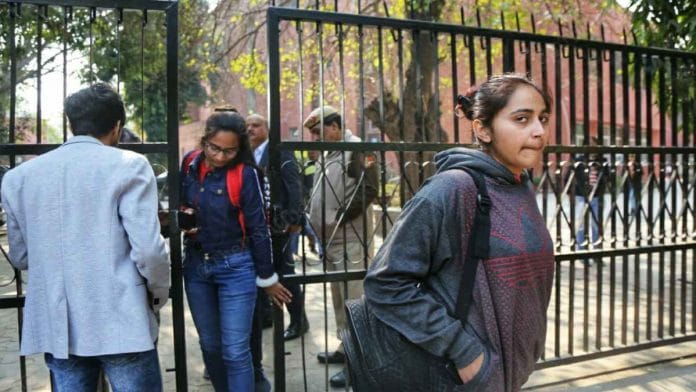
New Delhi: Academic and research freedom in Indian educational institutes and universities is at its lowest since 1900, even below the Emergency years between 1975 and 1977, an international ranking has highlighted.
India ranked among the bottom 10-20 per cent of countries globally in academic freedom, according to the V-Dem (Varieties of Democracies) Academic Freedom Index project—a collaboration between researchers at Germany’s Friedrich-Alexander-Universität Erlangen-Nürnberg (FAU), Sweden’s V-Dem Institute, the Scholars at Risk Network, and the Global Public Policy Institute (GPPi). The project assessed academic freedom across the world between 1900 and 2025.
The countries that outperformed India included Pakistan, Iraq, Sudan, Syria and Yemen. The Czech Republic topped the index, followed by Estonia, Belgium, Jamaica and Slovenia.
The index evaluated countries on five parameters—freedom to research and teach, institutional autonomy, academic exchange and dissemination, campus integrity, and academic and cultural expression.
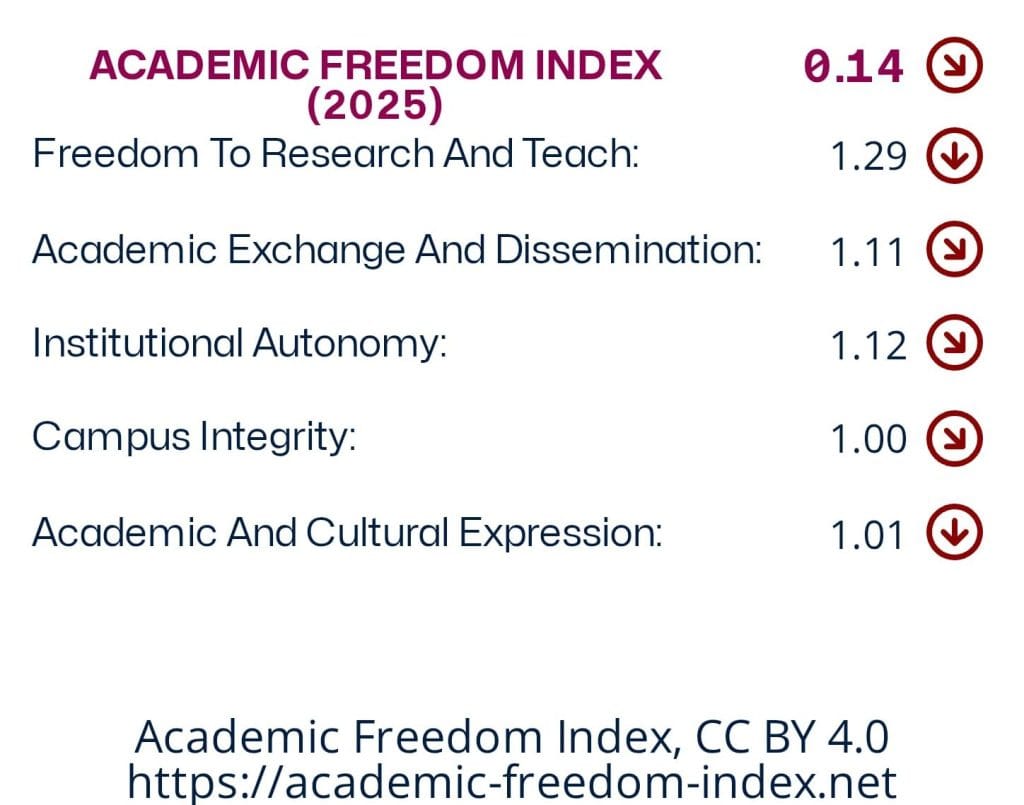
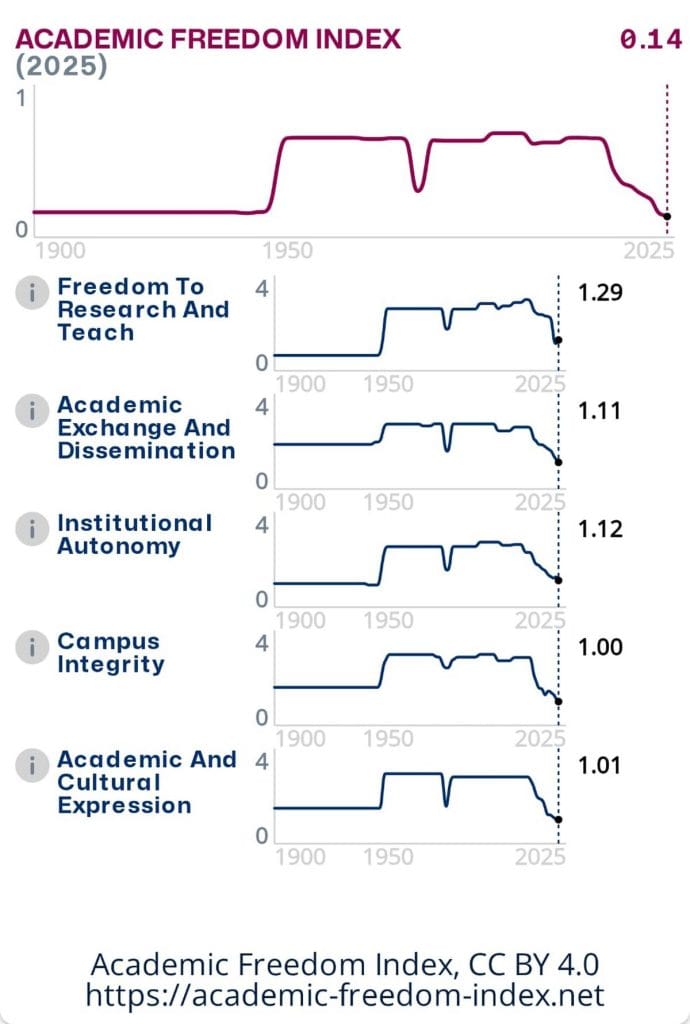
The data show that Indian institutes have seen a progressive decline in all of the parameters since 2013-14. Except for freedom to research and teach, which was at its lowest between 1900 and 1950, India recorded its lowest-ever scores in every other area in 2025.
Academics have expressed concern over India’s slipping ranking.
“As a scientist and mentor, I find this concerning because questioning, independent research, and the freedom to disagree are essential to science and national progress,” said Roxy Mathew Koll, a senior climate scientist at Pune’s Indian Institute of Tropical Meteorology (IITM).
Also Read: The pressure cooker life of a 16-year-old Indian student
How academic freedom was measured
The evaluation used publicly available data from 1900 to 2025 and includes more than a million coder-level data points, five indicators and an index on academic freedom based on a Bayesian IRT (item response theory) measurement model.
The model is customised and inputs sought from over 2,357 country experts around the world. While the Academic Freedom Index project said each country’s assessment is based on researchers from that country, it is important to note that the core regional teams do not include any Indian scientists or academics.
“The index defines a range of components ‘often considered essential to the de facto realisation of academic freedom based on a review of the literature and in-depth discussions with policymakers, academics and advocates in the higher education field,’” the 2026 report read.
The document explained that each year, a new calculation takes all available data into account and optimises comparability across years and countries.
India’s position
The ranking places India in the bottom 10-20 per cent of 179 countries and territories worldwide on academic freedom.
A detailed analysis showed that India scored 0.14 overall in 2025, on a scale of 0 to 1. This was 0.269 points lower than in 2015. In freedom to research and teach, India scored 1.29 (on a scale of 0 to 4), down 1.144 points from 2015. The score was 1.11 for academic exchange and dissemination, 1.12 for institutional autonomy, 1 for campus integrity and 1.01 for academic and cultural expression. All these scores were lower than in 2015.
The latest report said that between 2015 and 2025, academic freedom declined in about 50 countries. Only nine countries saw an improvement. The nations that performed worse include China, North Korea, Afghanistan, and Myanmar, among others.
Binay Panda, professor at the School of Biotechnology at Delhi’s Jawaharlal Nehru University (JNU), said that while China had less academic freedom, it has climbed much higher than India in scientific productivity.
“Despite having less academic freedom, China has climbed much higher in scientific productivity than India. The real question for us is, are we ready for lower academic freedom in exchange for massive infusion of public funding into science?” he said in a post on X.
This is pure fiction. The survey methodology is 100% biased.
Hello Pillai, Soumya,
This claim and headline come across as hyperbolic and flawed. Pure pulp fiction.
During the Emergency, the government suspended Article 19, locked up thousands of professors and student leaders—including the liberals’ darlings at JNU, DU, and BHU—under MISA without trial, banned student unions, and enforced direct pre-publication censorship. Under that regime, this piece wouldn’t pass a censor’s desk, and your founders would be sitting in a cell. Capische?
Did you really not do your research before conflating these two eras?
How can anyone look at today’s institutional environment—where active, vociferous debates, anti-government protests, critical academic books, lawsuits against government policies, and dissenting faculty op-eds happen daily across public and private universities—and pretend it’s worse than an era of total constitutional suspension and pre-publication censorship? It stretches historical reality beyond recognition.
Stretching data continuity back to 1900 to claim democratic India has less academic freedom than a British colonial police state creates an absurd historical baseline. After looking through the methodological pitfalls, the anachronistic comparison between 2025 and 1900, and the bizarre cross-country anomalies that rank active warzones like Syria, Iraq, and Yemen above India, it’s clear this headline relies on a sensationalist reading of a deeply flawed quantitative index.
While one can legitimately critique state pressure on VC appointments, funding priorities, or research grants, equating routine political friction with an authoritarian police state is lazy reporting. Claiming conditions today are worse than a colonial police state in 1900 or an authoritarian dictatorship in 1975 is historically false, methodologically unviable, and utterly ridiculous.
I agree with SKANDA. My take on the issue on hand ;
The narrative of teh author are flawed on multiple fronts discussed below.
Beyond the Index: The Methodological Flaws and Empirical Realities of India’s Academic Landscape
The recent V-Dem Academic Freedom Index report, which places India’s academic freedom at a historic low—purportedly worse than during the 1975 Emergency and ranking it below nations like Pakistan, Syria, Yemen, and Sudan—presents a narrative that is increasingly difficult to reconcile with ground realities. While critical assessments of institutions are a vital part of a healthy democracy, a closer examination of the report’s methodology and a look at objective data regarding India’s higher education sector reveal a highly skewed, perception-based ranking that fails to capture the complexity of the world’s second-largest higher education system.
Here is a breakdown of why the V-Dem index’s conclusions regarding India warrant heavy skepticism.
1. Methodological Opacity and the “Expert” Echo Chamber
The most glaring vulnerability of the V-Dem index lies in its methodology. The index relies on a Bayesian item response theory model based on inputs from “coder-level data points” and “country experts.”
Absence of Core Representation: The report explicitly notes that the core regional teams do not include any Indian scientists or academics. When the core architects of a regional assessment do not possess lived, systemic experience of that region, the resulting index often reflects external geopolitical biases and media narratives rather than institutional realities.
Subjectivity over Hard Data: The index evaluates “freedom” based on subjective questionnaires filled out by a select group of unnamed experts. When qualitative, perception-based scoring is prioritized over quantitative realities, the results can easily become an echo chamber that amplifies isolated incidents while ignoring systemic growth.
2. The Absurdity of Comparative Rankings
The claim that academic freedom in India is lower than in nations actively experiencing civil war, systemic state collapse, or extreme religious censorship (such as Syria, Yemen, Sudan, and Pakistan) deeply undermines the credibility of the index.
In several of the countries ranked above India, universities have been physically destroyed by conflict, female students are legally barred from certain fields, or curricula are strictly dictated by theological mandates.
In contrast, Indian universities remain bustling hubs of political debate, frequent student protests, and vibrant ideological diversity. Equating a functioning, heavily subsidized democratic education system with war-torn or strictly authoritarian regimes suggests a catastrophic failure in the index’s comparative weighting.
3. The Empirical Reality: A System in Expansion
While the V-Dem index claims a progressive decline since 2014, measurable, objective data from the last decade points to an unprecedented expansion in Indian academia and research:
Scientific Output: India currently ranks among the top three nations globally in the volume of peer-reviewed scientific publications and PhDs awarded.
Institutional Growth: The last decade has seen a massive proliferation of autonomous institutions, including new IITs (Indian Institutes of Technology), IIMs (Indian Institutes of Management), IISERs, and central universities.
Global Innovation Index (GII): India has consistently climbed the ranks of the WIPO Global Innovation Index, a metric heavily reliant on university-industry collaboration, research capabilities, and human capital. This systemic rise is mathematically incompatible with a nation experiencing an “academic dark age.”
4. Institutional Autonomy and the NEP 2020
The report claims a decline in institutional autonomy, yet this ignores the sweeping structural reforms introduced by the National Education Policy (NEP) 2020.
The NEP explicitly mandates the phasing out of the rigid affiliation system, granting unprecedented academic, administrative, and financial autonomy to colleges. It promotes interdisciplinary research, allows foreign universities to set up campuses in India, and led to the creation of the Anusandhan National Research Foundation (NRF) to seed and democratize research funding beyond elite institutions. These are the hallmarks of a system opening up, not shutting down.
5. The False Binary of Freedom vs. Funding
The article quotes a researcher comparing India to China, suggesting a tradeoff between academic freedom and scientific funding. This is a false binary. India’s trajectory is not about sacrificing democratic freedoms for centralized scientific output. Instead, India’s decentralized academic ecosystem—comprising Central universities, state-funded institutions, and a booming private university sector—ensures that no single political entity can monopolize or stifle academic discourse nationwide.
Conclusion
To suggest that Indian academic and research freedom is at its lowest since 1900 is to ignore the historical realities of colonial suppression, the actual suspension of civil liberties during the 1975 Emergency, and the empirical data of the modern era. While Indian academia undoubtedly faces challenges—including bureaucratic hurdles, funding distribution issues, and localized campus disputes—the V-Dem index’s apocalyptic portrayal is less a reflection of India’s campuses and more a reflection of a flawed, subjective methodology that equates complex democratic noise with authoritarian silencing.
Has V-Dem Academic Freedom used correct data set? How can India be ranked lower than Pakistan? The legitimacy of V-Dem Academic Freedom idex is questionable.