



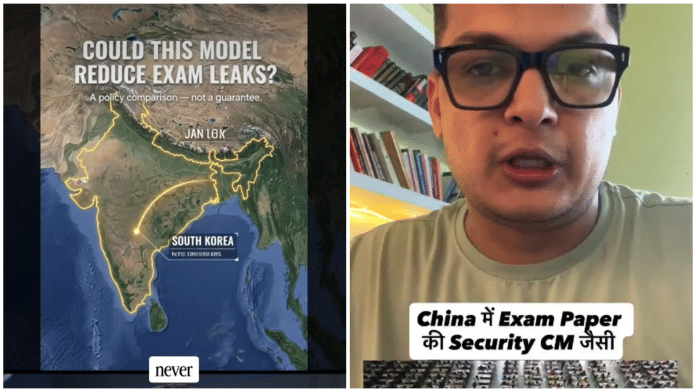

New Delhi: As the student protests at Delhi’s Jantar Mantar raged, social media platforms were flooded with videos, photos, and reels comparing India’s examination system with major competitive exams in China and South Korea.
Many featured captions such as “Learn from China” and “Take notes from South Korea”, pointing to the two countries’ exam-security systems as models India could follow to prevent paper leaks.
Several of the most widely shared videos focused on China’s Gaokao, the country’s national college entrance examination. The exam is taken annually by approximately 12.9 million to 13.4 million students and is considered one of the largest and most competitive academic examinations in the world.
“China’s exam paper security is like the CM’s. The paper never leaks here,” read the caption of one widely shared post on X.
Another AI-generated video titled “How to stop NEET paper leaks?” featured user Shivanshu Agrawal explaining how South Korea’s Suneung, also known as the College Scholastic Ability Test (CSAT), handles examination security.
The Suneung is South Korea’s high-stakes national college entrance examination, held every November. The exam plays a major role in determining students’ university admissions and career opportunities.
In the video, Agrawal explains how hundreds of teachers involved in preparing the examination paper are selected and isolated for several weeks before the exam to prevent leaks. Using AI-generated visuals, he says that these teachers, along with security personnel and support staff, remain in a controlled facility without access to mobile phones or outside communication.
“Around 500 teachers are selected to prepare the exam. To prevent paper leaks, they are kept inside a building for the next 30 to 40 days. Security staff and cooks also stay there, and even phones are not allowed,” Agrawal says in Hindi.
He further explains how question papers are printed and sealed at a secure location about a week before the examination. The Instagram video received more than 2.3 million views.
“Itna discipline follow karne ke liye India agle 1000 saal laga dega” (It will take India another 1,000 years to follow this level of discipline), read one Instagram comment under the video.
Also Read: Appointed to new fast-track court for NEET paper leak cases, who is judge Anu Grover Baliga
‘Why China is way ahead of us’
Another video explains why paper leaks do not happen in China and the model the country follows to prevent them.
“More than 1 crore people appear for China’s Gaokao exam, but the exam has never been leaked,” says the voiceover of the video posted by @DhruvRatheNx, accompanied by AI-generated images of students appearing for the exam and question papers being transported in highly secure vehicles.
The video explains how, after the exam papers are prepared in highly secure and isolated locations, they are transported using GPS trackers and a multi-layered security system. It also refers to China’s 2016 anti-cheating law, which includes strict punishments and prison sentences for those involved in exam-related fraud.
Clips of the video have been widely shared by multiple accounts with captions such as “1.3 crore students. Zero paper leaks”, “China paper never leaks” and “Why China is way ahead of us”.
Despair and hope
Several comments expressed frustration that, despite conducting large-scale competitive examinations, India has struggled to ensure the same level of transparency, security and accountability.
“Do you think this system will work here? Where corruption exists at every level. If not the paper setter, it will be an NTA member; if not an NTA member, it will be a security personnel member. It will continue… We are rotten to the core,” wrote @Raj1150 on X.
Some, however, were more hopeful.
“If India follows the system of South Korea, Indian politicians will not get benefits. When the youth become future politicians, I think that everything will change. Maybe a better future will happen one day,” said an Instagram comment on a video about Suneung.